
In 1774, as tensions boiled between the American colonies and the British Crown, Parliament passed a law that many Americans viewed as a final insult. It was not as flashy as the Boston Port Act, nor as dramatic as the Administration of Justice Act. It was quiet, buried in legal language, and wrapped in claims of necessity. But to many colonists, it was personal. It was called the Quartering Act, and to them, it meant that British soldiers could now take over barns, warehouses, and unoccupied homes. The Crown had not only come for their taxes and trade, but now it came for their space.
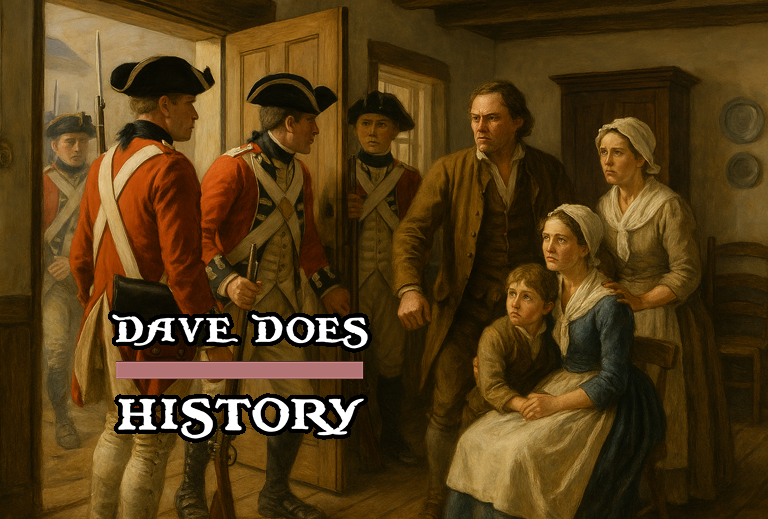
At its heart, the 1774 Quartering Act was a blunt tool to solve a logistical problem. British generals needed places to house soldiers. The American colonies were vast and under-defended, and ever since the French and Indian War, troops had been moving deeper into colonial towns and cities. The colonies had no real standing army of their own. Parliament believed that stationing soldiers throughout the colonies would provide stability and ensure obedience. But when local assemblies refused to provide the kind of housing the army demanded, London acted.
The earlier Quartering Act of 1765 had already caused no small amount of frustration. Colonial governments were told to house British troops in barracks if available, or if those were full, in taverns, inns, or even private businesses that sold liquor. But the 1774 version went a step further. It empowered royal governors to seize uninhabited buildings—barns, outbuildings, warehouses, any place not currently being lived in—and house troops there, with or without the consent of the property owner. The law never said that soldiers could be forced into occupied homes, but to the colonists, the line between uninhabited and private was not so clear.
Americans believed their homes were their castles. The idea of an armed force, answerable not to local laws but to distant authority, living in buildings that once belonged to neighbors or friends, felt more like a military occupation than law and order. Even if the soldiers were polite and well-behaved, their presence served as a constant reminder that the King’s government no longer trusted the colonists to govern themselves. For many, this was not just about housing. It was about the right to be left alone. It was about the ability to close the door at night and not wonder who might claim the property tomorrow.
What makes the 1774 Quartering Act especially interesting is that it was not a stand-alone law. It came packaged as one of the infamous Coercive Acts, which the colonists soon labeled the Intolerable Acts. Alongside laws like the Boston Port Act, which shut down the harbor until colonists paid for the destroyed tea, and the Administration of Justice Act, which allowed royal officials accused of crimes to be tried in England, the Quartering Act was one more pressure point. One more nail in the coffin of colonial patience. It told Americans that their land, their economy, their courts, and now even their property rights were subject to royal whim.
Yet it is important not to paint every colonial experience with the same broad brush. Not every American town reacted to quartered troops with torches and pitchforks. In New Brunswick, New Jersey, the British 26th Regiment had been quartered peacefully for nearly three years. The local citizens even threw a farewell dinner for Major Charles Preston when his men were reassigned. They published an open letter thanking the soldiers for their good behavior and civil conduct. Major Preston replied with heartfelt gratitude. This small town, just miles from the hotbeds of resistance in New York and Boston, showed that harmony was possible.
Why was New Brunswick so different? For one, the British troops stationed there respected the limits of their presence. They paid rent. They supported local businesses. They did not act like occupiers. Many were married. Some had children born in the barracks. There were almost no incidents of violence or misconduct. The soldiers blended into the rhythm of the town rather than disrupting it. That kind of coexistence was rare. Most other towns, especially larger ones, had not been so fortunate. In Boston, the same year New Brunswick held its dinner, British troops opened fire on a crowd of civilians. That was the Boston Massacre.
Still, the goodwill in New Brunswick could not withstand the rising storm. When war came, even that peaceful town turned. The 26th Regiment was replaced by the 29th, the very regiment involved in the Boston Massacre. The townspeople did not throw them a party. They joined the colonial boycott of British goods. Some took up arms. In time, British troops returned not as neighbors, but as invaders. They built redoubts, occupied homes, and fought with the local militia. Whatever harmony once existed was lost in the roar of musket fire and the glow of burning buildings.
The Quartering Act of 1774 expired in March 1776, just months before independence was declared. But by that time, its damage was done. It had contributed to the growing sense that the British government had no respect for American liberty. It confirmed for many colonists that the British army was not a shield, but a sword. In the list of grievances included in the Declaration of Independence, the colonists cited the quartering of troops among them as a violation of their rights. It was grievance number thirteen.
When the new American republic was formed, its leaders did not forget. They enshrined in the Constitution the idea that soldiers could not be quartered in homes during peacetime without the consent of the owner. That promise became the Third Amendment. It is rarely litigated today, but at the time, it meant everything. It was a firm rejection of what had come before, a boundary line no government could cross.
The Quartering Act also helped shape another principle. Americans came to believe that a standing army in peacetime was a dangerous thing. The Second Amendment, the right to bear arms, was partly born from this distrust. Colonists wanted to be able to defend themselves not just from foreign enemies, but from their own government if necessary. They had seen how quickly a soldier sent to keep order could become a symbol of tyranny.
The Quartering Act of 1774 never put redcoats into bedrooms, but it planted a seed of fear that they might be just one law away from doing so. The fear was not unfounded. During the French and Indian War, British officers had often ignored laws against billeting in private homes. They had forced their way in when they felt it necessary. Colonial memories were long, and trust was thin. It did not matter that the 1774 Act limited quartering to uninhabited buildings. What mattered was that the colonists did not get to decide. The decision came from London, and London did not care what they thought.
That is the real legacy of the Quartering Act. It was not just about where soldiers slept. It was about who got to decide. It was about power, consent, and self-government. It told the colonists that Parliament could reach into their towns, take their property, and post a musket at the door—and there was nothing they could do about it. That lesson burned deeper than any single policy. It helped teach a generation of Americans that freedom was not just about grand speeches or taxes on tea. It was about the right to say no.
In the end, the Quartering Act became more than a law. It became a symbol. It stood for the idea that the government should serve the people, not command them. It stood for the belief that property rights matter, that the home is a sacred space, and that military power must be accountable to civil authority. Those are not ideas bound to the eighteenth century. They are just as relevant today.
What would it mean today if the government could requisition barns, vacant rentals, or commercial spaces at will? What if the state declared that, for the sake of national security or emergency response, it could take over a home or a business, and place armed men there? Most Americans would object. Most would reach for their Constitution and their lawyer. But in 1774, the colonists had neither recourse. They had only their voices, their pens, and eventually their rifles.
When Americans talk about liberty, they often think in big terms—freedom of speech, freedom of religion, the right to vote. But liberty also lives in the small things. It lives in the space behind your fence, in the right to lock your door, in the ability to say, this is mine, and you may not take it without my leave. The Quartering Act of 1774 crossed that line. It taught the colonists that when a government forgets its limits, the people will remind it.
That lesson is part of who we are. It is why the Third Amendment exists. It is why the founders chose to fight. And it is why the Quartering Act, though forgotten by many, still casts a long shadow across the idea of American freedom.



 DAVE DOES HISTORY
Leave a comment