
On the morning of June 1, 1794, the Atlantic Ocean was quiet. No land in sight, no coastal landmarks to bear witness. Just water, sails, and the pounding tension of two battle lines inching toward history. That day, far off the coast of France and even farther from political civility, the British and French navies collided in what the British would come to call the Glorious First of June. The French had another name for it, of course. They called it the Battle of the 13th Prairial, Year II. Leave it to a revolution to throw out the calendar.
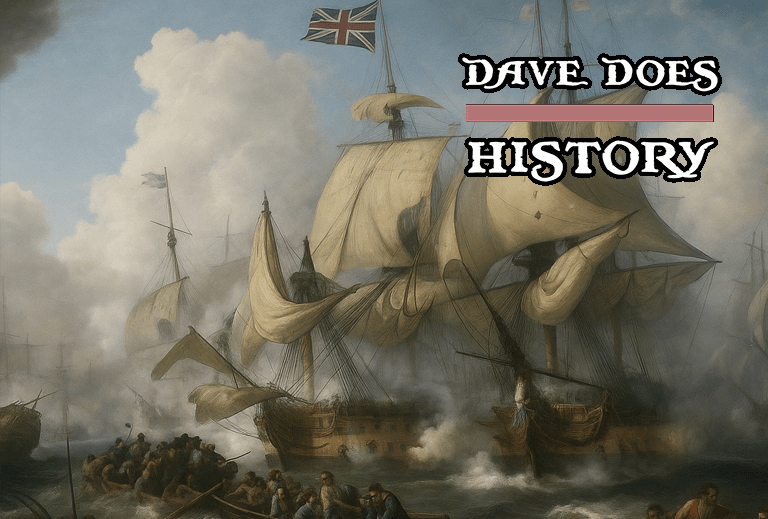
The sea battle was the first major fleet action of the French Revolutionary Wars. It was also one of the bloodiest. British Admiral Richard Howe, a steady hand with a steel jaw and a sense of tactical daring, had been ordered to do something very simple in theory but quite difficult in practice, stop a French grain convoy coming from the United States. That convoy was not just any flotilla. It was a lifeline for a starving, revolutionary France. Paris was teetering on the edge of another political explosion, and food, or the lack of it, was the spark that could blow the whole thing up. Howe’s job was to cut the fuse.
France in 1794 was a nation still shaking from the guillotine. The Reign of Terror had turned political paranoia into state policy, and the French Navy was one of the many institutions gutted by suspicion. Experienced officers had been imprisoned, exiled, or executed. Replacements were chosen more for revolutionary zeal than for seamanship. Ships went unpaid. Crews went unfed. At one point, the Brest fleet had literally mutinied and brought their ships into harbor in search of food. Despite the chaos, Rear-Admiral Louis Thomas Villaret de Joyeuse took command of the French Atlantic Squadron. He was brave, competent, and, perhaps most important, lucky.
Meanwhile, across the Channel, the British Navy had its own problems. There were not enough sailors. Press gangs swept the streets for able-bodied men, many of whom had never seen the open ocean, let alone stood in a line of battle. Marines were in short supply too. Infantry soldiers from the Army were packed aboard warships to fill the gaps. But what Britain lacked in manpower, it made up for in organization. Unlike during the American War, the Navy’s dockyards were ready. Ships were repaired quickly. Guns were cast and mounted with efficiency. Howe had a fleet ready to fight.
At the heart of the matter was food. The French had turned to the United States for grain. A massive convoy, escorted by Rear-Admiral Pierre Van Stabel, set sail in April. The Americans were willing to help. After all, France had helped them during the Revolution. Van Stabel’s convoy gathered at Chesapeake Bay and began the transatlantic journey. French agents had secured flour, produce, and even some willing fighters. For France, the arrival of that food could mean the difference between a continued republic or a return to chaos. The British Admiralty knew it, Howe knew it, everyone knew it.
In May, Howe set out from Portsmouth to find and destroy the convoy. He split his forces into three groups. One under Rear-Admiral Montagu went to the south Atlantic. Another patrolled for British convoys. Howe took the bulk of the fleet himself, twenty-five ships of the line and support vessels, out into the open sea. Villaret de Joyeuse, for his part, sailed from Brest to cover the convoy’s approach. The two fleets finally caught sight of each other on May 28. For days, they danced through fog and haze. Skirmishes broke out. Ships exchanged fire. But the real fight did not come until June 1.
That morning, under clear skies, Howe closed in. He had the weather gauge, an upwind position that allowed him to choose the moment of attack. It was a major tactical advantage. His plan was bold. Instead of the traditional line-on-line broadside engagement, Howe ordered each of his ships to individually break through the French line, rake their enemies with cannon fire from stern to bow, and reform on the far side. If executed properly, it would cut the French fleet to pieces. But many of his captains misunderstood or flat out ignored the signal. Only seven of twenty-five British ships managed to break the line.
Still, the battle that followed was savage. Ships collided. Sails burned. Gunports shattered. Howe’s flagship, HMS Queen Charlotte, sailed straight for the French Montagne and let loose a barrage. HMS Brunswick, under Captain John Harvey, slammed into the Vengeur du Peuple. The ships became entangled. The crews were so close that the Brunswick had to fire through closed gunports. Harvey, gravely wounded, refused to cut the French ship loose. “We have got her and we will keep her,” he reportedly said. The Vengeur would later sink, becoming a symbol of revolutionary martyrdom in French lore.
Other British ships fought valiantly. HMS Marlborough, under George Cranfield Berkeley, became locked in brutal combat with the Impétueux. Both were dismasted. Captain Berkeley was wounded and had to turn over command to a lieutenant. The confusion of battle was total. Some British ships failed to engage at all. Others, like HMS Latona and HMS Aquilon, sailed into the thick of the fight to tow crippled vessels out of danger. French ships retreated in disorder. Villaret had done his job, though. He had distracted Howe long enough for the grain convoy to escape.
By noon, the guns fell silent. The French had lost seven ships, six captured, one sunk. The British had lost none. Over four thousand French sailors were dead or wounded. Three thousand more were captured. The British suffered around twelve hundred casualties. On paper, it was a crushing British victory. But strategically, the French had succeeded. The grain convoy reached Brest on June 12. France would eat. The revolution would go on.
In the days after the battle, both sides claimed success. The British press hailed the Glorious First of June as a triumph. Medals were struck. Songs were sung. But behind the celebration, there were tensions. Several British captains were hauled before inquiries for failing to follow orders. Captain Molloy of HMS Caesar, in particular, was court-martialed and removed from command. Howe, ever the stoic, was disappointed that his plan had not been fully executed. The opportunity to annihilate the French fleet had slipped through his fingers.
The French, on the other hand, seized on the narrative of sacrifice. The loss of the Vengeur du Peuple became legendary. French propagandists claimed her crew refused to surrender, choosing instead to go down with revolutionary colors flying. The truth was more complicated, but the story served the revolution well. In the long run, the French Navy survived. It would never fully recover its dominance, but it would fight on for years to come.
There is a painting, by Philippe de Loutherbourg, that tries to capture the moment. It shows chaos, cannon smoke, and drowning sailors being rescued by British hands. Lord Howe reportedly disliked the painting. He felt it showed the Queen Charlotte in the wrong position and gave the impression that the Montagne had slipped away. His Master of the Fleet, James Bowen, took even greater offense. But the painting captured something deeper. The sea does not care for pride. It only remembers the struggle.
Decades later, in 1847, the British government issued a campaign medal, the Naval General Service Medal. Veterans of the Glorious First of June were among those eligible. More than fifty years after the smoke cleared, fifty-four surviving sailors claimed the medal’s bar. One of them, Richard Libertine, had served on HMS Orion. He would go on to fight at Trafalgar and four other engagements. He lived out his days as a pensioner at Greenwich Hospital, a living link to the day Britain’s navy showed the world what it could do, even when half its captains missed the memo.
The Glorious First of June was not Trafalgar. It did not end a war or break an empire. But it showed that the Royal Navy, for all its problems, was a force to be reckoned with. It also showed that the French, for all their chaos, could fight like lions when the Republic needed them to. And it proved a timeless truth of warfare, sometimes victory on the sea is measured not in ships captured, but in bread delivered.



 DAVE DOES HISTORY
Leave a comment