
The morning of May 28, 585 BCE, must have felt like any other on the plains near the Halys River. For six long years, the Lydians and the Medes had been at war, clashing over territory and pride. There had been victories on both sides, defeats as well, and even a curious battle fought in the dark of night. But on this day, the two armies met once again, swords drawn and shields raised, unaware that history was about to change in a way no one could have expected.
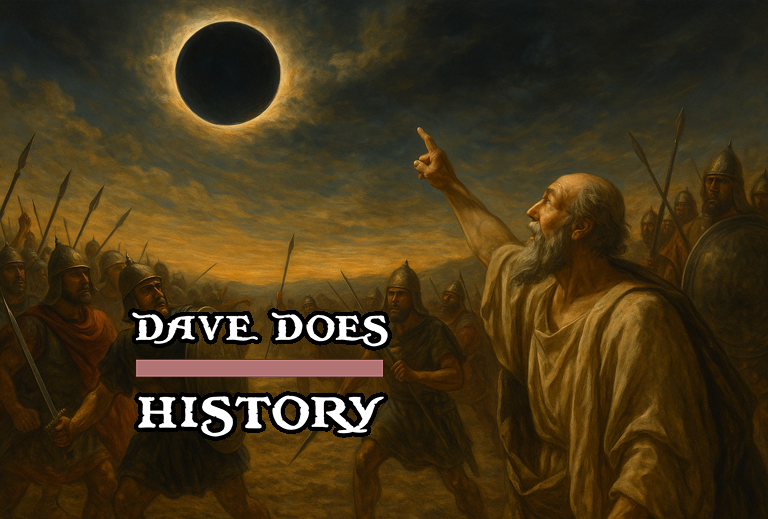
As the fighting escalated, the skies began to dim. Soldiers on both sides paused. Confusion turned to awe. The sun, the ever-reliable guide of the day, was vanishing. Darkness fell. Day became night. The men, hardened by years of conflict, dropped their weapons. They looked to the heavens. The war was over.
This was the so-called Battle of the Eclipse. What turned it from a typical ancient war into something extraordinary was not the outcome, but the claim that the eclipse was predicted in advance. And the man credited with the forecast? Thales of Miletus, a philosopher from a small Ionian city-state on the Aegean coast.
According to the historian Herodotus, who wrote about the event more than a century later, Thales foretold this loss of daylight, even assigning it to the correct year. That is the story, at least. Whether or not he actually did so is a matter that historians and scientists have debated ever since. But the story endured, passed down through generations as a moment when reason, or perhaps coincidence, seemed to outshine the gods.
To understand why this moment matters, one must look at the man behind the legend. Thales was no ordinary thinker. He was one of the Seven Sages of Greece, a figure who worked in geometry, politics, and astronomy. He believed that water was the essential substance of all matter and that the Earth floated on it like a raft. He was reportedly able to measure the height of pyramids by their shadows and calculate the distance of ships at sea. Whether he truly accomplished all this, or whether these accounts were embellished over time, remains unclear. But it is certain that Thales was admired and respected in his time.
When it comes to the eclipse, however, modern scholars are cautious. Predicting a solar eclipse, even today, requires deep understanding and precise calculations. In the sixth century BCE, the cause of eclipses was not known. The idea that the moon could block the sun had not yet been discovered. The Earth was still widely believed to be flat, resting on water. Thales could not have known the mechanics behind what he may have predicted.
At best, he might have recognized a pattern. And that pattern, if it existed, likely came from the Babylonians. Babylonian astronomers had kept records of celestial phenomena for centuries. They had identified what is now known as the Saros cycle, a period of about eighteen years and eleven days after which similar eclipses occur. However, the Saros cycle only predicts that an eclipse will happen, not where it will be visible. This means that even with access to Babylonian knowledge, Thales would not have been able to determine the location or time of the eclipse with any certainty.
Moreover, the eclipse of May 28, 585 BCE, passed over western Anatolia in the late afternoon. It would have occurred near sunset in the general area where the battle is believed to have taken place. That makes its impact more plausible, but it also raises questions. Battles in the ancient world rarely began late in the day. Some historians suggest that the timing of the eclipse may not have matched the battle at all, and that the connection between the two events may have been exaggerated or misreported by Herodotus.
Others have offered alternative explanations. Some believe the event described may have been a lunar eclipse, or even an unrelated atmospheric event misunderstood over time. Still others argue that Thales might have made a vague prediction based on regional eclipse sightings and was simply fortunate that a dramatic event occurred close enough to his timeframe to be remembered as a prophecy.
Whatever the case, the result was dramatic. The armies of Lydia and Media, seeing the midday sky turn to twilight, interpreted it as a sign from the heavens. They stopped fighting. A truce was declared. A marriage alliance was arranged between Aryenis, daughter of King Alyattes of Lydia, and Astyages, son of King Cyaxares of Media. The Halys River became the agreed border between the two kingdoms. The war ended not through conquest, but through celestial awe.
For many, this event symbolizes the dawn of scientific thinking. The idea that nature follows observable patterns, that celestial events could be anticipated, marked a shift from reliance on divine caprice to rational inquiry. Even if Thales was guessing, the attempt to predict an eclipse reflects a new kind of thinking. It suggests that the universe was not ruled entirely by gods, but that it might have rules that men could understand.
This story also raises enduring questions about how history remembers the past. Is it more important that Thales was accurate, or that he tried to find order in the sky? Should his legacy rest on whether the prediction was real, or on the fact that he represented a turning point in human thought? For readers who value tradition, Thales represents the wisdom of the ancients and the foundations of Western civilization. For those who champion rationalism, he marks the first flicker of scientific thought.
There is also a lesson here in humility. Today, astronomers can predict eclipses decades in advance, calculating their timing and visibility to the second. Yet we still argue over what happened on a battlefield more than two and a half millennia ago. We still question whether a single man could have foreseen it. The truth may be lost to time, but the story lives on, because it speaks to something greater than just science. It speaks to wonder.
The Battle of the Eclipse may not have been won by generals. It may have been won by the sky itself. Or perhaps by an aging philosopher who dared to believe the universe had a rhythm that could be known. Whether his prediction was genius, good luck, or myth, the story endures. And in that endurance lies the real power of history.


 DAVE DOES HISTORY
Leave a comment