
In this week’s Dave Does History segment on Bill Mick Live, Dave Bowman kicked off the 8 a.m. hour with a slithery metaphor—and no, it wasn’t about politicians.
History doesn’t always begin with fireworks. Sometimes, it starts with molasses—and cobras.
In this week’s Dave Does History, we went far from the thirteen colonies to colonial India, where a bounty on dead cobras went about as well as you’d expect. The British government, in an effort to reduce the number of venomous snakes, offered payment for every cobra killed. Predictably, locals began breeding cobras to kill them for cash. When the government shut the program down, breeders simply released the snakes. India ended up with more cobras than before.
This absurd episode became a case study in what economists now call the “Cobra Effect”—a well-intentioned policy that backfires spectacularly. But as strange as it sounds, this colonial fumble mirrors what Britain was doing across the globe in the 1700s—with molasses.
Back in 1733, British sugar planters in the Caribbean—Jamaica and Barbados—faced stiff competition from the French, who produced a cheaper, higher-quality molasses in their colonies like Saint-Domingue. American colonists, especially in New England, loved molasses. They needed it to make rum, and rum was as essential to their economy as coffee is to ours.
So Britain did what empires do: they imposed a tax. The Molasses Act levied six pence per gallon on French molasses imports. But instead of boosting British sales, the result was smuggling, bribery, and fraud. Colonists ignored the tax. British officials barely enforced it. Over thirty years, Britain spent more trying to collect the tax than they ever brought in.
It was a joke. And colonists learned a dangerous lesson: laws don’t really matter if no one enforces them.
Then came 1763.
The French and Indian War had left Britain with a massive empire—and a massive debt, to the tune of £122 million. A new king, George III, took the throne. He was a deeply religious man, faithful to his wife, and nicknamed “Farmer George” for his obsession with agriculture. But George also believed in divine right. He saw his monarchy as a moral obligation to uphold law and order—God’s law and order.
And he was done letting the colonies run themselves.
That year, he issued the Proclamation of 1763, forbidding settlement west of the Appalachian Mountains. The goal was to prevent conflict with Native tribes like those under Pontiac, who had launched a rebellion that year. But the colonists—many of whom had already speculated in western lands—saw the proclamation as betrayal.
They had fought and died to win that land. And now the Crown was saying, “No. You can’t have it.” Troops were stationed in towns. Customs officials cracked down. Smuggling suddenly had consequences. And the molasses tax? It was back in force.
The colonists began to feel that their rights as Englishmen—property, liberty, representation—were no longer secure. Those rights were now conditional. Negotiable. Distant.
And for the first time, Americans began to wonder whether the empire that had once protected them now needed to be protected from them.
The discontent wasn’t yet revolution. But the fuse was lit.
Soon, men like James Otis would stand up and say, “Taxation without representation is tyranny.” Parliament, blind to colonial sentiment, would impose the Sugar Act, the Stamp Act, and more.
And George III, the sober, principled monarch who had never traveled more than 50 miles from London, would become the villain of a new nation’s founding story.
Next Week on Liberty 250: We take up the Stamp Act, the Sugar Act, and the question every colonist was asking—who has the right to tax us?



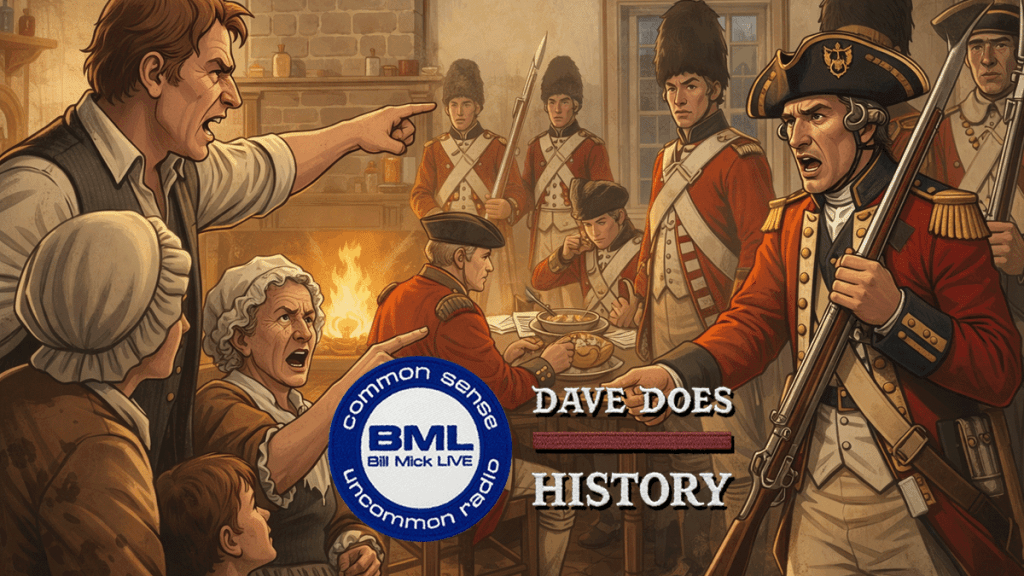
 DAVE DOES HISTORY
Leave a comment