
On May 26, 946, during a church feast in the quiet village of Pucklechurch, England lost a king in a way that felt more like legend than record. King Edmund I, just twenty-five years old, was stabbed to death during mass by an exiled criminal he had once banished. His killer was cut down almost instantly, but the damage had been done. England was without its king, and history had just lost one of its most underrated rulers.
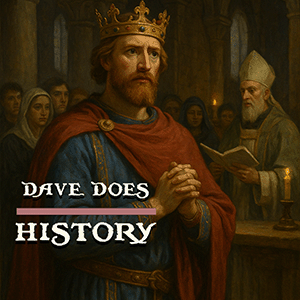
Edmund was born in 921, the son of Edward the Elder and his queen, Eadgifu. His older half-brother, Athelstan, had been the first monarch to truly unify the English kingdom. That meant Edmund inherited a throne that was still very much held together with string and steel. But long before he wore the crown, he proved his mettle on the battlefield.
In 937, Edmund fought alongside Athelstan at the Battle of Brunanburh. It was one of the most important battles in English history, where a coalition of Vikings, Scots, and Britons tried to crush the young English kingdom. They failed, thanks in part to the courage of a teenage Edmund who learned early that being a prince meant bleeding for your country.
Athelstan died in 939. Edmund was just eighteen. Almost immediately, Olaf Guthfrithson, the Norse king of Dublin and York, pounced on the perceived weakness. He seized York and pushed deep into Mercia. Edmund responded quickly, chasing Olaf to Leicester. But instead of open battle, two archbishops stepped in and negotiated peace. The result? Olaf kept control of the north, but acknowledged Edmund as his overlord. They even agreed that the longer-lived of the two would inherit the other’s lands.
Fate sided with the English. Olaf died within a year. Edmund struck back, reclaiming the Midlands and the Five Boroughs—key towns in the Danelaw that had fallen under Viking influence. It marked the beginning of Edmund’s resurgence.
But Norse ambition didn’t die with Olaf. Two new Viking kings, Olaf Sihtricson and Raegnald, tried to reclaim York. Edmund rode north again and in 944 drove them out. The north was English once more. He was not just recovering lost land. He was consolidating the fragile idea of one kingdom under one crown.
When the Kingdom of Strathclyde backed the wrong side, Edmund didn’t hesitate. He marched in, conquered it, and then made a brilliant move—he handed it over to Malcolm I of Scotland. That turned a northern threat into a northern ally. Peace with Scotland bought England breathing room, and Edmund knew the value of a secured border.
His reach extended beyond the British Isles. On the continent, his half-sister Eadgifu pleaded with him to intervene after her son, Louis IV of France, had been captured by Hugh the Great, a powerful French noble. Edmund issued threats. Hugh relented. Louis was restored. No armies were needed. Just a firm voice from across the Channel.
At home, Edmund picked up where Athelstan had left off. He strengthened royal law, curbed blood feuds, and supported religious reform. He promoted learning and monastic revival, especially among noblewomen. He elevated Dunstan, the future saint, to lead Glastonbury Abbey. And his efforts helped pave the way for the English Benedictine reform that would flourish in the next generation.
He married twice. His first wife, Aelfgith of Shaftesbury, bore him two sons—Eadwig and Edgar—and was later canonized. After her death, he married Ethelflaed of Damerham, whose powerful family helped shore up political support in southern England.
By 946, Edmund had stabilized a kingdom that could have fractured in the wake of Athelstan’s death. He had defeated Viking invasions, secured the borders with Scotland and Wales, influenced events in France, and championed both law and faith at home.
Then came the Feast of St. Augustine.
During mass at Pucklechurch, Edmund saw a man named Leofa, whom he had previously exiled for criminal activity. Outraged that Leofa dared show his face, Edmund tried to remove him personally. In the struggle, Leofa drew a blade and stabbed the king. Leofa was killed on the spot by the king’s men. But the fatal blow had been struck.
Edmund died at just twenty-five years old.
He was buried at Glastonbury Abbey, under the care of St. Dunstan. His sons were too young to inherit. The crown passed to his brother Eadred. But both Eadwig and Edgar would grow to wear the crown. Edgar, in particular, would become one of the most successful kings of the Anglo-Saxon era, carrying forward the vision Edmund helped lay down.
It’s easy to overlook Edmund. His reign lasted only seven years, sandwiched between two legendary names. But in those seven years, he kept England from splintering. He proved that strength wasn’t just on the battlefield, but in alliance, diplomacy, and reform. He ruled with sword and statute. He died young, but he died a king.
Today, May 26, we remember Edmund the Magnificent—not just for how he died, but for how he ruled.



 DAVE DOES HISTORY
Leave a comment