
My wife is a Labor and Delivery nurse. She works twelve-hour shifts that often run long, on her feet for nearly all of it, juggling life-and-death decisions while somehow managing to smile at the mother clinging to her hand and the father turning pale in the corner. There are moments of joy, yes—new life, grateful parents—but there are also the heartbreaks, the complications, and the quiet courage it takes to walk back into another room and do it all again. If you have ever witnessed a nurse at work, then you already know what Florence Nightingale knew nearly two centuries ago: this is not a job. It is a calling.
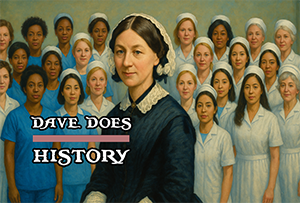
Each year on May 12, the world observes International Nurses Day, commemorating the birth of Florence Nightingale in 1820. It is more than just a date on the calendar. It is a reminder. A reminder that without nurses, health care collapses. It is not an exaggeration. They are the backbone, the first line, the last voice, and often the only hand to hold. The International Council of Nurses formalized the observance in 1974, but the profession had already been shaped, molded, and lit from within by the figure whose birthday we mark.
Florence Nightingale was born into privilege. Her family was wealthy, educated, and thoroughly Victorian. A young woman of her class was expected to marry well, manage a household, and attend the proper social functions. Florence had other ideas. From a young age, she believed that God had called her to a life of service. She read philosophy and statistics. She studied medicine on the sly. She refused a marriage proposal from a man she respected deeply, fearing that such a union would pull her away from her purpose. Her mother wept. Her sister fumed. Florence remained unmoved.
She trained as a nurse at Kaiserswerth in Germany, unheard of at the time for someone of her status. When the Crimean War broke out in 1853, and the press exposed the horrid conditions faced by wounded British soldiers, Nightingale saw her moment. With the support of Secretary of War Sidney Herbert, she led a group of 38 nurses to the Barrack Hospital in Scutari, across the Bosporus from Constantinople. What they found was filth, rot, and death. Soldiers died not from wounds but from typhus, cholera, and dysentery. The hospital was a charnel house. Nightingale called it the “Kingdom of Hell.”
She did not blink.
She scrubbed floors. She organized laundry. She ordered supplies with money donated by the readers of The Times. She demanded clean water, better food, and some semblance of dignity for the men in those beds. She made rounds by lamplight after the doctors had gone home, offering comfort and presence. The soldiers began to call her “The Lady with the Lamp.” A correspondent for The Times immortalized the image. So did Henry Wadsworth Longfellow, who wrote of her gliding through the gloom, a living angel.
Florence Nightingale became a legend. But the work was only beginning.
Upon her return to England, Nightingale was ill with what was likely brucellosis, a lingering infection that would cause her pain and fatigue for the rest of her life. Still, she pushed forward. In 1860, she founded the Nightingale Training School for Nurses at St. Thomas’ Hospital in London. It was the first scientifically based nursing school, and it marked the true beginning of professional nursing. Her students went on to establish hospitals and nursing schools around the world—from Australia to China to the United States.
She was not merely a nurse. She was a statistician, an innovator, a reformer. Her famous “coxcomb” diagrams showed military officials how bad sanitation was killing more soldiers than bullets ever could. She used data to argue for better hospital designs, cleaner barracks, and more humane treatment of the poor. She advised British and American officials, including during the Civil War. She redefined what it meant to care.
In her later years, Nightingale became a recluse of sorts, often bedridden but still writing letters and reports. She refused accolades and turned down burial in Westminster Abbey. She died in 1910 at the age of ninety, and her family laid her to rest in a simple grave in Hampshire. No fanfare. Just a name and two dates.
But her light had already spread.
Today, the observance of International Nurses Day is global. In some countries, it is part of a week-long celebration. In London, a symbolic lamp is carried in a service at Westminster Abbey. In Ireland, messages of thanks are turned into ebooks and distributed to hospitals. In Canada and the United States, nurses are recognized for their service and sacrifice. The International Council of Nurses issues annual themes to highlight ongoing challenges and advances—topics like health equity, system resilience, and the economic power of care.
It is worth pausing to remember what Florence Nightingale fought for. She did not just clean hospitals. She professionalized compassion. She made it acceptable, even noble, for women to enter the field. She believed in structure, discipline, and accountability. She taught that observation was a form of love and that data could save lives. She was not interested in empty platitudes. She wanted change, and she got it.
And yet, some things remain unchanged. Nurses still work long hours in broken systems. They still face staffing shortages, emotional burnout, and physical exhaustion. They are underpaid and overburdened. And they still show up. They still fight for their patients, for dignity, for life. They still walk the halls with tired feet and steady hands. And in every hospital, in every ward, in every delivery room and ICU, there is still a light. It is not always a lamp. Sometimes it is a clipboard. Sometimes it is a gentle voice. Sometimes it is just the act of staying.
My wife stayed last week after her shift ended. That is nursing. That is the legacy of Florence Nightingale.
That is why the lamp still burns.




 DAVE DOES HISTORY
Leave a comment