
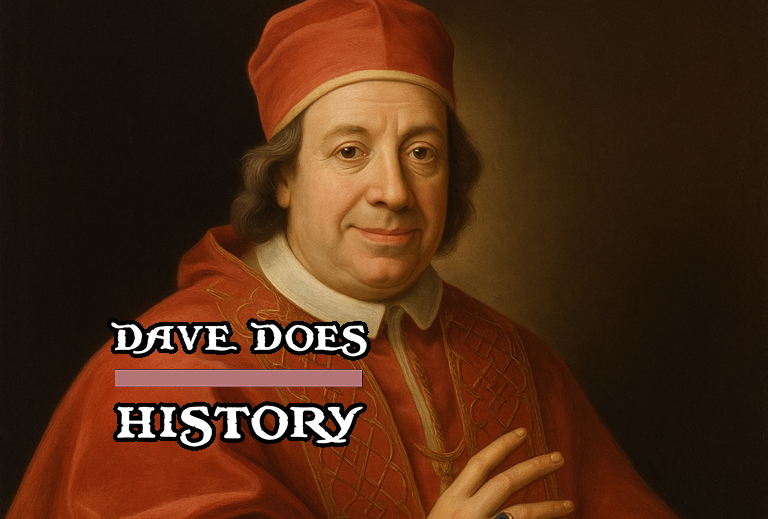
Underneath the gilded ceilings of the Apostolic Palace in the spring of 1721, the future of the Catholic Church waited behind locked doors. Cardinals from across Europe, men of ambition, devotion, and dynastic loyalty, had gathered in solemn secrecy. The death of Pope Clement XI in March had triggered what became one of the most complex and politically charged papal conclaves of the early eighteenth century. For thirty-nine days and seventy-five ballots, the Sacred College debated, plotted, and maneuvered their way through factions, vetoes, and intrigue. And at the end of it all, Michelangelo dei Conti, a nobleman-turned-cardinal with a quiet disposition and a talent for diplomacy, emerged as Pope Innocent XIII.
The Church of the early 1700s was in no small turmoil. The War of the Spanish Succession had just ended, but its political shockwaves continued to reverberate. The balance of power in Europe was as fragile as spun glass, and both Bourbon and Habsburg monarchs wanted a pope who would tip that balance in their favor. At the same time, within the Church itself, battles over doctrine and missionary policy, especially in China, had left deep divisions. This conclave was not just a matter of electing a spiritual leader. It was a high-stakes contest between emperors, kings, cardinals, and reformers.
When the conclave opened on March 31, only twenty-seven cardinals were present. More arrived gradually, but even with a full complement, unity proved elusive. Four powerful factions dominated the proceedings. The strongest was the Imperial faction, loyal to Holy Roman Emperor Charles VI and led by his minister Althan. They held between twenty and twenty-five votes. On the opposite side stood the Bourbon faction, representing the crowns of France and Spain under Louis XV and Philip V. They could count on a dozen votes. Then came the Clementines, cardinals created by the late Pope Clement XI and loyal to his nephew Annibale Albani. Finally, there was the Zelanti, a smaller but vocal group of reform-minded cardinals who rejected the secular influence of monarchs altogether.
With so many voices at the table, there was no shortage of candidates. One man stood out as the early favorite: Cardinal Francesco Pignatelli. Backed by the Austrians and popular among the Zelanti, Pignatelli looked like a frontrunner. But his candidacy fell apart when the Spanish Crown issued a formal veto. This was not a backroom whisper or a suggestion. It was a public, authoritative rejection based on the ancient privilege of exclusion, a political grenade thrown into the middle of the conclave. Pignatelli was out.
The next hopeful was Fabrizio Paolucci, former secretary of state under Clement XI and Albani’s personal choice. Paolucci gathered momentum quickly, and in the very first ballot he came within three votes of victory. But that, too, fell apart in spectacular fashion. This time it was the Imperial faction that vetoed him, with Cardinal Althan speaking on behalf of Emperor Charles VI. Two days later, Paolucci’s name had all but vanished from the discussion.
At this point, the conclave resembled a chess match with too many bishops and not enough pawns. Names were floated and discarded with dizzying speed—Spada, Gozzadini, Cornaro, Caracciolo. None could rally sufficient support. The month dragged on. Cardinals came and went with news from royal courts. France began to push quietly for one candidate they believed acceptable to all: Cardinal Michelangelo dei Conti.
Conti was not a flashy figure. Born into the noble Conti family of Poli in 1655, he was the son of Duke Carlo II and Isabella d’Monti. His pedigree was impeccable. He studied under the Jesuits in Rome and earned doctorates in canon and civil law from La Sapienza University. He entered the priesthood and took on several administrative roles, including governorships and diplomatic posts. He served as nuncio to both Switzerland and Portugal. By 1706, Pope Clement XI had made him a cardinal. He was well-liked, respected, and known for being moderate, intelligent, and personally modest. In short, he was the kind of man every faction could live with, even if none found him particularly thrilling.
Still, even Conti’s candidacy took time to gather steam. On April 25, he received just seven votes. By early May, however, support for him began to solidify. When Pignatelli arrived at the conclave on May 1, hopes of resurrecting his campaign were immediately crushed. Spain confirmed its veto. The Austrian-aligned cardinals, finally accepting the futility of their own ambitions, shifted their support toward Conti. With France already on board and the curial factions weary of the stalemate, momentum tilted decisively.
On the morning of May 8, the seventy-fifth ballot was cast. Fifty-five votes were tallied. Fifty-four bore the name of Michelangelo dei Conti. Only one did not—his own. By tradition and humility, he cast his vote for the Dean of the College, Cardinal Sebastiano Tanara. But the decision was clear. The cardinals had found their pope. Conti accepted the election and took the name Innocent XIII, a nod to Innocent III, his ancestor and one of the Church’s most formidable medieval popes.
Ten days later, on May 18, he was crowned by the protodeacon, Cardinal Benedetto Pamphili, in a ceremony rich with tradition and pageantry. But what followed was not a papacy of grand reform or sweeping change. Instead, Innocent XIII presided over a brief and restrained pontificate that lasted just under three years.
He entered the papacy with a quiet agenda. He was known for opposing nepotism and issued a decree that barred future popes from giving land or income to relatives. He tightened the purse strings of the Vatican, eliminating lavish spending. His stance on foreign missions, particularly in China, was firm. The Chinese Rites controversy had raged under his predecessor. Innocent XIII responded by halting Jesuit missions entirely, a decision that strained ties with parts of the missionary world but appeased factions within the Church that saw the Jesuits as too autonomous.
Innocent XIII also maintained the Vatican’s support for the Jacobite cause. He favored James Francis Edward Stuart, the so-called Old Pretender to the British throne. His cousin served in the Pretender’s makeshift Roman court. Though less publicly involved than Clement XI had been, Innocent still saw value in challenging the Protestant succession in England.
Domestically, he created only three cardinals during his reign, one of whom was his own brother. He beatified three saints, including his own ancestor, Andrea dei Conti. In 1722, he named Saint Isidore of Seville a Doctor of the Church, recognizing the saint’s immense contributions to Christian scholarship.
But illness stalked his papacy. Just months after his election, he developed a painful hernia. Combined with chronic kidney stones, excessive eating, and general lethargy, his condition worsened over time. In February of 1724, he became bedridden. His legs swelled with fluid, and his doctors feared heart failure. On March 5, a purgative administered by a papal physician aggravated the hernia. The resulting inflammation led to fever. He received the last rites, made his confession, and died on March 7, 1724, at the age of sixty-eight.

Public Domain
His death closed a chapter on a quietly competent but physically troubled reign. He was not a trailblazer, nor a firebrand, but rather a steady hand in a storm of competing interests. He did not change the course of Church history in a dramatic way, but he prevented it from veering too far into the hands of worldly kings or doctrinal extremists. He was, in many ways, the compromise candidate who performed his duties with grace, dignity, and a measure of quiet resolve.
Today, Innocent XIII is largely forgotten outside academic and clerical circles. His tomb lies in the grotto beneath Saint Peter’s Basilica. His name, last borne by a pope, has not been chosen again. And yet, in the spring of 1721, he was the answer to a Church teetering between tradition and reform, between empire and faith.
The conclave that elected him was a model of the age’s complexities. It showed how far secular power had seeped into spiritual decisions, but also how capable the cardinals were of finding someone willing to place the Church ahead of politics—if only for a short while. Pope Innocent XIII may not have been a titan of the Church, but he was a man of integrity who navigated the thorns of power with the gentle touch of a pastor and the measured stride of a Roman noble. Sometimes, in the halls of faith and history, that is legacy enough.
Primary and Secondary Sources
- Catholic Encyclopedia. Pope Innocent XIII. New York: Robert Appleton Company, 1910. Transcribed by Douglas J. Potter. Accessed May 6, 2025. http://www.newadvent.org/cathen/08023a.htm.
- Innocent XIII. Encyclopaedia Britannica. Last updated March 3, 2025. Accessed May 6, 2025. https://www.britannica.com/biography/Innocent-XIII.
- PopeHistory.com. Pope Innocent XIII – The 244th Pope. Accessed May 6, 2025. https://popehistory.com/popes/pope-innocent-xiii/.
- Wikipedia contributors. Pope Innocent XIII. Last modified April 2024. Accessed May 6, 2025. https://en.wikipedia.org/wiki/Pope_Innocent_XIII.
- Wikipedia contributors. 1721 Papal Conclave. Last modified April 2024. Accessed May 6, 2025. https://en.wikipedia.org/wiki/1721_papal_conclave.
- Cheney, David M. Conclave – 1721. Catholic-Hierarchy.org. Accessed May 6, 2025. https://www.catholic-hierarchy.org/event/c1721.html.


 DAVE DOES HISTORY
Leave a comment