
In 1483, a boy was born into the cultured court of Urbino, a city nestled in the hills of central Italy, already known as a beacon of humanism and refined learning. That boy was Raffaello Santi—whom the world would come to revere as Raphael. His arrival came during one of the most pivotal moments in the history of Western art: the High Renaissance. To understand Raphael’s genius is to step into this radiant hour of creativity, where the ideals of antiquity met the innovations of the modern mind, and painting emerged as a vessel for reason, faith, and beauty.
Listen to the article (appx 10:20)
The Italian Renaissance had been simmering since the 14th century, sparked by figures like Giotto, Petrarch, and Brunelleschi. But by Raphael’s time, it had reached a sublime maturity. This flowering of intellect and artistic skill was not confined to paint and brush. It was a revolution of the human spirit. Painting now fused the real with the ideal, capturing not just appearances but inner truths. The High Renaissance, spanning roughly 1490 to 1520, was a crescendo of this movement, marked by a new level of mastery in form, harmony, and perspective. Its holy trinity—Leonardo da Vinci, Michelangelo, and Raphael—represented three dimensions of this new art: invention, intensity, and grace.
Raphael was born on either March 28 or April 6, 1483, in Urbino—a cultured duchy ruled by the Montefeltro family, themselves steeped in both martial prowess and classical learning. His father, Giovanni Santi, was a court painter and something of a poet. While not considered a master in his own right, Giovanni ensured that his son was introduced early to the principles of painting and the refined courtly atmosphere that prized intellect, dignity, and poise.
Tragedy shaped Raphael’s childhood. His mother died when he was just eight years old, and his father followed three years later. By eleven, the boy was orphaned. Yet this did not dim his path. He likely began his training with Pietro Perugino, one of the leading painters of the Umbrian school. By 1500, Raphael was recognized as a “master,” and his early works clearly reflect Perugino’s influence, particularly in the soft sweetness of figures and the use of perspective. However, even as a teenager, Raphael’s compositions revealed a liveliness and emotional connection that exceeded his master’s approach.
From 1504 onward, Raphael spent substantial time in Florence—a city that had become the spiritual home of Renaissance art. This was the city of Masaccio, Fra Bartolommeo, Leonardo da Vinci, and Michelangelo. Raphael came to study, not to compete, and it shows. He took from Leonardo a command of composition and subtle shading, particularly the use of sfumato, and from Michelangelo a greater sense of physical dynamism. But he tempered their intensity with his own sense of calm and grace.
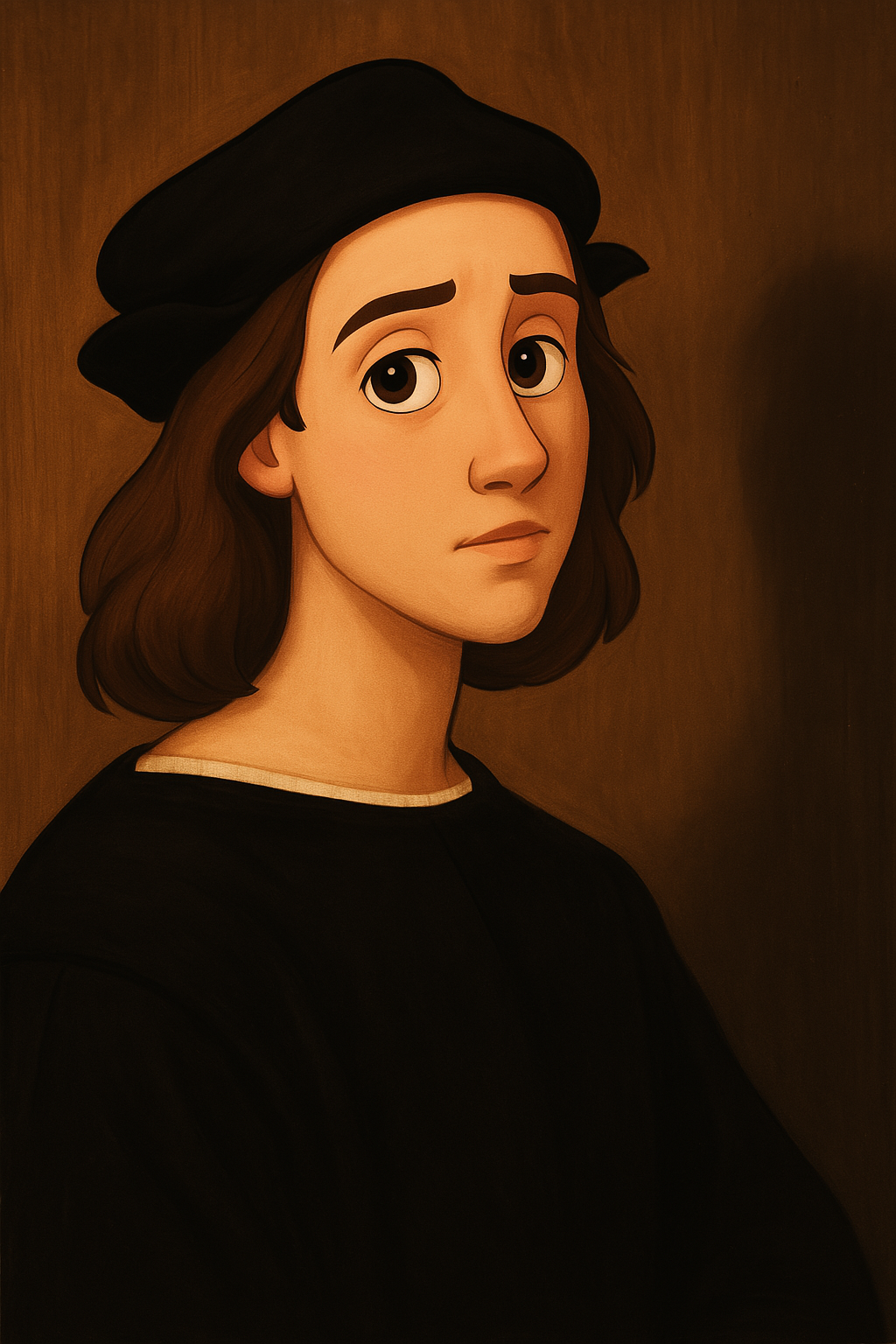
During this time, he produced a string of Madonna paintings that remain among the most cherished works in Western art: Madonna of the Goldfinch, Madonna del Prato, La Belle Jardinière, and Madonna of the Pinks. These are intimate, human images—Mary as a young mother, Christ as a playful child—not distant icons, but approachable figures rendered with gentle realism. The influence of the Byzantine and Gothic traditions lingered in subject matter, but Raphael’s figures breathe. Their poses form pyramidal compositions inspired by Leonardo, yet their expressions are uniquely his: serene, soulful, and filled with warmth.
In 1508, at the age of twenty-five, Raphael was called to Rome by Pope Julius II, likely on the recommendation of the architect Donato Bramante, a fellow native of Urbino. Rome, under Julius’s energetic and sometimes tyrannical direction, was undergoing a cultural transformation. Julius had already summoned Michelangelo to paint the Sistine Chapel ceiling. Raphael, by contrast, was given the Vatican’s Apostolic Palace—specifically, the rooms now known as the Stanze di Raffaello. He began with the Stanza della Segnatura, which included The School of Athens.

The painting has long been my favorite renaissance work and has often decorated my home
(PUBLIC DOMAIN)
Painted between 1509 and 1511, The School of Athens is Raphael’s masterpiece, and arguably the finest encapsulation of the High Renaissance spirit. It depicts the great philosophers of antiquity—Plato, Aristotle, Pythagoras, Heraclitus, Euclid—gathered in a space that mirrors Bramante’s architectural ideals. Raphael united classical reason with Christian thought, all beneath a ceiling of majestic Roman arches. He placed Plato and Aristotle at the center—Plato pointing to the heavens with a copy of Timaeus, Aristotle gesturing toward the earth with his Ethics. Michelangelo appears as a brooding Heraclitus, and Raphael, with charming humility, includes himself at the edge of the scene.
The composition is stunning not just for its intellectual content, but for its technical precision. Raphael achieved a nearly perfect balance of gesture, light, and perspective. The figures do not crowd the space—they belong to it. It is painting as architecture, philosophy, and theater all at once.
Raphael’s success in the Vatican earned him the continued patronage of Julius II and his successor, Pope Leo X. He completed additional rooms—Stanza d’Eliodoro, Stanza dell’Incendio del Borgo—often with assistance from a growing workshop. His designs extended beyond painting. When Bramante died in 1514, Raphael was appointed chief architect of the new St. Peter’s Basilica. Though Michelangelo would later alter his plans, Raphael’s architectural vision helped shape the monumental classical style of the new Rome.
His output was prodigious. Raphael directed a large studio that included students and assistants who helped execute his designs. He also produced cartoons for tapestries, architectural projects like the Chigi Chapel, and countless portraits. His style remained consistent—balanced, graceful, and suffused with an idealized beauty that reflected both Christian piety and classical serenity.
Despite his enormous fame, Raphael led a relatively private personal life. He never married, though he was engaged briefly to Maria Bibbiena, niece of a powerful cardinal. His romantic affections, it is said, may have been directed elsewhere. Some sources suggest an attachment to a woman known only as “La Fornarina,” the baker’s daughter, who appears in several portraits. Whether she was muse or mistress, the facts remain shrouded in mystery, and perhaps that is just as well.
On April 6, 1520—his 37th birthday—Raphael died suddenly, possibly of an acute illness or fever. His death shocked the city. He was laid to rest in the Pantheon, one of the most revered buildings of ancient Rome. His epitaph, written by the poet Pietro Bembo, still stirs the soul: “Here lies Raphael, by whom Nature feared to be outdone while he lived, and when he died, feared she would die with him.”
In the centuries that followed, Raphael’s reputation would wax and wane. During the Baroque period, Michelangelo’s stormy genius eclipsed Raphael’s quiet harmony. But in the 18th and 19th centuries, scholars and artists again turned to Raphael as the supreme example of balance and clarity. Johann Joachim Winckelmann, the father of art history, held him as a model of noble simplicity and calm grandeur. Yet not everyone adored him. The Pre-Raphaelites of 19th-century England, rebelling against academic convention, chose their name in deliberate rejection of the style they felt had become too idealized, too safe.
Even so, Raphael’s legacy endures. His Madonnas remain icons of maternal love. His School of Athens continues to draw awe-struck visitors into its philosophical embrace. His drawings, elegant and unforced, still teach students of art how to see. He was not the most radical of artists, nor the most tempestuous. But he was perhaps the most complete—a man who, in thirty-seven short years, gave us a vision of the world not as it is, but as it might be when beauty and thought are held in perfect balance.
Raphael did not roar like Michelangelo, nor brood like Leonardo. He sang—quietly, masterfully, with a voice that still echoes in every gallery, every chapel, and every soul that seeks beauty not in chaos, but in harmony.
Bibliography:
- “Raphael.” Encyclopaedia Britannica. Accessed April 4, 2025. https://www.britannica.com/biography/Raphael-Italian-painter-and-architect.
- “Renaissance Art.” Encyclopaedia Britannica. Accessed April 4, 2025. https://www.britannica.com/art/Renaissance-art.
- “High Renaissance.” Wikipedia: The Free Encyclopedia. Last modified March 2025. https://en.wikipedia.org/wiki/High_Renaissance.
- “The School of Athens.” Encyclopaedia Britannica. Accessed April 4, 2025. https://www.britannica.com/topic/School-of-Athens.
- “Madonna (Art).” Encyclopaedia Britannica. Accessed April 4, 2025. https://www.britannica.com/topic/Madonna-art.
- “Raphael (Raffaello Sanzio da Urbino).” Wikipedia: The Free Encyclopedia. Last modified March 2025. https://en.wikipedia.org/wiki/Raphael.




 DAVE DOES HISTORY
Leave a comment