
Amanda Clement’s journey to baseball legend began in Hudson, Dakota Territory, where she was born on March 20, 1888. Raised by her mother after her father passed away, Amanda and her brother Hank spent much of their childhood around the local baseball field. Hank was a ballplayer, and Amanda was never far from the action. While girls of her time weren’t encouraged to play, Amanda found another way to be part of the game—by umpiring the boys’ informal sandlot games. Without knowing it, she was training for a career that had never existed before.
Listen to the Article (appx 5:37)
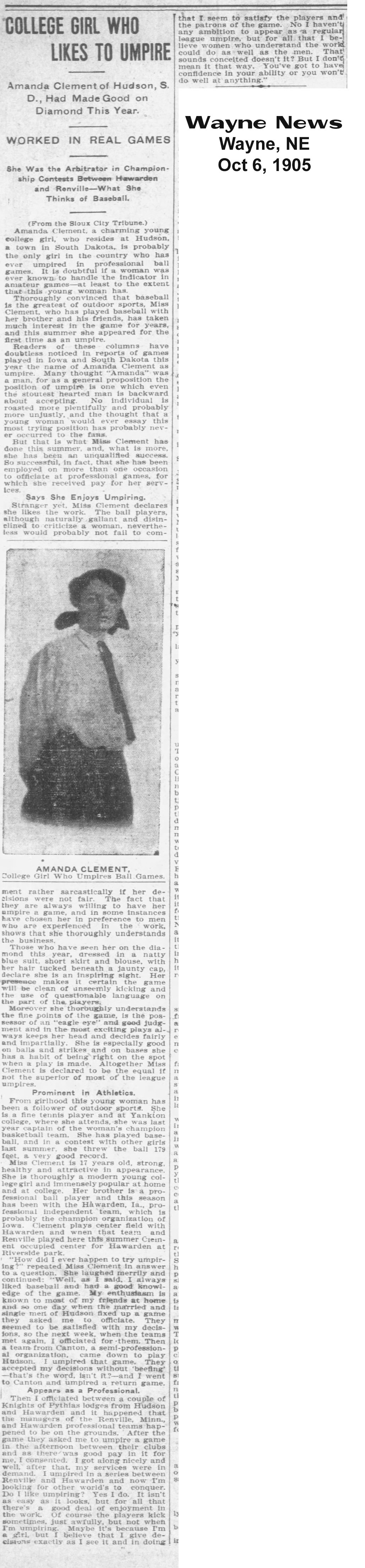
Her big break came almost by accident. In 1904, Amanda traveled to Hawarden, Iowa, to watch Hank pitch in a semi-pro game. The scheduled umpire never arrived, and in a moment that would change baseball history, Hank suggested his sister step in. Amanda took the field and impressed both teams with her poise, knowledge of the game, and ability to make tough calls with confidence. When the umpire for the main game also failed to show, the teams agreed to let Amanda call that one too—this time, for pay. Just like that, she became the first woman to be paid for umpiring a baseball game. Some sources dispute the exact year of her first game, with some accounts placing it in 1903 or 1905, but 1904 remains the most widely accepted date.
For the next six years, Amanda Clement was a fixture on baseball diamonds across the Midwest. She umpired around 50 games each summer in South Dakota, Minnesota, Iowa, Nebraska, and North Dakota. In an era when umpires typically worked alone and stood behind the pitcher to call balls and strikes, Clement commanded respect on the field. She was known for her keen eyesight, quick decision-making, and refusal to be intimidated. Reporters described her as having “an eagle eye” and noted that her presence often led to cleaner games—players were less likely to argue or swear in front of a lady umpire.
Her presence on the field wasn’t just about novelty; it was about skill. She was known for her consistency and professionalism, which earned her the respect of players and promoters alike. It also didn’t hurt that her presence drew crowds. Baseball was the dominant form of entertainment at the time, and having a female umpire added a unique draw that teams capitalized on. One newspaper even claimed that Clement received over 60 marriage proposals from men who admired her from the stands. Her response? “I’m wedded to baseball.”
Clement’s career as an umpire helped finance her education. She attended Yankton College and later the University of Nebraska, earning a degree in physical education. While in college, she continued to break barriers, playing basketball, running track, and setting a national record for women in the baseball throw. She also refereed high school basketball games, leading some to speculate that she was the first woman to officiate that sport as well.
Her athletic prowess and leadership extended beyond the baseball diamond. After earning her degree, she went on to teach physical education at various institutions, including the University of Wyoming and Jamestown High School in North Dakota. She also worked for the YWCA in La Crosse, Wisconsin, where she advocated for better health and fitness programs for women. She even took up social work, helping those in need during the Great Depression and beyond.
While she left umpiring as a full-time profession after six years, Clement never truly left the game. She occasionally returned to officiate special events, and her love of baseball remained a lifelong passion. Even in her later years, she was known to be an avid fan of the Minnesota Twins, following the sport she had once helped revolutionize.
Amanda Clement’s legacy is one of quiet, determined defiance against the limitations placed upon her by society. She never set out to be a feminist icon or a trailblazer; she simply loved baseball and was good at calling the game. Yet, by doing what she did, she challenged the prevailing norms of her era and opened the door—however slightly—for women in sports.
Even today, female umpires remain rare, particularly at the highest levels of professional baseball. The fact that Amanda Clement did what she did over a century ago makes her story all the more remarkable. She wasn’t just a curiosity; she was an umpire in every sense of the word. The game was better for her presence, and her example still resonates in a world where women continue to push for greater inclusion in sports.
Amanda Clement may not be a household name, but she should be. She was, in every sense, a pioneer. A woman who saw a need, filled it, and did so with a level of competence and grace that silenced the doubters. In a sport where the umpire is often the most unpopular person on the field, Amanda Clement managed to turn skepticism into admiration. And that, more than anything, is what makes her story worth telling.




 DAVE DOES HISTORY
Leave a comment