
In the early months of 1942, the United States found itself reeling from the attack on Pearl Harbor. The fear of invasion, espionage, and sabotage gripped the West Coast, where residents and military officials alike braced for what seemed like an inevitable assault on the mainland. Rumors ran rampant—some claimed Japanese troops were already landing in California, while others believed enemy aircraft were hidden in remote airstrips ready to strike. Air raid drills became commonplace, and authorities anxiously scanned the horizon for signs of Japanese forces. It was in this atmosphere of paranoia and uncertainty that the Japanese submarine I-17 made its approach toward the California coastline.
I-17 was a B1-type submarine, a long-range vessel designed not only to attack shipping but to launch sporadic bombardments against enemy shores. Under the command of Kozo Nishino, the I-17 had already participated in a series of attacks on merchant vessels and was now being tasked with something far more provocative—an attack on the continental United States. The mission was symbolic rather than strategic, an effort by the Imperial Japanese Navy to show the vulnerability of America’s coast and to create fear among its civilian population.
On the evening of February 23, 1942, as President Franklin D. Roosevelt delivered a radio address to the nation, the I-17 surfaced near Ellwood, California, an oil-producing region west of Santa Barbara. Nishino ordered his crew to man the deck gun, and within minutes, shells began raining down on the oil facilities. Their primary target was a Richfield aviation fuel tank, which, had it been hit directly, could have caused a significant explosion. However, in the chaos of nighttime firing, the shells largely missed their mark. The damage was minimal—some punctured pipelines, a destroyed catwalk, and a pumphouse that was left smoldering—but the psychological impact was immense.
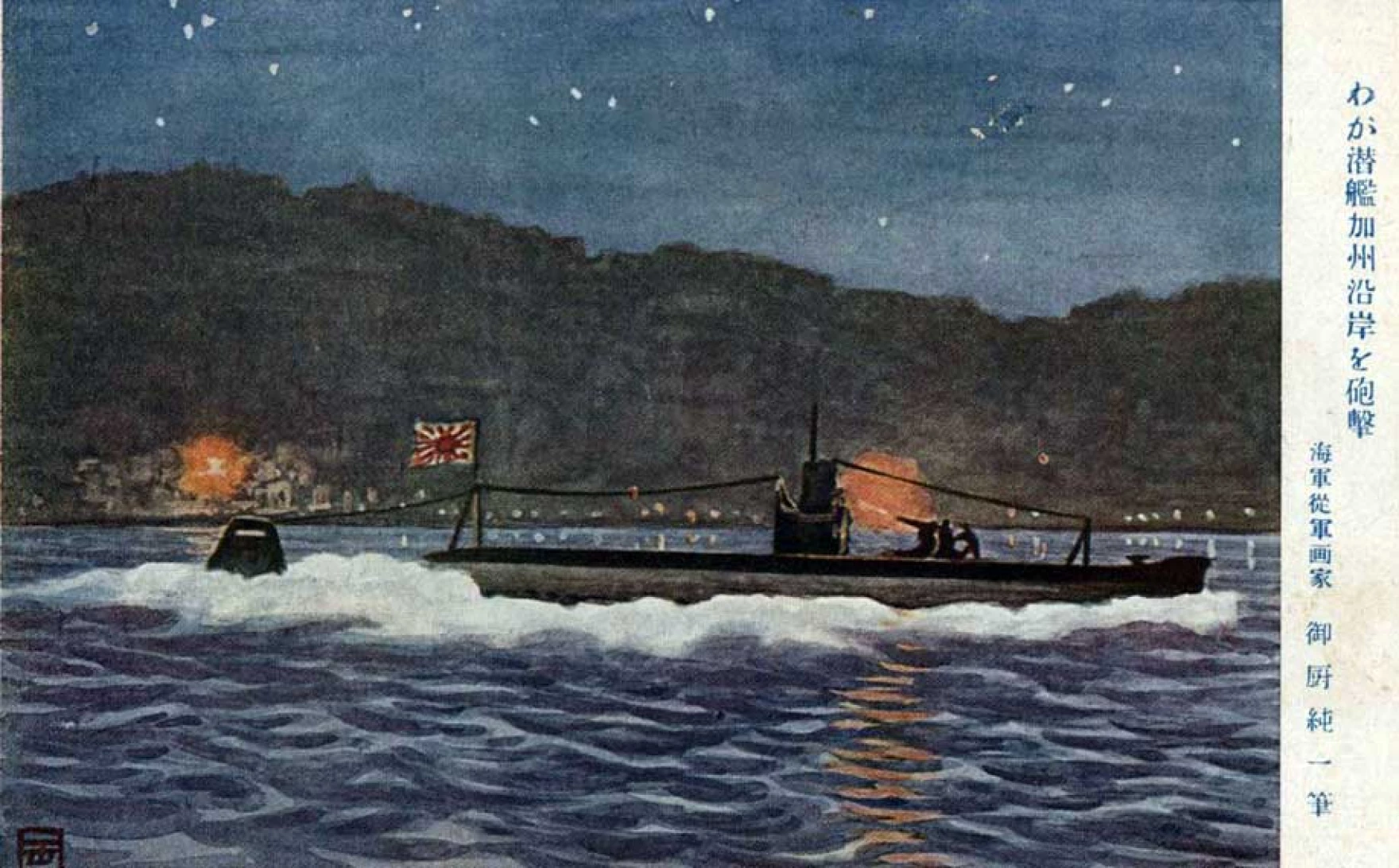
“By Navy war artist Jun Mikuriya” – PUBLIC DOMAIN
The Americans onshore were caught off guard. A skeleton crew working in the oil fields initially mistook the explosions for some kind of internal accident until one worker spotted the dark silhouette of the submarine offshore. The Santa Barbara County Sheriff’s Office was soon flooded with calls, and speculation quickly spiraled out of control. Some residents reported seeing enemy troops wading ashore, while others claimed to hear the sounds of approaching aircraft. The response was chaotic—coastal defense units were put on high alert, and searchlights swept the waters for any further threats. It was not long before newspapers reported exaggerated accounts of the attack, with some claiming that Nishino had unleashed a devastating barrage that set the entire coastline ablaze. The reality, of course, was far tamer, but perception mattered more than the actual scale of the damage.
The Japanese high command received Nishino’s report that the attack had been a success, but the actual military significance was negligible. In the grand scheme of things, a few damaged structures hardly made a dent in the American war effort. However, the attack achieved what Japan had hoped—it created hysteria. The following night, nervous anti-aircraft gunners in Los Angeles fired thousands of rounds into the sky in what became known as the “Battle of Los Angeles,” convinced that an enemy raid was imminent. Reports of enemy planes, paratroopers, and spies ran wild—one witness swore they saw parachutes drifting toward the ground, while another insisted that radio towers had been hijacked to coordinate the attack. Years later, the Santa Barbara historian Neal Graffy uncovered that supposed spy signals from the Santa Ynez Mountains were actually the headlights of a local rancher driving along a winding road.
The full story behind the I-17’s mission remains a mystery. The sub was sunk in combat in 1943, and only a handful of its crew members survived. Just days after the attack, however, President Roosevelt used it as additional justification for Executive Order 9066, forcing over 120,000 Japanese Americans into internment camps, arguing that espionage and sabotage were real threats. The fear sparked by the attack had lasting consequences, shaping public perception and government policy in ways that extended beyond the battlefield.
I-17 continued its wartime service, playing a role in operations around Guadalcanal and other Pacific engagements, but its days were numbered. On August 19, 1943, the submarine met its end when it was hunted down and sunk by the New Zealand armed trawler HMNZS Tui and U.S. Kingfisher floatplanes. Nishino and nearly all of his crew perished. The Ellwood bombardment, while militarily insignificant, remained one of I-17’s most infamous actions.
In the years that followed, Hollywood would mine the attack for inspiration, most notably in the 1979 film 1941, a comedic take on the paranoia that swept California after the attack. Though exaggerated for laughs, the film captured the absurdity of the West Coast’s reaction to the bombardment—how a few shells from a submarine could send an entire region into a panic. While the film turned the event into slapstick, it underscored the very real hysteria that gripped the American public at the time.
Today, Ellwood bears little trace of its moment in history, now home to the Sandpiper Golf Course and a few commemorative plaques. The attack stands as a strange footnote in the grand narrative of World War II, a reminder of how fear and perception can sometimes outweigh the actual force of arms.



 DAVE DOES HISTORY
Leave a comment