
The United States in the late eighteenth and early nineteenth centuries was a nation in flux, a young republic still feeling its way through the murky waters of governance. The Constitution was new, political parties were solidifying, and men with towering ambitions clashed in a battle for the country’s direction. Among them was Aaron Burr, a man whose name remains forever entwined with words like ambition, treason, and, of course, that duel with Alexander Hamilton. To some, he was a schemer, a man who put his own interests ahead of the country. To others, he was a brilliant mind who was unfairly maligned by his enemies and by history itself. His story is one of political intrigue, personal vendettas, and an ultimate fall from grace, one that has fascinated Americans for over two centuries.
Aaron Burr was born on February 6, 1756, in Newark, New Jersey, to a family of privilege and intellect. His father, Aaron Burr Sr., was the president of the College of New Jersey (which would later become Princeton University), and his mother, Esther Edwards, was the daughter of the famed theologian Jonathan Edwards. It seemed the young Burr was destined for greatness. But fate had other plans—his parents died when he was still a child, leaving him and his sister orphans. Raised by relatives, Burr displayed an early brilliance, entering Princeton at the age of thirteen and graduating at sixteen. He originally studied theology before shifting his focus to law, but his studies were interrupted by a call to arms.
The American Revolution was the defining moment for the nation’s founders, and Burr, eager to prove himself, joined the Continental Army. He served with distinction, taking part in the grueling expedition to Quebec under Benedict Arnold and later acting as an aide to General Israel Putnam. However, his time with George Washington was less than cordial—Burr and the future president reportedly disliked each other, a rift that would last throughout their lives. Nevertheless, Burr rose to the rank of lieutenant colonel before illness forced him to resign from the army in 1779.
After the war, Burr turned to law and politics, setting up a practice in New York City. His charm and intelligence made him a natural politician, and he quickly climbed the ranks. In 1782, he married Theodosia Bartow Prevost, a wealthy widow ten years his senior. Their marriage was one of mutual respect and intellectual companionship. Theodosia was an educated woman, and Burr, unlike many men of his era, was a proponent of women’s education. Their daughter, Theodosia Burr Alston, would be the light of his life.
By the 1790s, Burr had established himself as a political force in New York. He was elected to the U.S. Senate in 1791, defeating Philip Schuyler—Alexander Hamilton’s father-in-law. This defeat planted the seeds of enmity between Burr and Hamilton, who already viewed Burr as unprincipled and opportunistic. Their rivalry would simmer for years before reaching its infamous boiling point. Burr also played a key role in New York’s political machine, helping to build Tammany Hall into a formidable power.
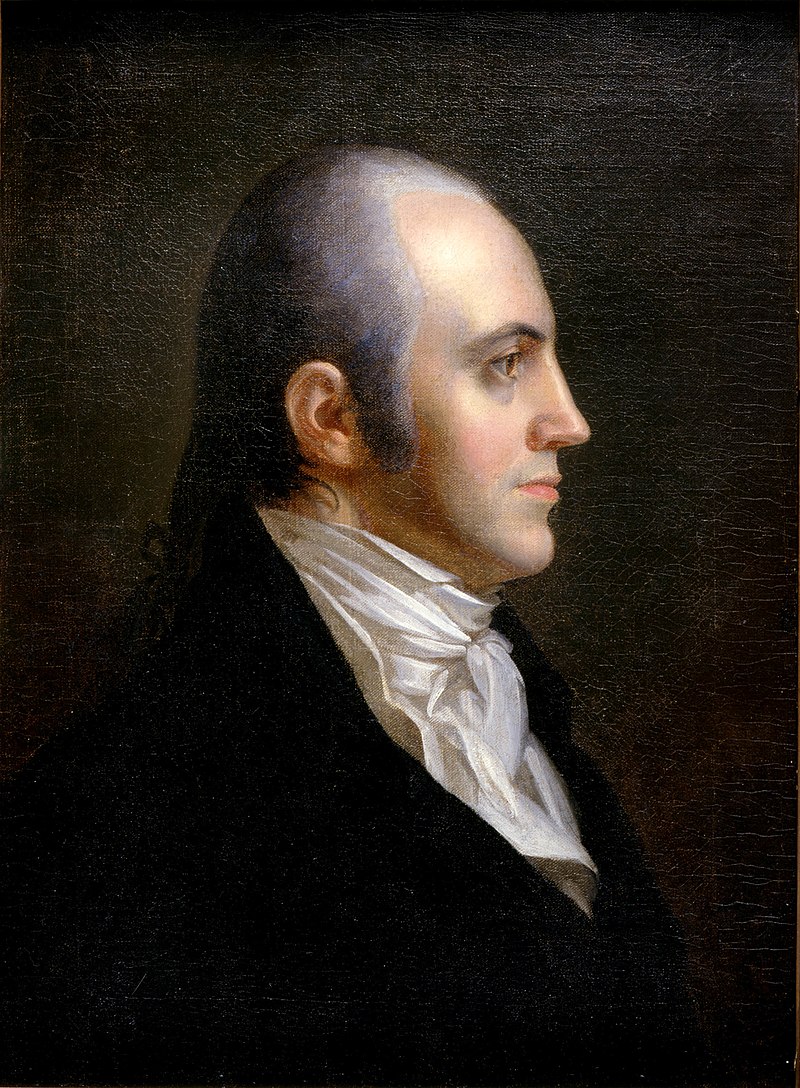
The election of 1800 was one of the most contentious in U.S. history. Burr ran as Thomas Jefferson’s running mate, and thanks to the peculiarities of the Electoral College, the two men ended up tied, throwing the election to the House of Representatives. Hamilton, though he despised Jefferson, pulled strings behind the scenes to ensure Burr would not become president. Burr was left with the vice presidency—a position with little power, especially under a president who distrusted him. It was a bitter pill, and Burr spent his term as a political outsider, biding his time.
Then came the duel. In 1804, after losing the New York governor’s race—thanks in no small part to Hamilton’s behind-the-scenes maneuvering—Burr challenged his longtime rival. On July 11, 1804, in Weehawken, New Jersey, the two men met for their fateful encounter. Hamilton, for reasons unknown, fired his shot into the air. Burr did not. Hamilton fell, mortally wounded. Within a day, he was dead, and Burr became the most hated man in America. Though dueling was illegal, Burr was never tried for the killing, but his political career was effectively over.
But Burr was not a man to fade quietly. With his reputation in tatters, he sought new opportunities—this time in the western frontier. He became embroiled in a scheme that remains a subject of debate to this day. Did Burr really intend to carve out his own empire in the West, possibly seizing Spanish lands and even breaking away from the United States? Or was he simply a victim of paranoia and political backstabbing? His exact intentions remain murky, but by 1807, President Jefferson—who had never trusted Burr—had him arrested for treason.
The trial that followed was one of the most sensational in American history. Chief Justice John Marshall presided over the proceedings, and the government struggled to produce concrete evidence that Burr had actually levied war against the United States. The prosecution, led by Jefferson’s allies, relied heavily on the testimony of General James Wilkinson—a man who, it turned out, was also a Spanish spy and not exactly the most trustworthy witness. In the end, Marshall ruled that Burr could not be convicted of treason because there was no overt act of war. Burr walked free, but his reputation was irreparably damaged.
After his acquittal, Burr spent several years in Europe, trying—unsuccessfully—to regain his political standing. He even attempted to secure support from the British for a new military adventure in the Americas, but nothing came of it. When he finally returned to the United States in 1812, he was a man without a country. He lived in relative obscurity, practicing law in New York and marrying a wealthy widow, Eliza Jumel. The marriage was short-lived, ending in a nasty divorce. Burr’s final years were lonely ones, his fortune gone, his influence diminished. He died in 1836, largely forgotten by a country that once held him in high regard.
“Burr’s enemies defined him, and history has yet to truly judge him.”
– Charles F. Hobson
So, was Aaron Burr a traitor? It depends on whom you ask. His duel with Hamilton made him a pariah, his western schemes painted him as a villain, and his trial for treason cemented his place in history as an enigmatic figure. But to dismiss him as merely a villain would be a mistake. He was a war hero, a skilled politician, and a man who, in many ways, was ahead of his time. He believed in merit over birthright, in education for women, and in the idea that America’s future lay beyond the Atlantic coast.
From a modern perspective, Burr’s story is a cautionary tale of unchecked ambition and government overreach. His downfall was engineered not just by his own missteps, but by the machinations of political rivals who were just as ruthless as he was. Jefferson’s administration used the weight of federal power to bring him down, despite a lack of clear evidence—a stark reminder of what happens when political vendettas override the rule of law.
Aaron Burr was neither wholly hero nor wholly villain. He was a man of contradictions, a man of great promise who made even greater mistakes. His legacy is complicated, and perhaps that is as it should be. Because history, like politics, is rarely black and white.



 DAVE DOES HISTORY

Leave a comment