
In the years following the Revolutionary War, the fledgling United States faced a storm of economic turmoil and political discord. Massachusetts, once a hub of revolutionary fervor, became the epicenter of this crisis. For the farmers and war veterans of western Massachusetts, independence had brought not prosperity but crushing debt, rising taxes, and a financial system seemingly designed to benefit eastern merchants at their expense. The Articles of Confederation, under which the national government operated, left states to fend for themselves. It was a patchwork system incapable of offering relief or cohesion. Massachusetts, under the leadership of Governor James Bowdoin, pursued aggressive measures to repay war debts, including taxes payable only in hard currency. For rural farmers scraping by in a barter economy, this was an impossible demand. Their land and livestock were seized, their debts were called in, and they were hauled before courts often far from their homes. The courts became symbols of oppression, places where economic ruin was formalized and independence dissolved.
Resistance began as murmurs in taverns and meetinghouses. Disenfranchised farmers organized and petitioned the legislature for relief, calling for the issuance of paper money to ease debts and a suspension of tax collections. These pleas fell on deaf ears. By the summer of 1786, frustration gave way to action. Armed protesters, calling themselves “Regulators” in homage to earlier uprisings, began closing courts across the state. Daniel Shays, a former Continental Army captain, became one of the movement’s leaders. Shays, like many of his compatriots, had fought for liberty only to return to poverty and lawsuits over unpaid debts. His leadership was symbolic, his rhetoric steeped in Revolutionary ideals. This was, after all, a second battle for independence—only now, the tyranny came from Boston rather than London.
The protesters achieved early victories, shutting down courts in Northampton, Worcester, and other towns. But the Massachusetts government responded swiftly. The legislature passed the Riot Act, suspended habeas corpus, and authorized privately funded militias to suppress the uprising. Governor Bowdoin and his allies saw the rebellion not as a plea for justice but as an existential threat to the rule of law. As tensions escalated, the focus of the conflict turned to Springfield, home to a federal armory brimming with muskets, artillery, and powder. For Shays and his followers, seizing the armory represented a chance to arm their forces and force the government to the negotiating table. For the government, defending it was paramount.
On January 25, 1787, Shays and his allies launched their bid to capture the Springfield Armory. Their plan was ambitious, a three-pronged assault with forces converging from the east, west, and north. But communication and coordination broke down. Luke Day, commanding the western force, delayed his advance by a day and sent word to Shays. That message never reached its destination, intercepted instead by government forces. Shays and Eli Parsons, leading the eastern and northern contingents, marched on the armory unaware they would receive no support. General William Shepard, a Revolutionary War veteran commanding the state militia, had fortified the armory with 1,200 men. Shepard’s orders were clear: defend the site at all costs. As Shays’s forces approached, marching through knee-deep snow, Shepard initially ordered his men to fire warning shots over their heads. When the rebels pressed on, Shepard unleashed grapeshot from his cannons. The effect was devastating. Four rebels were killed, and dozens more were wounded. Disorganized and outgunned, the rebel force disintegrated, retreating in confusion.
In the aftermath of the confrontation, Shays and his followers regrouped in Amherst but found themselves pursued by a second militia under General Benjamin Lincoln. Lincoln’s forces, funded by Boston merchants, pressed the rebels relentlessly through the snow-covered countryside. By early February, the rebellion had collapsed. The decisive blow came at Petersham, where Lincoln surprised the rebels and scattered their remaining forces. Shays and other leaders fled to Vermont and New York, seeking refuge from arrest and prosecution.
The Springfield confrontation and the subsequent crackdown reverberated far beyond Massachusetts. For George Washington, who had retired to Mount Vernon, it was a sobering reminder of the fragility of the union. Writing to Henry Knox, he lamented that the very men who had fought to establish the Constitution were now rising against it. To Washington, the rebellion underscored the need for a stronger central government capable of maintaining order and enforcing laws. Thomas Jefferson, serving as ambassador to France, offered a contrasting perspective. In a letter to James Madison, he famously wrote, “The tree of liberty must be refreshed from time to time with the blood of patriots and tyrants. It is its natural manure.” Jefferson’s view, though more philosophical, acknowledged the grievances that had driven Shays and his followers to act, highlighting the growing chasm between the ideals of liberty and the realities of governance.
Massachusetts moved swiftly to punish the insurgents. Hundreds were arrested, and more than a dozen were sentenced to death for treason. Yet public sympathy for the rebels complicated the government’s efforts. Many citizens, even those who opposed the rebellion, understood the desperation that had fueled it. Bowdoin’s harsh response contributed to his defeat in the next gubernatorial election. His successor, John Hancock, adopted a more conciliatory approach, issuing pardons to most of the condemned, including Shays himself. Shays lived out his days in relative obscurity, a symbol of rebellion but also of the economic inequities that remained unresolved.
Shays’ Rebellion left an indelible mark on the nation. It exposed the weaknesses of the Articles of Confederation, highlighting the inability of the federal government to respond effectively to domestic crises. It was no coincidence that the Philadelphia Convention convened later that year, with delegates determined to draft a Constitution that would create a stronger central government. Provisions for a standing army, federal control over interstate commerce, and mechanisms to suppress insurrections were shaped by the rebellion’s lessons. James Madison and Alexander Hamilton pointed to the uprising as evidence of the need for a government that could balance liberty with order.
The rebellion also revealed deep divides within American society. It was a clash between rural and urban interests, between debtors and creditors, and between the ideals of the Revolution and the realities of governance. While the Regulators failed to achieve their immediate goals, their fight underscored the necessity of a government that could address the needs of all its citizens, not just the elite.
Shays’ Rebellion and the Battle at Springfield Armory remain pivotal moments in American history. They were not merely a footnote to the Revolution but a continuation of its struggles. They forced the nation to confront the tensions inherent in its founding principles and to craft solutions that would endure. The rebellion’s legacy is one of resilience and reform, reminding us that the Constitution’s mechanisms for addressing domestic insurrection were forged in the crucible of these very struggles. While the Regulators’ march ended in failure, their story endures as a vital chapter in the journey toward a more perfect union.
Generally ranked as the BEST episode of Constitution Thursday, The Hanging of Captain Henry Gale is an episode that deals with the impact of Shay’s Rebellion on the Convention in Philadelphia.



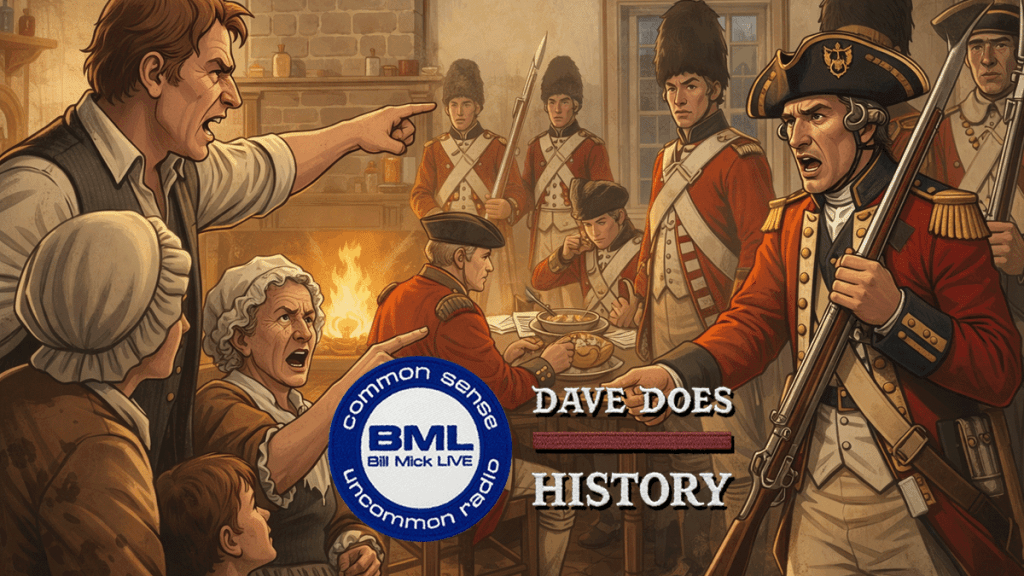
 DAVE DOES HISTORY
Leave a comment