
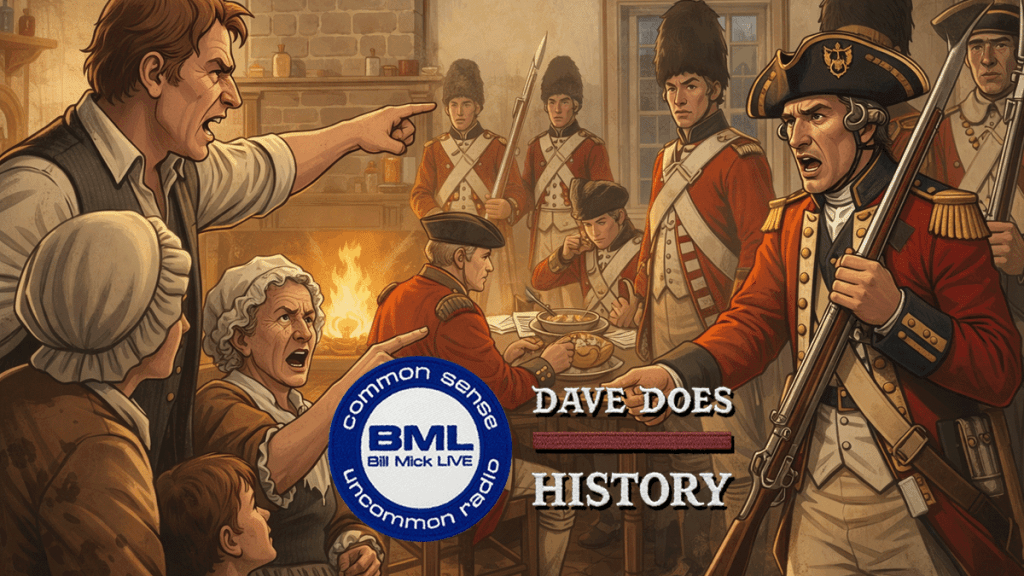
In this latest episode of Dave Does History on the Bill Mick Live show, Dave Bowman takes listeners deep into the chaotic period that followed the American Revolutionary War, focusing on the often-overlooked Annapolis Convention of 1786. Bowman brilliantly unpacks the reality of life in post-war America, shattering the common myth that the end of the war brought instant peace, prosperity, and unity to the new nation. Instead, Dave paints a picture of economic instability, social unrest, and a weak central government struggling to keep the fragile union together.
From the outset, Bowman’s storytelling shines as he draws listeners into the real struggles of ordinary Americans during this time. Far from enjoying the spoils of victory, farmers and merchants were crushed under the weight of debt and a dysfunctional economy. The Articles of Confederation had created a government so weak it couldn’t regulate trade, impose taxes, or even defend itself against external threats. Each state acted as its own sovereign entity, leading to tariff wars and economic gridlock that stifled the young nation’s recovery. It’s a moment that Dave compares, in his signature humorous way, to the frustrations of modern-day HOA fees.
What stands out in this episode is Bowman’s ability to contextualize the critical significance of the Annapolis Convention. While many listeners may be familiar with the more well-known Constitutional Convention that followed in 1787, Bowman skillfully explains how the seeds of that historic event were planted in Annapolis. Only five states showed up to Annapolis—Virginia, New York, Pennsylvania, New Jersey, and Delaware—but what began as a regional meeting to discuss trade issues blossomed into a pivotal turning point for American governance. Dave highlights key figures like James Madison and Alexander Hamilton, whose presence at Annapolis helped steer the conversation toward the realization that reforming trade wasn’t enough—America needed a complete overhaul of its government structure.
Listeners are treated to an in-depth explanation of how the Articles of Confederation, for all their well-meaning intentions, were fundamentally flawed. Bowman delves into the writings of Madison and Hamilton, underscoring the universal failures of confederate governments throughout history, a point that would resonate years later when the Southern Confederacy met its own demise. Bowman’s analysis makes clear that the framers of the Constitution didn’t set out with a blueprint in hand; they were grappling with monumental decisions about how to balance the autonomy of states with the need for a strong central government—a tension that still echoes in today’s political debates.
Bill Mick, as always, plays the perfect foil to Dave’s historical depth, providing relatable and often humorous commentary that keeps the discussion grounded for the average listener. One of the episode’s most engaging moments comes when Mick quips that early America might have been “too libertarian to succeed,” to which Bowman responds by acknowledging the serious debates among Anti-Federalists and Federalists over the size and scope of republican government. It’s moments like this that showcase Bowman’s ability to make dense historical debates not only accessible but entertaining.
The episode also touches on the broader global implications of America’s failure to solidify its government. Bowman paints a vivid picture of a fractured America, with states threatening to align with foreign powers like France and Spain. This sense of urgency is central to Bowman’s analysis: the Annapolis Convention, despite its lack of immediate success, was a wake-up call for the nation’s leaders. The episode crescendos as Bowman recounts how the modest proposal by New Jersey’s delegation—to scrap the Articles and form a new governing framework—would set the stage for the Philadelphia Convention and, ultimately, the U.S. Constitution.
The final moments of the episode drive home just how precarious America’s position was in 1786. Bowman reminds listeners that just months before the Annapolis Convention, American soldiers were firing on their own citizens in Shays’ Rebellion, a symbol of the deep unrest and governmental impotence that defined the period. It’s a stark reminder of how close the fledgling country came to collapsing under the weight of its own contradictions.
Overall, this episode of *Dave Does History* offers a masterclass in historical storytelling. Bowman’s deep knowledge of the subject, combined with his relatable and humorous approach, makes for an engaging listen that both informs and entertains. Whether you’re a history buff or a casual listener, this episode provides a nuanced understanding of one of the most critical, yet often overlooked, moments in the formation of the United States. By the end, you can’t help but appreciate just how improbable, and fragile, the American experiment truly was.



 DAVE DOES HISTORY
Leave a comment