
The first Lincoln-Douglas debate on August 21, 1858, in Ottawa, Illinois, marks a pivotal moment in American political history. This was more than just a senatorial debate; it was a clash of ideas that would shape the future of the United States. In the sweltering heat of late summer, two men, Abraham Lincoln and Stephen A. Douglas, stood before a crowd of thousands to present their visions for the nation’s future. But to truly understand the weight of this debate, we must first understand the political climate of 1858.
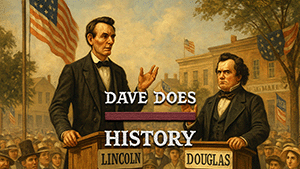
At this time, the nation was deeply divided over the issue of slavery. The Illinois Senate race between Lincoln and Douglas was not just a local affair; it was a microcosm of the national struggle between the forces that sought to expand slavery and those that wished to contain it. Douglas, the incumbent senator and a leading Democrat, was a formidable figure known for his advocacy of popular sovereignty—the idea that the residents of a territory should decide the issue of slavery for themselves. Lincoln, on the other hand, was a relatively unknown Republican challenger, but his eloquence and moral clarity would soon propel him to national prominence.
To appreciate the intensity of this debate, we must first set the stage with some historical context. Just one year before, in 1857, the Supreme Court had handed down the infamous Dred Scott decision, which ruled that African Americans, whether free or enslaved, could not be considered citizens and that Congress had no authority to prohibit slavery in the territories. This decision sent shockwaves through the nation, further polarizing the already bitterly divided country.
Another critical piece of this puzzle is the Kansas-Nebraska Act of 1854, which Douglas himself had authored. This act effectively repealed the Missouri Compromise by allowing the territories of Kansas and Nebraska to decide for themselves whether to allow slavery, based on popular sovereignty. The act led to violent conflict in Kansas, known as “Bleeding Kansas,” and contributed to the formation of the Republican Party, which was founded on the principle of opposing the expansion of slavery.
Against this backdrop, Lincoln and Douglas represented two starkly different visions for America. Lincoln, though cautious in his approach to racial equality, was clear in his moral opposition to slavery’s expansion. Douglas, while personally indifferent to the morality of slavery, staunchly defended the idea that each state or territory should make its own decision without interference from the federal government.
On that August day in Ottawa, the air was thick not just with humidity but with the tension of an audience eager to hear these two men clash. The debate began with Stephen A. Douglas, who took the opportunity to frame the contest on his terms. Douglas wasted no time in labeling Lincoln as a radical, accusing him of being an abolitionist in disguise. He argued that Lincoln’s position on slavery would lead to the dissolution of the Union and accused him of promoting racial equality, a charge intended to alarm the predominantly white audience.
Douglas’s main argument was a defense of popular sovereignty. He insisted that it was the only fair and democratic way to resolve the slavery issue. For Douglas, the question wasn’t about the morality of slavery but about the rights of states and territories to govern themselves. He portrayed Lincoln as someone who sought to impose his moral views on others, thereby threatening the very fabric of the Union.
Lincoln’s response was a masterclass in rhetoric and moral clarity. He began by addressing Douglas’s accusations head-on, clarifying his position on slavery. Lincoln was careful to distance himself from the abolitionist label, emphasizing that his goal was not to abolish slavery where it already existed but to prevent its expansion into new territories. He famously argued that “a house divided against itself cannot stand,” asserting that the nation could not endure permanently half slave and half free.
Lincoln also took aim at the concept of popular sovereignty, arguing that it was morally indifferent and ultimately unsustainable. He contended that if slavery was wrong—and he believed it was—then it should not be allowed to spread, regardless of what the residents of a particular territory might want. Lincoln’s argument was that the issue of slavery was not just a political or legal question but a moral one that demanded a clear and principled stance.
One of the most memorable exchanges of the debate revolved around the issue of race. Lincoln, aware of the racist attitudes prevalent among many in the audience, took a cautious approach. He made it clear that while he opposed the spread of slavery, he did not advocate for full social and political equality between races—a position that has been the subject of much historical debate. Douglas seized on this, using it to paint Lincoln as a hypocrite and to bolster his own appeal to white supremacist sentiments.
The immediate reaction to the debate was mixed, reflecting the deep divisions within the country. In Illinois, the local audience was split, with Douglas’s supporters praising his forceful defense of popular sovereignty and Lincoln’s followers impressed by his moral conviction and eloquence. The debate was reported in newspapers across the country, and the coverage was as polarized as the nation itself.
Northern newspapers tended to be more favorable to Lincoln, emphasizing his principled stand against the expansion of slavery. Southern newspapers, on the other hand, lauded Douglas as a defender of states’ rights and a bulwark against the radicalism of the Republican Party. The press coverage played a crucial role in shaping public perception of the debate and in amplifying its impact beyond the borders of Illinois.
In the short term, the debate had a significant impact on the Illinois Senate race. While Lincoln put on an impressive performance, Douglas’s status as the incumbent and his national reputation gave him an edge. Ultimately, Douglas won re-election to the Senate, but the debates catapulted Lincoln into the national spotlight, setting the stage for his successful bid for the presidency in 1860.
The long-term consequences of the Lincoln-Douglas debates, however, were far more profound. These debates brought the issue of slavery to the forefront of national politics in a way that no previous event had. Lincoln’s articulation of the moral and political challenges posed by slavery resonated with a growing number of Americans who were increasingly uncomfortable with the institution.
The debates also exposed the deepening sectional divide that would eventually lead to the Civil War. Douglas’s defense of popular sovereignty and Lincoln’s insistence on the moral wrongness of slavery’s expansion highlighted the irreconcilable differences between the North and the South. The Lincoln-Douglas debates, therefore, can be seen as a precursor to the conflict that would erupt just a few years later.
The first Lincoln-Douglas debate on August 21, 1858, was more than just a political contest between two candidates. It was a defining moment in American history, a clash of ideas that would shape the future of the nation. Through this debate, Lincoln emerged as a national leader, and his words would continue to resonate as the country moved toward the great conflict of the Civil War. The legacy of this debate reminds us of the power of words and ideas to influence the course of history.
Read the full debate HERE



 DAVE DOES HISTORY
Leave a comment