
In the early months of the American Civil War, the Union sought to define its war aims clearly and publicly. The Crittenden-Johnson Resolution, passed by Congress on July 25, 1861, played a pivotal role in this endeavor. This resolution, co-authored by Senator John J. Crittenden of Kentucky and Congressman Andrew Johnson of Tennessee, aimed to reassure the Union states, the border states, and the broader international community about the Union’s intentions.
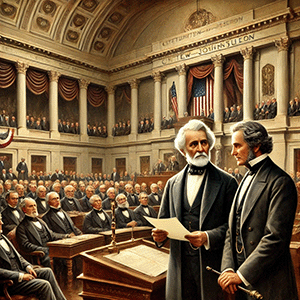
In 1861, the United States was engulfed in a conflict that threatened to tear the nation apart. The Civil War had erupted in April following the Confederate attack on Fort Sumter. The Union, led by President Abraham Lincoln, faced the monumental task of preserving the nation while addressing the concerns of various political factions and maintaining the loyalty of the border states—slave states that had not seceded. Senator John J. Crittenden, known for his previous efforts to prevent the war through the Crittenden Compromise, and Congressman Andrew Johnson, a Southern Unionist, stepped forward with a resolution to clarify the Union’s war aims.
At the start of the Civil War, the Union’s primary goal was to preserve the nation. However, there were widespread fears, especially in the border states, that the war might become a crusade to abolish slavery. The Crittenden-Johnson Resolution sought to alleviate these fears by explicitly stating the Union’s objectives. It was crucial to keep the border states—Kentucky, Missouri, Maryland, and Delaware—aligned with the Union to prevent further secession and maintain strategic advantages.
The Crittenden-Johnson Resolution was succinct but powerful in its message. It declared that the war was not being waged for “overthrowing or interfering with the rights or established institutions of those States, but to defend and maintain the supremacy of the Constitution and to preserve the Union.” This meant that the war’s sole objective was to restore the Union, not to interfere with slavery where it already existed. The resolution emphasized that once the Union was preserved, the war should end.
The resolution was introduced in both the House of Representatives and the Senate, sparking debates among lawmakers. Despite the contentious political climate, it garnered bipartisan support, reflecting a shared desire to present a united front. The House passed the resolution with a vote of 117 to 2, while the Senate followed with a vote of 30 to 5. The overwhelming support illustrated the consensus among many politicians that preserving the Union was the paramount objective.
The immediate impact of the Crittenden-Johnson Resolution was to boost morale among Union supporters and clarify the war’s aims. For the border states, the resolution provided assurance that the war would not directly threaten their institution of slavery, thereby encouraging them to remain loyal to the Union. The Confederacy, however, viewed the resolution with skepticism, seeing it as a strategic maneuver rather than a genuine declaration of intent. Internationally, the resolution helped frame the conflict in a way that emphasized constitutional preservation over social revolution, which was crucial for gaining support or neutrality from foreign powers.
As the war progressed, the Union’s war aims evolved. The initial focus on preserving the Union was gradually complemented by a growing emphasis on ending slavery, particularly as it became clear that the institution was central to the Confederate war effort. The issuance of the Emancipation Proclamation by President Lincoln on January 1, 1863, marked a significant shift. The proclamation declared the freedom of all slaves in Confederate-held territory, transforming the war into a fight for both union and emancipation. This shift reflected changing public sentiment and strategic considerations, making the Crittenden-Johnson Resolution seem increasingly out of step with the evolving objectives of the war.
The long-term significance of the Crittenden-Johnson Resolution lies in its reflection of the Union’s initial war aims and the political complexities of the time. Modern historians view it as an important document that illustrates the Union’s strategy to maintain broad support for the war effort, especially among the border states. It also highlights the challenges faced by the Union leadership in balancing different political and social interests during a period of national crisis. While the resolution’s aims were eventually superseded by the broader goal of emancipation, it remains a key part of Civil War historiography.
The Crittenden-Johnson Resolution of July 25, 1861, was a significant legislative effort to define and communicate the Union’s war aims at the outset of the Civil War. By emphasizing the preservation of the Union and the Constitution, it sought to unify the Northern states and reassure the border states of their place within the Union. Though the war’s objectives evolved over time, the resolution remains a testament to the complexities and shifting priorities of a nation in turmoil.




 DAVE DOES HISTORY
Leave a comment