
In the pantheon of American patriotic songs, few resonate as deeply as “America the Beautiful.” Written by Katharine Lee Bates in 1893, the song captures the grandeur of the American landscape and the spirit of its people. Its journey from a poem inspired by a visit to Pikes Peak to a beloved anthem is a tale of inspiration, musical adaptation, and national pride.
Katharine Lee Bates was born on August 12, 1859, in Falmouth, Massachusetts. She was an accomplished scholar, earning degrees from Wellesley College and later becoming a professor of English literature at her alma mater. Bates was not only an educator but also a prolific writer, penning numerous books and poems. Her deep appreciation for literature and nature would eventually culminate in the creation of “America the Beautiful.”
In the summer of 1893, Bates embarked on a journey that would forever change her life and contribute to American culture. She accepted a summer teaching position at Colorado College in Colorado Springs, a decision that would take her far from her New England roots. The trip to Colorado was arduous, involving long train rides and traversing the vast American landscape.
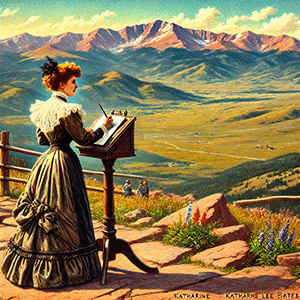
Once in Colorado Springs, Bates and a group of colleagues decided to make the climb to the summit of Pikes Peak. The ascent was challenging, but the reward was immeasurable. As Bates stood at the peak on July 22, 1893, she was overwhelmed by the breathtaking panorama. The vast expanse of the plains, the rolling hills, and the majestic mountains inspired her deeply. She later described the scene as one of “purple mountain majesties” and “spacious skies,” phrases that would become immortalized in her poem.
The view from Pikes Peak was a revelation for Bates. The beauty of the landscape moved her to jot down the first lines of what would become “America the Beautiful.” She saw the vastness of the country, from the “amber waves of grain” to the “fruited plain,” and felt a profound sense of patriotism and gratitude. This inspiration led to the creation of a poem that celebrated the natural splendor of the United States and the ideals it represented.
Upon returning to her hotel room, Bates continued to refine her poem, initially titled “Pikes Peak.” The verses flowed easily, a testament to the deep impression the landscape had made on her. Bates’ reflections on the unity and potential of America were evident in her words, capturing a vision of a country blessed by both natural beauty and the hard work of its people.
The poem first appeared in print on July 4, 1895, in the Congregationalist, a weekly journal. It was well-received, and its popularity grew quickly. Bates continued to revise the poem over the years, making subtle changes to enhance its lyrical quality. The final version, which is widely known today, was published in 1913.
The poem gained further recognition when it was set to music. Several melodies were considered, but it was Samuel A. Ward’s “Materna” that ultimately became inseparable from Bates’ words. Ward, an organist and composer, had written “Materna” in 1882 as a hymn tune. The melody’s dignified and uplifting character perfectly complemented the patriotic and reverent tone of Bates’ poem.
The combination of Bates’ evocative lyrics and Ward’s stirring melody was a natural fit. “America the Beautiful” quickly became a staple at public gatherings, schools, and patriotic events. Early performances and recordings helped solidify its place in American culture, and it was soon embraced by the public as an unofficial national anthem.
“America the Beautiful” holds a special place in the hearts of Americans. While “The Star-Spangled Banner” is the official national anthem, Bates’ song is often regarded as equally significant in expressing the nation’s ideals and aspirations. Its imagery of natural beauty and calls for brotherhood resonate with people across the country.
The song has been featured in numerous national ceremonies, including presidential inaugurations and Independence Day celebrations. It serves as a reminder of the country’s scenic wonders and the values of freedom, justice, and unity. From classrooms to concert halls, “America the Beautiful” continues to inspire and uplift.
The journey of “America the Beautiful” from a poem scribbled on a mountaintop to a beloved patriotic anthem is a testament to Katharine Lee Bates’ talent and vision. Her words, inspired by the breathtaking beauty of Pikes Peak, capture the essence of America’s landscape and spirit. Today, “America the Beautiful” remains a cherished part of the nation’s cultural heritage, a song that celebrates both the grandeur of the land and the ideals of its people. Bates’ legacy lives on, reminding us of the enduring beauty and promise of the United States.




 DAVE DOES HISTORY
Leave a comment