
Sparta, renowned for its formidable military prowess, stood as an indomitable force in ancient Greece for centuries. The Battle of Leuctra, fought in 371 BC, marked a dramatic turning point in Spartan history. This chapter delves into the background, events, and aftermath of this pivotal battle, exploring how it reshaped the perception of Sparta as an unrivaled military power.
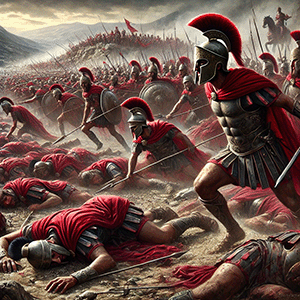
Spartan society was built around a rigorous military ethos. From a young age, Spartan boys were trained to become elite warriors, embodying discipline, endurance, and combat skill. This relentless focus on military excellence enabled Sparta to dominate the Greek world, particularly after their victory in the Peloponnesian War (431-404 BC). Sparta’s hegemony extended across the Peloponnesian Peninsula and beyond, instilling both fear and respect among its rivals.
In contrast to Sparta’s militaristic society, Thebes had a more balanced social structure, with a mix of agriculture, trade, and military focus. However, Thebes began to assert its power under the leadership of innovative commanders like Epaminondas and Pelopidas. The growing tension between Thebes and Sparta was exacerbated by Spartan interventions in Boeotia, the region surrounding Thebes, which set the stage for an inevitable clash.
The lead-up to the Battle of Leuctra was marked by a series of conflicts and shifting alliances. Sparta’s aggressive policies in Boeotia provoked Theban resistance, culminating in the decision to confront the Spartans directly. Leuctra, a small town in Boeotia, became the chosen battlefield for this historic encounter due to its strategic importance.
The Spartan army, led by King Cleombrotus I, was a formidable force composed of heavily armed hoplites. In contrast, the Theban army, though smaller, was led by the brilliant tactician Epaminondas. The Theban forces included the elite Sacred Band, a unit of 300 handpicked soldiers known for their exceptional bravery and skill.
Sparta relied on its traditional phalanx formation, characterized by tightly packed rows of soldiers moving in unison. Epaminondas, however, introduced a revolutionary tactic: the oblique phalanx. This strategy involved concentrating his forces on the left flank to deliver a decisive blow to the Spartan right wing, where Cleombrotus was stationed.
The battle commenced on July 6, 371bce, with initial skirmishes, but the turning point came when the Theban left flank, led by Epaminondas, executed a powerful charge. This concentrated attack overwhelmed the Spartan right wing, breaking their lines and causing chaos among the ranks. The Sacred Band played a crucial role in this assault, demonstrating unmatched valor and effectiveness.
The battle resulted in a catastrophic defeat for Sparta. King Cleombrotus was killed, and the Spartan army suffered significant casualties. The Thebans, despite being outnumbered, emerged victorious, shattering the myth of Spartan invincibility.
The defeat at Leuctra sent shockwaves through Sparta and its allies. The once-dominant Spartan army retreated in disarray, and the news of Cleombrotus’ death demoralized the Spartan population. Thebes, on the other hand, celebrated its newfound ascendancy, marking the beginning of its hegemony in Greece.
The loss at Leuctra marked the decline of Spartan military dominance. The battle exposed vulnerabilities within Spartan society, particularly the reliance on a relatively small population of full citizens (Spartiates) to maintain their military power. The defeat also strained Sparta’s helot system, as uprisings and internal dissent grew more frequent, further destabilizing the state.
The Battle of Leuctra shifted the balance of power in Greece. Thebes, under the leadership of Epaminondas, emerged as a major power, challenging Spartan dominance. This period saw a realignment of alliances, with many former Spartan allies gravitating towards Thebes. The shifting political landscape set the stage for future conflicts and the eventual rise of Macedon under Philip II and Alexander the Great.
Before Leuctra, Sparta was viewed as the epitome of military strength and discipline. The Spartan phalanx was considered nearly unbeatable, and their society’s singular focus on warfare was both admired and feared throughout Greece. Spartan training and discipline became legendary, influencing other Greek states and their military practices.
The defeat at Leuctra shattered the illusion of Spartan invincibility. The image of an unbeatable Spartan army was replaced by the reality of a state in decline. Greek literature and historical records began to reflect a more nuanced view of Sparta, acknowledging both its strengths and its vulnerabilities. The legacy of Leuctra influenced subsequent military thought, emphasizing the importance of innovation and adaptability in warfare.
The Battle of Leuctra stands as a watershed moment in the history of Sparta. It marked the end of an era of unchallenged Spartan dominance and heralded the rise of Thebes as a major Greek power. The battle’s aftermath reshaped the political landscape of Greece and altered the perception of Sparta’s military might. Despite its decline, the legacy of Spartan discipline and valor continued to inspire future generations, offering enduring lessons in the art of war and the rise and fall of great powers.





 DAVE DOES HISTORY
Leave a reply to The Chronicles of History Cancel reply