
The Battle of Gettysburg, fought from July 1 to July 3, 1863, stands as a pivotal moment in the American Civil War. The third day of this epic confrontation saw events that would seal the fate of the Confederate forces and mark a turning point in the war. This article delves into the crucial moments of July 3, 1863, examining the strategies, key battles, and enduring legacy of that fateful day.
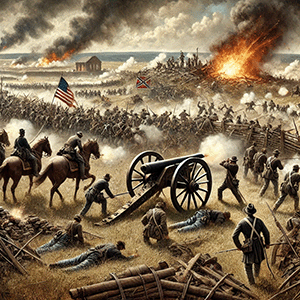
As dawn broke on July 3, 1863, both Union and Confederate forces braced for what they knew could be a decisive day. General Robert E. Lee, commanding the Confederate Army, and General George G. Meade, leading the Union forces, prepared their troops for a final, climactic clash. Lee, undeterred by the setbacks of the previous days, was determined to break through the Union lines.
The early hours saw significant cavalry skirmishes to the east and south of Gettysburg. Confederate cavalry, led by General J.E.B. Stuart, attempted to outflank the Union positions, while Union cavalry, under General David McMurtrie Gregg, sought to thwart these maneuvers. These engagements, though smaller in scale, were crucial in shaping the day’s larger confrontations by preventing Confederate forces from exploiting any potential weaknesses in the Union lines.
Around 1 p.m., a massive Confederate artillery barrage commenced, targeting the center of the Union line on Cemetery Ridge. Over 150 Confederate cannons roared to life, aiming to weaken the Union defenses in preparation for an infantry assault. Union artillery responded in kind, creating a deafening and devastating exchange that lasted nearly two hours. The bombardment caused significant casualties and destruction but failed to achieve its intended purpose of softening Union defenses sufficiently.
The highlight of the third day was undoubtedly Pickett’s Charge, a bold and desperate Confederate assault. Planned by General Lee and executed by divisions under Generals George Pickett, James Pettigrew, and Isaac Trimble, the charge aimed to pierce the Union center. Around 3 p.m., approximately 12,500 Confederate soldiers emerged from the woods and began their fateful march across open fields toward Cemetery Ridge.
Despite the courage displayed by the Confederate troops, the charge faced insurmountable challenges. Union artillery and infantry, well-positioned and fortified, unleashed a relentless barrage of cannon and rifle fire. As the Confederates advanced, their lines were decimated by the withering fire. Only a fraction of the attacking force reached the Union line, and those who did were quickly overwhelmed.
The failure of Pickett’s Charge marked a devastating blow to Confederate hopes. The assault resulted in over 50% casualties among the attacking forces and shattered the morale of Lee’s army. Union defenders, led by General Winfield Scott Hancock, had held firm, ensuring the Union line remained unbroken.
General Lee’s decision to launch Pickett’s Charge has been the subject of much historical debate. Critics argue that the assault was a costly mistake, reflecting Lee’s overconfidence and underestimation of Union strength. Conversely, General Meade’s defensive strategy, characterized by strategic positioning and effective use of artillery, played a crucial role in repelling the Confederate assault and securing a Union victory.
With the failure of Pickett’s Charge, the Battle of Gettysburg effectively came to an end. Lee, recognizing the futility of further attacks, began preparations for a retreat. The Union army, though exhausted and battered, remained in control of the battlefield. The three-day battle resulted in approximately 51,000 casualties, making it one of the bloodiest engagements in American history.
The events of July 3, 1863, had far-reaching consequences. The defeat at Gettysburg marked the end of Lee’s invasion of the North and a turning point in the Civil War. The Union victory bolstered Northern morale and weakened the Confederate war effort. In the years that followed, the third day of Gettysburg became a symbol of courage, sacrifice, and the high stakes of the Civil War.
The third day of the Battle of Gettysburg remains one of the most studied and significant episodes in American military history. The combination of strategic decisions, intense combat, and the bravery of soldiers on both sides created a day that would shape the course of the Civil War and the future of the United States.



 DAVE DOES HISTORY
Leave a comment