
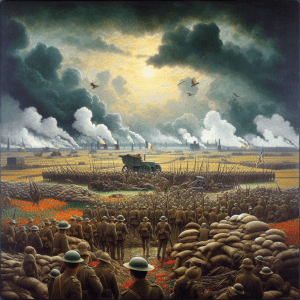
 The Battle of the Somme, one of the most infamous and devastating battles of World War I, commenced on July 1, 1916. Marked by immense casualties and a strategic stalemate, the first day of the battle remains etched in history for its scale of human loss and the brutal reality of trench warfare. This article delves into the background, strategic situation, forces involved, and the harrowing events of the first day’s action.
The Battle of the Somme was conceived against the backdrop of a prolonged stalemate on the Western Front. By 1916, the Allies and Central Powers had been locked in trench warfare for nearly two years, with neither side able to secure a decisive breakthrough. The Allies, particularly the British and French, aimed to break this deadlock with a major offensive.
The primary objectives of the Battle of the Somme were threefold: to break through the heavily fortified German lines, relieve the beleaguered French forces at Verdun, and inflict substantial casualties on the German Army. The Germans, anticipating an offensive, had fortified their positions with deep trenches, bunkers, and an extensive network of barbed wire, creating formidable defensive lines.
The British Expeditionary Force (BEF), under the command of General Sir Douglas Haig, spearheaded the offensive. The BEF comprised regular soldiers, Territorial units, and the newly formed Kitchener’s Army, which consisted of volunteers responding to Lord Kitchener’s call to arms. The French Army, commanded by General Ferdinand Foch, supported the British in the southern sector of the battlefield, adding depth and strength to the Allied assault.
Facing the Allies was the German Second Army, commanded by General Fritz von Below. The Germans had spent months preparing their defenses, creating a labyrinth of trenches, dugouts, and fortified positions that posed significant challenges to any attacking force.
The Allies spent a week prior to the assault bombarding the German lines with an unprecedented artillery barrage, aiming to destroy the German defenses and clear the way for the infantry. Despite the intensity of the bombardment, many German positions remained intact, as the deep dugouts provided effective shelter.
Allied trench raids and reconnaissance missions sought to gather intelligence and weaken German defenses further. Logistically, the Allies amassed vast quantities of ammunition, supplies, and troops in preparation for the assault.
The German defenders were well-prepared, having constructed deep and interconnected trench systems reinforced with concrete bunkers and extensive barbed wire entanglements. Their defensive strategy relied on the depth and resilience of these fortifications, coupled with well-positioned machine gun nests and artillery batteries.
The British artillery bombardment began on June 24, 1916, and lasted seven days. Despite firing over 1.5 million shells, the bombardment failed to destroy the German defenses as intended. Many shells were duds, and the deep German dugouts provided effective protection against the artillery onslaught.
At 7:30 AM on July 1, 1916, the Allied infantry, laden with heavy packs and equipment, went “over the top” and advanced across no man’s land. The British and French troops faced immediate and devastating machine gun fire as they emerged from their trenches.
The advance on Beaumont-Hamel saw the British troops suffer catastrophic losses as they were mowed down by German machine guns. Similarly, the attack on Thiepval met with fierce resistance and resulted in heavy casualties. In the southern sector, the struggle for Mametz and Fricourt saw some limited success, with the British managing to capture and hold some German positions, albeit at a high cost.
The first day of the Battle of the Somme was marked by staggering casualties. The British suffered approximately 57,470 casualties, including 19,240 killed, making it the bloodiest day in British military history. French and German casualties were also significant, though not as severe as those of the British.
Despite the immense sacrifice, the Allies achieved minimal territorial gains. Some sectors, like Mametz and Montauban, saw modest successes, but overall, the first day’s objectives were not met, and the hoped-for breakthrough did not materialize.
The immediate aftermath of the first day saw the Allies reeling from the scale of their losses. Morale among the troops was severely affected, and there was public outcry back home in Britain. Strategically, the failure to achieve a breakthrough forced the Allies to reconsider their tactics and adapt their approach for the continued offensive.
The Battle of the Somme continued for another 140 days, ultimately resulting in over a million casualties on both sides. The first day set the tone for the brutal and attritional nature of the battle. The Somme’s legacy is a poignant reminder of the horrors of World War I and the profound human cost of trench warfare.
The first day of the Battle of the Somme stands as a testament to the courage and sacrifice of the soldiers who fought amidst unimaginable adversity. While the tactical gains were minimal, the strategic and human impact of that day continues to resonate in history. Reflecting on the events of July 1, 1916, underscores the profound significance of the Battle of the Somme in the broader context of World War I and military history.




 DAVE DOES HISTORY
Leave a comment