
The Battle of Sullivan’s Island, fought on June 28, 1776, stands as a pivotal moment in American Revolutionary history. This battle not only marked a significant victory for the American forces but also laid the foundation for what is now celebrated as Carolina Day, a unique South Carolina holiday commemorating this historic event.
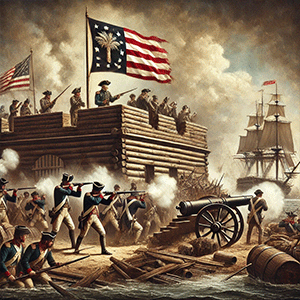
As tensions between the American colonies and British crown escalated into open conflict, the strategic importance of key locations became increasingly evident. Charleston, South Carolina, with its vital port and defensive potential, was a prime target for the British. Control of Charleston meant control over a significant portion of the Southern colonies. In early 1776, British forces set their sights on Charleston, believing a swift victory there would quash the rebellion in the South and secure their dominance.
The battle commenced on June 28, 1776, with British naval forces launching a full-scale assault on the American defenses at Sullivan’s Island. Colonel William Moultrie led the American forces, bolstered by General Charles Lee’s strategic insights. Opposing them was Sir Peter Parker, commanding a formidable British fleet.
The British plan was to bombard and breach Fort Sullivan, a hastily constructed fortification primarily built from palmetto logs and sand. The palmetto logs, however, proved remarkably effective at absorbing and deflecting the cannon fire. As the British ships struggled against the fort’s resilient defenses and the treacherous shoals surrounding the island, American forces, undeterred, launched a fierce counterattack.
Fort Sullivan, later renamed Fort Moultrie in honor of Colonel Moultrie, was crucial to the American defense. Despite being outgunned and facing a superior naval force, the American defenders utilized the fort’s unique construction to their advantage. The spongy palmetto logs absorbed the impact of British cannonballs, preventing significant damage and preserving the integrity of the fort.
The British fleet, hampered by navigational challenges and underestimating the American resolve, encountered numerous setbacks. The shallow waters and hidden sandbars trapped several ships, rendering them easy targets for the American cannons. After a grueling day of battle, the British forces, unable to breach the fort, were forced to withdraw, marking a decisive victory for the American defenders.
The Battle of Sullivan’s Island was a critical boost to American morale. The victory demonstrated that the colonial forces could effectively resist and defeat the might of the British military. This triumph came at a crucial time, bolstering the confidence of the Continental Congress and the American public. The British, on the other hand, were forced to reassess their strategy and expectations regarding the rebellion in the Southern colonies.
Carolina Day commemorates this historic victory and honors the bravery and resilience of the American defenders. The holiday’s origins trace back to the early 19th century when South Carolinians sought to preserve and celebrate their revolutionary heritage. June 28 was chosen to mark the anniversary of the battle, and over the years, the day has evolved into a significant cultural and historical event.
Today, Carolina Day is celebrated with a variety of events and activities that pay tribute to the battle and its participants. Historical reenactments bring the battle to life, offering educational insights into the strategies and experiences of the time. Parades, ceremonies, and community gatherings foster a sense of pride and unity among South Carolinians. Schools and historical societies often hold special programs to educate the public about the significance of the battle and the broader Revolutionary War.
The Battle of Sullivan’s Island remains a testament to the courage and determination of the American forces during the Revolutionary War. Carolina Day serves as a reminder of this pivotal moment in history, encouraging reflection on the sacrifices made for American independence and the enduring legacy of those who fought. As South Carolinians celebrate this day, they honor a rich heritage and reaffirm their commitment to preserving the history that defines their state and nation.



 DAVE DOES HISTORY
Leave a comment