
The First Punic War (264-241 BCE) was a monumental conflict between the two ancient superpowers of the Mediterranean: Rome and Carthage. This long and exhausting struggle was primarily fought over the control of Sicily. Rome, a rising power on the Italian peninsula, was keen on expanding its influence beyond the mainland, while Carthage, an established maritime and commercial empire, was determined to maintain its dominance in the western Mediterranean. The war saw a series of battles, both on land and at sea, with control of Sicily swinging back and forth between the two contenders.
Sicily was the central theater of the First Punic War, witnessing numerous engagements and sieges. The conflict began with Rome’s intervention in a dispute between the Sicilian cities of Messina and Syracuse, which quickly escalated into a full-blown war against Carthage for control of the island. Over the years, both sides had their victories and defeats, with key battles at Agrigentum, the capture of Corfinium, and the siege of Lilybaeum, among others. The operations on Sicily were characterized by both conventional warfare and guerrilla tactics used by the Romans and Carthaginians, respectively.
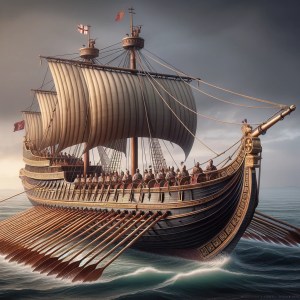 The naval aspect of the First Punic War featured innovations and the massive deployment of resources by both powers. The Carthaginians, with their established naval prowess, initially had the upper hand at sea. Their fleet mainly consisted of quinqueremes, large warships with five rows of oars, capable of carrying substantial numbers of soldiers, and equipped for ramming enemy vessels.
The Romans, initially at a disadvantage at sea, engineered their own fleet, incorporating captured Carthaginian ships as models. They developed the “corvus,” a boarding bridge that allowed their superior infantry to engage in hand-to-hand combat on board, turning sea battles into more familiar land battles.
In preparation for the decisive battle, Rome built a new fleet of 200 quinqueremes, despite the severe financial strains and losses from previous engagements. This fleet was hastily assembled and crewed largely by inexperienced sailors. However, the determination of the Roman Republic to end the conflict was evident in their substantial investment in this naval force.
The Battle of the Aegates took place on March 10, 241bce, near the Aegadian Islands, off the western coast of Sicily. The Roman fleet, commanded by Gaius Lutatius Catulus, caught the Carthaginian fleet, led by Hanno the Great, off guard. The Carthaginians were attempting to deliver supplies to their forces on Sicily. The Romans, with better ships and tactics, managed to block and decisively defeat the Carthaginian fleet. The use of the corvus was likely abandoned by this time due to its destabilizing effect on ships; however, Roman naval improvements and tactics played a crucial role in their victory.
The defeat at the Aegates Islands forced Carthage to sue for peace. The Treaty of Lutatius, signed later in 241 BCE, ended the First Punic War. Carthage agreed to evacuate Sicily, making it Rome’s first province outside the Italian peninsula. Additionally, Carthage was compelled to pay a significant indemnity to Rome over the following years, significantly weakening its economic power.
The conclusion of the First Punic War marked the beginning of Rome’s dominance in the western Mediterranean. The loss of Sicily was a significant blow to Carthage, but it managed to recover economically by expanding its influence in Spain. However, the war sowed the seeds of animosity and rivalry that would eventually lead to the Second Punic War, featuring the famous Carthaginian general Hannibal.
In recent times, marine archaeologists have explored the waters around the Aegadian Islands, uncovering remnants of the ancient battle. Shipwrecks, helmets, amphorae, and ramming rostra have been discovered, providing valuable insights into the naval warfare of the period and the scale of the battle.
The exploration of these ancient conflicts, especially through the lens of marine archaeology, continues to enrich our understanding of the ancient world, shedding light on the complexities of Mediterranean geopolitics and warfare.




 DAVE DOES HISTORY
Leave a comment