
William “Buffalo Bill” Cody was a figure larger than life, embodying the spirit of the American West in the late 19th and early 20th centuries. His life story reads like a tale of adventure, showmanship, and the changing face of the United States during a pivotal era.
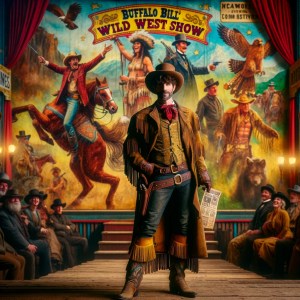 William Frederick Cody was born on February 26, 1846, in Le Claire, Iowa Territory, to Isaac and Mary Ann Cody. His family moved to Kansas in 1853, where Cody grew up amidst the violent confrontations between pro-slavery and anti-slavery forces. This tumultuous environment shaped Cody’s early experiences and honed his skills as a rider and marksman.
Cody served in the Union Army during the American Civil War, after which he worked as a scout for the U.S. Army in the Indian Wars. His skills as a scout and his bravery in action were recognized in 1872 when he was awarded the Medal of Honor for gallantry as a civilian scout in the action against the Indians at Platte River, Nebraska. However, in 1917, his Medal of Honor was revoked as part of a wider purge of medals awarded to civilians. It was posthumously restored in 1989.
Cody earned his famous nickname, “Buffalo Bill,” due to his prowess in hunting. He was contracted to supply Kansas Pacific Railroad workers with buffalo meat, reportedly killing 4,282 American bison in eighteen months from 1867 to 1868. His nickname became synonymous with his legend, embodying his deep connection to the American frontier.
In 1883, Cody founded “Buffalo Bill’s Wild West,” a show that dramatized the experiences of frontier life. It included sharpshooting, horseback riding, and reenactments of battles with Native American tribes, showcasing figures like Sitting Bull and Annie Oakley. The show toured extensively in the United States and Europe, captivating audiences and royalty alike, and significantly contributed to the romanticized image of the American West worldwide.
Cody was instrumental in the founding of Cody, Wyoming, in the 1890s, envisioning it as a gateway to Yellowstone National Park. He was involved in the development of irrigation projects, hotels, and the establishment of the Cody Stampede Rodeo, which remains a popular event. Cody, Wyoming, is a testament to his enduring influence on the American West.
Cody married Louisa Frederici in 1866, and the couple had four children, two of whom died young. Despite his extensive travels and the demands of show business, Cody’s family life was important to him, though not without its strains and challenges.
Buffalo Bill Cody died on January 10, 1917, in Denver, Colorado, of kidney failure. He was buried on Lookout Mountain, near Golden, Colorado, a site with a sweeping view of the Great Plains and the Rockies, fitting for a man who had embodied the spirit of the American West.
Cody’s legacy is a complex blend of showmanship, myth, and reality. He was a pivotal figure in shaping the global image of the American West and its culture. While his shows played a role in popularizing a certain narrative of the West, they also provided employment and visibility to many Native Americans, albeit in a context that was often simplistic and stereotypical. Today, Buffalo Bill’s life and legacy are preserved in museums, literature, and the town of Cody, Wyoming, serving as a reminder of a pivotal era in American history and the enduring allure of the West.



 DAVE DOES HISTORY
Leave a reply to Doug Thomas Cancel reply