
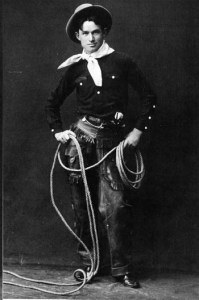
Born William Penn Adair Rogers on November 4, 1879, in the Cherokee Nation in Indian Territory (now present-day Oklahoma), Will Rogers hailed from a prominent Cherokee family. His parents, Clement Vann Rogers and Mary America Schrimsher, were both of part Cherokee descent. Young Rogers grew up with an admiration for the cowboy way of life, a theme he would later infuse into his acts and writings.
Public Domain
Will Rogers began his career performing in Wild West shows, showcasing his expert roping skills, which he had developed on his family’s ranch. He then journeyed to South Africa, performing in the circus. By the 1910s, he had become a headlining act with the Ziegfeld Follies, broadening his act to include humorous commentary on current events.
His humor and observations on life struck a chord with the American public. By the 1920s, Rogers had become a national treasure, well-regarded for his witty and insightful commentary on the nation’s social and political landscape. He would often start his monologues with the catchphrase, “All I know is what I read in the papers.”
His multi-faceted career expanded to include writing, acting, and radio. He wrote over 4,000 newspaper columns and authored several books. In the realm of cinema, he starred in 71 films (50 silent films and 21 “talkies”) and worked with directors like John Ford.
Rogers was an influential voice on the radio, where his unique blend of humor and homespun wisdom resonated with listeners across the country. His ability to comment on pressing issues with a touch of humor was unparalleled, and he could bridge divides, offering commentary that appealed to both urban intellectuals and rural folks alike.
Outside of his entertainment career, Rogers was known for his philanthropic efforts. During the Great Depression, he used his platform to advocate for aviation and drought relief. He also worked tirelessly for the Red Cross, helping to raise funds for disaster victims.
Will Rogers met an untimely death in a plane crash near Point Barrow, Alaska, on August 15, 1935. He was traveling with famous aviator Wiley Post when their plane went down. Both men perished in the crash, leaving the nation in shock.
Rogers’s impact on American culture was profound. He was not just a humorist but also a social commentator, shedding light on the intricacies and idiosyncrasies of American life. His legacy is cemented in the numerous parks, theaters, and monuments dedicated to him.
Today, the Will Rogers Memorial Museum in Claremore, Oklahoma, and the Will Rogers State Historic Park in Los Angeles, California, serve as tributes to his lasting impact. Every year on “Will Rogers Day,” admirers celebrate his contributions to American entertainment, literature, and culture.
In a world of increasing complexity and division, the words of Will Rogers still echo with a timeless relevance, reminding us of the power of humor, the importance of perspective, and the value of shared humanity.



 DAVE DOES HISTORY
Leave a comment