
Lance Armstrong, born on September 18, 1971, in Plano, Texas, catapulted into global fame with a record-breaking seven consecutive Tour de France victories from 1999 to 2005. His story wasn’t just about cycling dominance; it was a tale of resilience and comeback. After being diagnosed with testicular cancer in 1996, which then spread to his brain and lungs, Armstrong’s chances of survival were slim. Yet, he not only beat the disease but returned to professional cycling with an unmatched vengeance.
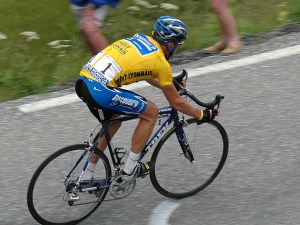
By Bjarte Hetland – Self-photographed, CC BY 3.0, https://commons.wikimedia.org/w/index.php?curid=3723883
Even as Armstrong was accumulating his Tour de France titles, murmurs of performance-enhancing drug use were never far behind. The world of professional cycling, already tainted by doping scandals, viewed Armstrong’s rapid ascent with suspicion. These doubts intensified due to his association with the controversial Italian doctor, Michele Ferrari, known for his lenient stance on doping.
In 2004, the book “L.A. Confidential: The Secrets of Lance Armstrong” was published, detailing allegations of Armstrong’s doping. It contained testimonies from former teammates and others close to Armstrong.
However, the real turning point came in 2010, when former teammate Floyd Landis, who himself was stripped of his 2006 Tour de France title due to doping, sent a series of emails to cycling officials and sponsors admitting to his own doping and accusing Armstrong and the U.S. Postal Service team of systematic doping.
This was followed by a comprehensive investigation by the United States Anti-Doping Agency (USADA). In 2012, they released a damning 1,000-page report which detailed the most sophisticated, professionalized, and successful doping program cycling had ever seen. The evidence included blood tests, financial payments, emails, and testimonies from 11 former teammates.
Armstrong vehemently denied the allegations for years. He not only rejected the claims but also aggressively pursued those who accused him, whether through lawsuits or public denunciations. His defiant stance had won him a fair share of supporters.
However, the walls started to crumble in January 2013, when Armstrong appeared on Oprah Winfrey’s television show and admitted to using performance-enhancing drugs throughout his seven Tour de France victories.
In light of the overwhelming evidence and Armstrong’s admission, on October 22, 2012, the International Cycling Union (UCI) for22mally stripped him of his seven titles and banned him from professional cycling for life.
The UCI faced a dilemma. The era during which Armstrong raced was tainted by widespread doping. Consequently, the UCI chose not to award the titles to any other rider, effectively leaving a void for those seven years. The reasoning was simple: many of those who had stood on the podium alongside or just behind Armstrong were also implicated or suspected in various doping scandals.
Lance Armstrong remains one of the most enigmatic figures in sports history. On one hand, his cancer comeback story and philanthropic efforts through the Livestrong Foundation inspired millions. On the other hand, his fall from grace and the deceit that surrounded his victories tainted not only his legacy but also the integrity of professional cycling.
Today, the cycling community remains divided. Some view Armstrong as a product of an era where doping was rampant, while others see him as the embodiment of its sins. Regardless, his story serves as a stark reminder of the lengths athletes might go to win and the cost of losing one’s way in the pursuit of glory.



 DAVE DOES HISTORY
Leave a comment