
On October 17, 1777, a pivotal moment occurred in the American Revolutionary War, reshaping the trajectory of the conflict and ultimately the future of a nation. The Battle of Saratoga, comprising two significant engagements fought 18 days apart, culminated in a decisive American victory that changed the course of history.
The British devised a plan in 1777 to cut off the rebellious New England colonies from the rest by seizing control of the Hudson River. Commanded by General John Burgoyne, a British force would march south from Canada, while another contingent led by Sir William Howe would push north from New York City. Meeting in the middle, the British believed this pincer move would quash the rebellion. However, miscommunication, misjudgments, and the resilience of the Continental Army threw a wrench in these plans.
The events at Saratoga were divided into two primary battles:
1. First Saratoga (Freeman’s Farm) – September 19: In the first engagement, the British found success against the American forces led by Horatio Gates and Benedict Arnold. Although the British won the day, their casualties were substantial, depleting their already limited manpower.
2. Second Saratoga (Bemis Heights) – October 7: Benedict Arnold, despite being removed from command, played a crucial role in the American counterattacks that pushed back the British forces. The day ended with the British retreating to their fortifications.
By October 17, after ten days of encirclement and no hope of reinforcements, Burgoyne realized the untenability of his position. With dwindling supplies and morale, he opted for a negotiated surrender.
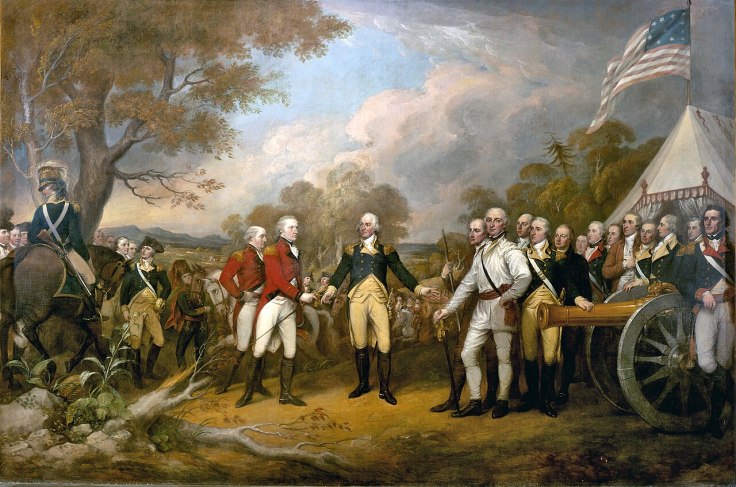
By John Trumbull – 1. United States Architect of the Capitol2. aoc.gov, Public Domain, https://commons.wikimedia.org/w/index.php?curid=1379709
The terms of the surrender were generous to the British. Known as the “Convention of Saratoga”, it stipulated that the British troops would be returned to England on the condition that they would not serve again in North America during the war. Though later the Continental Congress would void this agreement, causing tension.
Implications:
The victory at Saratoga had several profound implications:
1. Foreign Support: The most immediate and consequential result was the Franco-American Alliance in 1778. With the American victory at Saratoga as proof of their viability, France officially recognized the United States and entered the war as their ally. This drastically shifted the balance of power and expanded the war globally.
2. Boosted Morale: The win instilled confidence within the Continental Army and provided a much-needed morale boost.
3. Shift in British Strategy**: Recognizing the growing challenges of the American theater, especially with France’s entry into the war, the British began recalibrating their strategies, leading to a southern-focused campaign.
In conclusion, the events of October 17, 1777, at the Battle of Saratoga stand as a testament to the determination, resilience, and strategic acumen of the Continental Army. It was not just a battle won, but a turning point that shaped the future of the American Revolution and, by extension, the nascent United States.




 DAVE DOES HISTORY
Leave a comment