
Our exploration of Columbus Day begins on a somber note: the largest lynching in U.S. history. On March 14, 1891, in New Orleans, eleven Italian-Americans were brutally lynched by a mob, accused of the murder of the city’s police chief, David Hennessy. The lack of concrete evidence and the fevered atmosphere of anti-Italian sentiment led to this horrifying event.
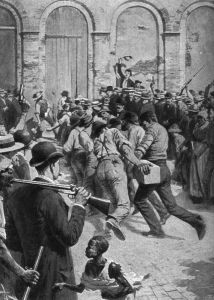
Public Domain
The lynching was more than a local tragedy; it evolved into an international incident. Italy, rightly outraged, recalled its ambassador from the U.S. The U.S., in turn, recalled its envoy from Rome. The possibility of a breakdown in diplomatic relations was real, and the incident brought to light the discrimination Italian-Americans faced.
Amidst these tensions, President Benjamin Harrison saw an opportunity for healing and unity. He declared the first national celebration of Columbus Day in 1892. Harrison aimed to placate the Italian government and the outraged Italian-American community. By celebrating Christopher Columbus, an Italian who “discovered” America, Harrison subtly aimed to recognize the Italian community’s significance in America.
Fast forward to the 1930s, Generoso Pope, an influential Italian-American businessman and publisher, played a pivotal role in further institutionalizing Columbus Day. Leveraging his media empire, Pope campaigned vigorously, leading to Congress passing a statute in 1937. This culminated with President Franklin D. Roosevelt proclaiming October 12th as Columbus Day.
The post-WWII era saw another push to elevate Columbus Day. Mariano A. Lucca and the National Columbus Day Committee tirelessly advocated throughout the 1950s and 60s to make Columbus Day a federal holiday. Their efforts bore fruit in 1968 when President Lyndon B. Johnson signed the Uniform Monday Holiday Act, designating the second Monday of October as Columbus Day.
For decades, Columbus Day has been a source of pride for Italian-Americans. Parades, feasts, and gatherings are common, with major cities like New York and San Francisco hosting grand events. Italian flags fly side by side with American stars and stripes, songs fill the air, and the history and contributions of Italian-Americans are celebrated.
While Columbus Day started as a way to ease national and international tensions, it grew to be a true celebration of Italian-American heritage. However, like many historical celebrations, it isn’t without controversy, especially from indigenous communities. As we reflect on its history, we must also remain open to dialogue about its broader implications and meaning in today’s diverse America.



 DAVE DOES HISTORY
Leave a comment