
The Battle of Cheat Mountain, fought on September 9, 1861, was a significant early engagement in the American Civil War, taking place in present-day West Virginia. It pitted Union forces, led by General George B. McClellan, against Confederate troops commanded by Brigadier General Robert E. Lee. This battle was part of the larger Western Virginia Campaign, which aimed to secure the region for the Union and prevent it from seceding along with the rest of Virginia.
In the early months of the Civil War, Western Virginia had a different demographic and political makeup compared to the eastern part of the state. The region was home to a significant number of Unionists and those opposed to secession. As a result, many Western Virginians wanted to remain loyal to the United States. Recognizing this, the Union sought to secure the area and maintain control of the important Baltimore and Ohio Railroad and the Kanawha River, vital transportation routes in the region.
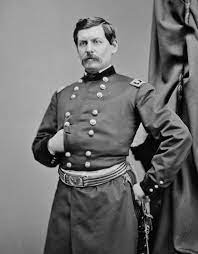
Public Domain
Union forces, numbering around 5,000 men, were commanded by General George B. McClellan. McClellan, who would later become a prominent Union general, was tasked with leading the Army of the Kanawha. His Confederate counterpart, Brigadier General Robert E. Lee, was still in the early stages of his military career but had already gained recognition for his abilities.
The battle at Cheat Mountain primarily centered around the Confederate position at the pass known as “Cheat Summit Fort.” This location was strategically important because it controlled the road and rail routes through the region. General Lee ordered Colonel Albert Rust to defend Cheat Summit Fort, while other Confederate forces were stationed in nearby positions.
McClellan’s Union forces initiated their attack on September 9, 1861, with the objective of capturing Cheat Summit Fort. The engagement featured several skirmishes and fighting at various points along the Cheat Mountain range. The terrain was challenging, with dense forests and rugged mountainsides, making movement difficult for both sides.
Despite initial Union successes and determined Confederate resistance, the battle ultimately resulted in a stalemate. The Union forces were unable to capture Cheat Summit Fort, and Lee’s Confederates held their ground. In the aftermath, both sides dug in, fortifying their positions.
While the Battle of Cheat Mountain itself did not produce a clear victor, it was a psychological win for the Union. McClellan’s reputation as a capable general grew, and his army remained in control of key transportation routes in Western Virginia. The conflict in the region continued, ultimately culminating in the creation of the separate state of West Virginia in 1863, which remained loyal to the Union throughout the Civil War.
The Battle of Cheat Mountain, though not a major engagement in terms of casualties or territory gained, played a crucial role in securing Western Virginia for the Union and preventing it from seceding with the rest of the state. It was an early indicator of the military prowess that both McClellan and Lee would exhibit in the years to come during the Civil War.
Also on September 9, 1861, during the early stages of the American Civil War, Union forces occupied the city of Lexington, Kentucky. This event was part of the broader context of the Civil War’s Western Theater, where both Union and Confederate forces sought to control strategically important regions and gain the support of border states like Kentucky.
Kentucky was a border state during the Civil War, meaning it had both Unionist and Confederate sympathizers. The state’s neutrality was tenuous, and both sides recognized the importance of securing Kentucky for various reasons, including its geographic location, resources, and transportation networks.
Union forces, under the command of Major General William “Bull” Nelson, occupied Lexington. Nelson was a staunch Unionist and played a significant role in maintaining Union control in Kentucky.
The occupation of Lexington by Union forces in September 1861 was relatively peaceful compared to many other Civil War actions. The city did not experience significant battles or military confrontations during this period. Instead, Union troops entered Lexington without much resistance, and their presence aimed to assert Union control and maintain order.
The occupation of Lexington was notable for several reasons:
1. Strategic Location: Lexington’s geographic location made it strategically important. It was a hub for transportation and communication routes, including roads, railroads, and telegraph lines, which made it valuable for both sides.
2. Political Significance: Kentucky’s government officially declared neutrality at the outbreak of the Civil War, but this neutrality was difficult to maintain. Unionist sentiments were strong in some areas, including Lexington, while Confederate sympathies existed elsewhere. The Union occupation helped solidify control in this pro-Union part of the state.
3. Resource and Recruitment Center: Lexington was a significant center for recruiting Union troops in Kentucky. The Union presence there allowed for the enlistment and organization of local troops and support for the Union war effort.
4. Symbolic Value: The Union occupation of Lexington sent a message to both the citizens of Kentucky and the Confederacy that the federal government was willing to exert its authority and maintain control over key areas within the state.
5. Maintaining Stability: Although the occupation was generally peaceful, it aimed to prevent any pro-Confederate uprisings or military actions in the region. The presence of Union troops helped maintain stability in Lexington and deterred Confederate sympathizers from taking action.
The Union occupation of Lexington continued for several months, helping to maintain a pro-Union presence in this part of Kentucky. However, the situation in Kentucky remained complex throughout the war, with shifting loyalties and military actions taking place in different areas of the state.
In subsequent years, Kentucky would become a contested battleground as both Union and Confederate forces vied for control. The Civil War in Kentucky reflected the broader complexities of a border state during this tumultuous period in American history.
These events from September 9, 1861, reflect the ongoing conflict and military operations of the American Civil War, which was a defining period in American history.



 DAVE DOES HISTORY
Leave a comment