
On August 2, 1943, during the height of World War II in the Pacific Theater, a tragic and heroic incident occurred in the Solomon Islands: the sinking of the motor torpedo boat PT-109. This event would later become a symbol of courage, leadership, and resilience, largely due to the actions of its commanding officer, Lieutenant John F. Kennedy, who would go on to become the 35th President of the United States.
PT-109, designated as Motor Torpedo Boat (MTB) PT-109, was one of several patrol torpedo boats employed by the United States Navy during World War II. These PT boats were small, fast vessels designed to engage enemy ships and conduct various naval operations, particularly in the shallow waters and narrow straits of the Pacific islands.
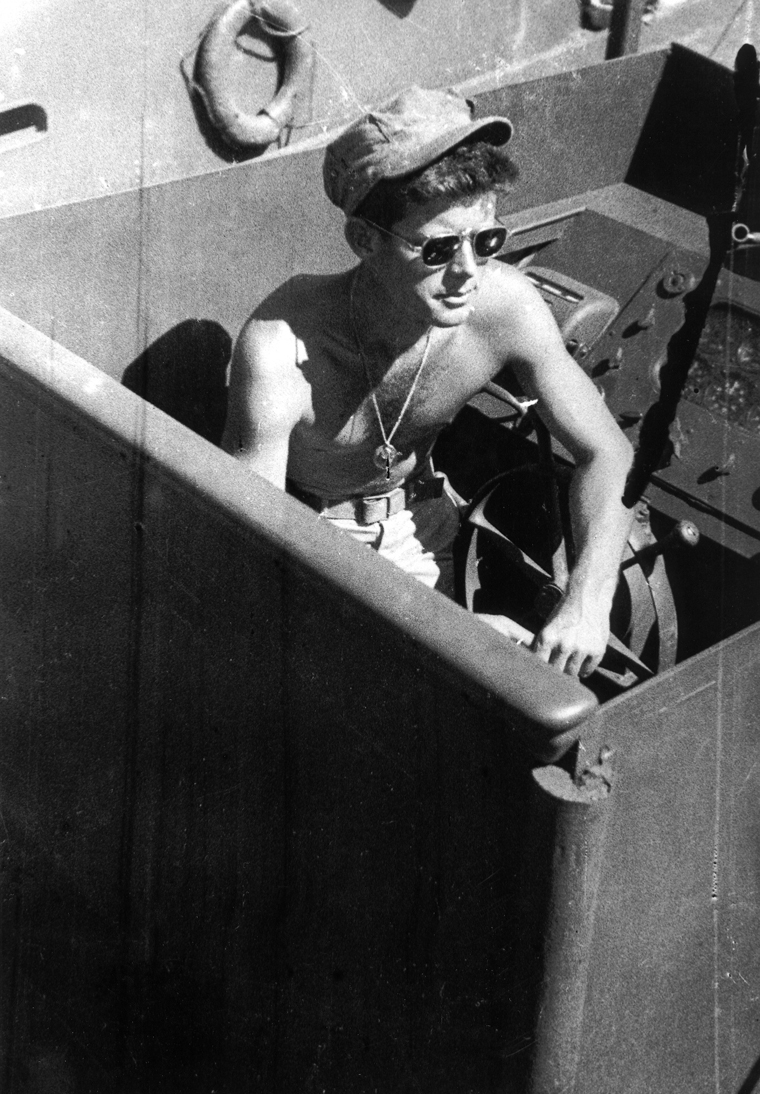
Photograph in the John F. Kennedy Presidential Library and Museum, Boston.
Lieutenant John F. Kennedy, a young and charismatic naval officer, was assigned to command PT-109 in the South Pacific. PT-109 was part of Motor Torpedo Boat Squadron 2 (MTBRON 2), stationed in the Solomon Islands. Kennedy and his crew of 12 enlisted men undertook various missions, including night patrols and reconnaissance.
On the night of August 2, 1943, while PT-109 was patrolling the waters near the Solomon Islands, it encountered a Japanese destroyer, Amagiri. In a deadly collision, the larger and faster Japanese destroyer struck PT-109, splitting the smaller boat in two. The force of the impact threw several crew members into the water, and PT-109 quickly sank.
Despite suffering injuries, Kennedy displayed remarkable leadership and presence of mind in the chaotic aftermath of the collision. He began organizing the survivors, many of whom were injured and disoriented, and led them to the wreckage floating in the water. After a head count, Kennedy realized that two crew members were unaccounted for and, despite his own injuries, dove into the water to search for them.
For the next several hours, Kennedy and the survivors clung to the floating wreckage, hoping to be rescued. They faced many challenges, including exhaustion, dehydration, and exposure to the elements. Kennedy displayed exceptional courage and resourcefulness, fashioning a makeshift life raft by lashing together pieces of floating wreckage. He also used a coconut shell as a makeshift scoop to gather rainwater to quench their thirst.
On August 8, 1943, after six days of struggle and survival, Kennedy and his crew were finally rescued by native Solomon Islanders who had been alerted to their presence by a message etched into a coconut shell and delivered to an Australian coastwatcher.
The heroic actions of Lieutenant John F. Kennedy and the crew of PT-109 were later recognized and lauded. Kennedy was awarded the Navy and Marine Corps Medal for his leadership and heroism during the ordeal. The incident also brought him national attention, which ultimately played a role in his political career, leading to his election as a U.S. Congressman and, later, as President of the United States.
The sinking of PT-109 on August 2, 1943, was a tragic event that showcased the bravery, determination, and leadership of its young commanding officer, Lieutenant John F. Kennedy. His actions and the survival of his crew in the face of great adversity are an inspiring tale of heroism and resilience during one of the darkest periods in world history. The sinking of PT-109 and its aftermath remain an enduring symbol of courage and sacrifice, forever etched into the annals of naval and military history.




 DAVE DOES HISTORY
Leave a comment