
The 9th of Av, also known as Tisha B’Av, is a significant date in the Jewish calendar and holds great historical and religious importance for the Jewish people. It is observed on the ninth day of the Hebrew month of Av, which usually falls in July or August of the Gregorian calendar. The day is marked by fasting, mourning, and commemoration of various tragic events in Jewish history that occurred on or around this date.
1. Destruction of the Temples: The primary event commemorated on the 9th of Av is the destruction of the First and Second Temples in Jerusalem. The First Temple, built by King Solomon, was destroyed by the Babylonians in 586 BCE. The Second Temple, constructed after the return from the Babylonian exile, was destroyed by the Romans in 70 CE. Both temples were central to Jewish worship, and their destruction resulted in the dispersion of the Jewish people and the beginning of the long exile from the land of Israel.
The destruction of the First Jewish Temple in Jerusalem, also known as Solomon’s Temple, is a significant event in Jewish history. The temple’s destruction marked the end of the First Temple period and led to the dispersion of the Jewish people and the beginning of the Babylonian exile. The events leading to the temple’s destruction are recounted in the Hebrew Bible, particularly in the books of 2 Kings, 2 Chronicles, and Jeremiah.
The First Temple was built by King Solomon in the 10th century BCE on Mount Moriah in Jerusalem. It served as the central place of worship and sacrifice for the Jewish people and housed the Ark of the Covenant, which contained the Ten Commandments. The temple became the religious and spiritual center of the Jewish nation, a symbol of God’s presence among His chosen people.
The deterioration of the kingdom of Israel and the kingdom of Judah, following the death of King Solomon, led to political instability and moral decline. Both kingdoms experienced internal strife, idol worship, and disobedience to God’s laws, as described in the biblical texts.
In 722 BCE, the Assyrians invaded and conquered the northern kingdom of Israel, leading to the dispersion of the ten northern tribes. The southern kingdom of Judah, with Jerusalem as its capital, remained standing but continued to face internal challenges.
In 586 BCE, the Babylonians, led by King Nebuchadnezzar II, besieged Jerusalem. The siege lasted for several months, during which the city faced severe food shortages and hardships. The Babylonians eventually breached the walls of Jerusalem and captured the city.
On the 9th of Av (Tisha B’Av) in 586 BCE, the Babylonian forces destroyed the First Temple. The biblical account describes how the Babylonian soldiers set fire to the temple, including its magnificent furnishings and sacred artifacts. The Ark of the Covenant, along with other treasures, was looted and taken away.
The destruction of the First Temple marked a profound and tragic turning point in Jewish history. Thousands of Israelites were killed during the siege and the subsequent destruction, while many others were taken captive and exiled to Babylon. This period of exile is known as the Babylonian Captivity or Babylonian Exile.
During their exile, the Jewish people faced significant challenges to their faith, identity, and cultural practices. However, their religious and spiritual traditions survived and thrived even in foreign lands. The longing for the restoration of Jerusalem and the rebuilding of the Temple became central themes in Jewish prayers, liturgy, and literature during this period.
The destruction of the First Temple is a deeply significant event in Jewish memory, and it continues to be commemorated annually on the 9th of Av. It stands as a reminder of the consequences of moral decline, disobedience to God, and the enduring longing for the rebuilding of the Temple and the restoration of the Jewish people to their ancestral homeland.
The destruction of the Second Jewish Temple in Jerusalem is a pivotal event in Jewish history and is traditionally commemorated on the 9th of Av (Tisha B’Av). The Second Temple period began after the return of the Jewish people from the Babylonian exile and lasted until its destruction by the Romans in 70 CE.
The Second Temple was constructed under the leadership of Zerubbabel and later expanded and renovated by King Herod the Great. It served as the central place of worship and sacrifice for the Jewish people, replacing the First Temple that was destroyed by the Babylonians in 586 BCE.
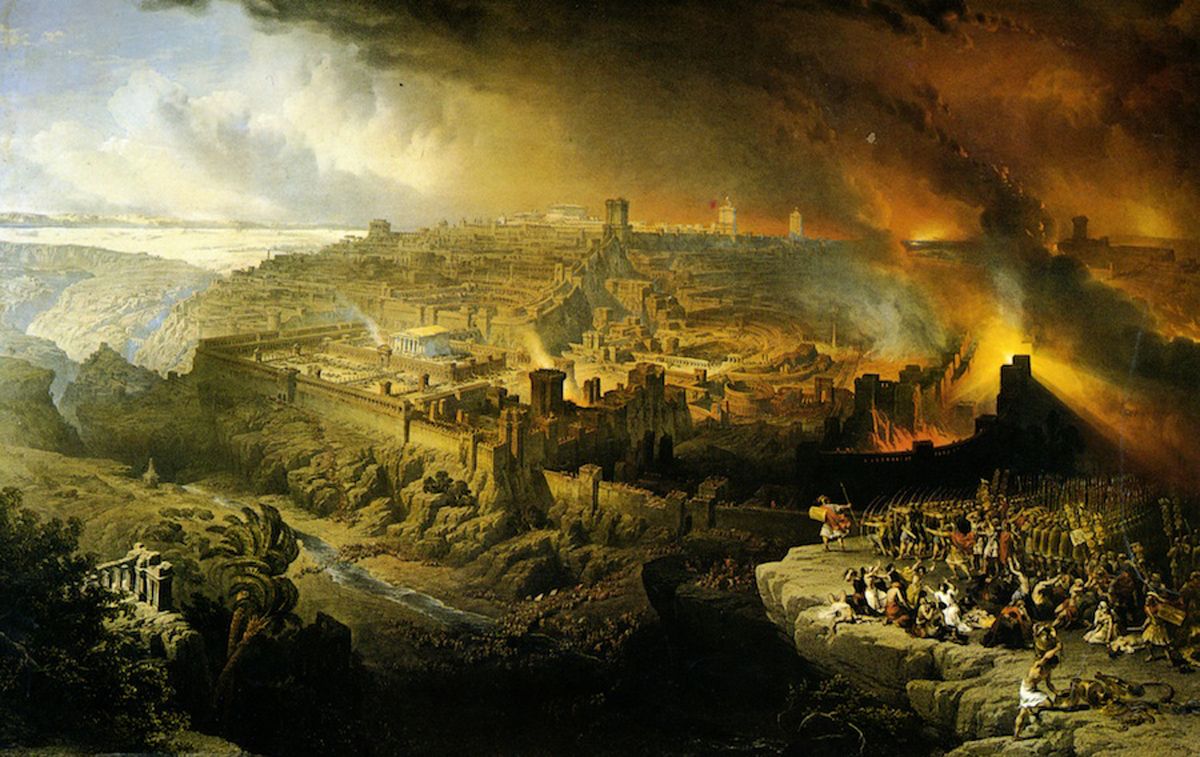
(David Roberts 1850 Collection of Yeshiva University Museum)
The Second Temple period was characterized by various political, social, and religious tensions. While the temple remained the spiritual center of the Jewish people, it was also influenced by the shifting tides of regional power.
During this period, Judea was under Roman rule, and the presence of Roman soldiers and officials in Jerusalem led to increasing tensions between the Jewish population and the occupying forces. Additionally, political divisions and internal strife among various Jewish factions further destabilized the region.
The Zealots, a group of Jewish rebels, rose against Roman authority, leading to a series of uprisings and armed conflicts. In 66 CE, the Great Jewish Revolt erupted, and the Zealots managed to temporarily gain control of Jerusalem, driving out the Roman forces.
In response to the rebellion, the Roman emperor Nero dispatched his general, Vespasian, to crush the Jewish revolt. Vespasian’s son, Titus, led the Roman forces in the siege of Jerusalem.
In 70 CE, after a grueling siege that lasted several months, the Roman legions breached the walls of Jerusalem and entered the city. They quickly overpowered the Zealot defenders and gained control of the Temple Mount.
Titus gave orders to destroy the Second Temple, intending to crush Jewish resistance and demoralize the Jewish population. The Roman soldiers set fire to the temple, resulting in its complete destruction. The Ark of the Covenant and other sacred artifacts were lost, mirroring the fate of the First Temple.
The destruction of the Second Temple marked a turning point in Jewish history. Thousands of Jewish people were killed during the siege and the destruction of Jerusalem, while many others were taken as slaves or captives. The event is traditionally considered the beginning of the Jewish Diaspora, a period of dispersion and exile that continues to shape Jewish history to this day.
The loss of the Second Temple deeply affected the religious and cultural practices of Judaism. The centrality of animal sacrifice, which was a fundamental part of temple worship, was no longer possible. In response, Judaism underwent significant transformation, with a greater emphasis on prayer, Torah study, and synagogue-based worship.
2. The Sin of the Spies: According to Jewish tradition, on the 9th of Av, the spies sent by Moses to scout the Promised Land returned with a negative report, causing the Israelites to lose faith in God’s promise and resulting in their wandering in the desert for forty years. The date is seen as a reminder of the consequences of doubt, lack of faith, and the missed opportunity to enter the land of Israel.
3. Other Historical Tragedies: In addition to the destruction of the Temples and the incident of the spies, several other tragic events in Jewish history are believed to have occurred on or near the 9th of Av. These include the crushing of the Bar Kokhba revolt by the Romans in 135 CE, leading to further Jewish exile and persecution. It is also said that the expulsion of Jews from England in 1290 and from Spain in 1492 happened around this time.
4. Commemoration of Jewish Suffering: The observance of Tisha B’Av serves as a solemn reminder of the long history of Jewish suffering, persecution, and displacement. It is a day of mourning for the losses endured by the Jewish people and a time for reflection on the challenges and resilience of Jewish history.
5. Modern-Day Significance: While the tragedies associated with Tisha B’Av happened centuries ago, the day remains relevant to modern Jewish identity. It is a day of unity, as Jews worldwide come together to mourn and remember their shared history. It also serves as a reminder of the importance of Jewish solidarity and the preservation of Jewish culture, tradition, and faith.
Overall, the significance of the 9th of Av lies in its remembrance of historical tragedies, particularly the destruction of the Temples in Jerusalem, and its role in shaping Jewish identity, fostering a sense of collective memory, and promoting unity within the Jewish community.




 DAVE DOES HISTORY
Leave a comment