
The Space Shuttle Atlantis, a symbol of human ingenuity and technological achievement, was one of NASA’s most iconic spacecraft. Throughout its storied history, Atlantis played a significant role in the United States’ space exploration efforts, contributing to numerous scientific discoveries and space missions. This essay delves into the history of the Space Shuttle Atlantis, highlighting its missions, achievements, and its legacy in shaping the future of space exploration.
The construction of the Space Shuttle Atlantis began in 1979 as part of NASA’s Space Shuttle program, a revolutionary initiative designed to create a reusable spacecraft capable of ferrying astronauts and cargo to and from Earth’s orbit. Atlantis was the fourth shuttle built and the last to be commissioned, taking its first flight on October 3, 1985.
Its inaugural mission, STS-51J, marked a resounding success for the shuttle program, deploying two communications satellites into orbit. Throughout its early missions, Atlantis played a crucial role in launching various scientific satellites, conducting research experiments, and supporting the construction and maintenance of the International Space Station (ISS).
One of the most renowned achievements of the Space Shuttle Atlantis was its role in servicing the Hubble Space Telescope (HST). In December 1993, Atlantis launched on the STS-61 mission, a daring venture to repair and upgrade the Hubble’s optical systems. During subsequent servicing missions, Atlantis and its crew made several critical upgrades to the telescope, enhancing its capabilities and extending its lifespan. These missions significantly expanded our understanding of the cosmos, as the HST continues to capture awe-inspiring images and invaluable scientific data.
Atlantis played a vital role in assembling and resupplying the International Space Station (ISS), a collaborative effort involving multiple countries. Its missions involved delivering modules, laboratory facilities, and equipment to the ISS, enabling astronauts to conduct groundbreaking research in microgravity. Atlantis’ last ISS mission, STS-132, took place in May 2010, marking the completion of its 32nd flight.
The Space Shuttle Atlantis, like other shuttles, faced significant challenges and tragedies during its operational lifespan. The loss of the Space Shuttle Challenger in January 1986 and the Space Shuttle Columbia in February 2003 cast a shadow over the entire shuttle program, prompting NASA to reassess safety protocols and implement extensive improvements.
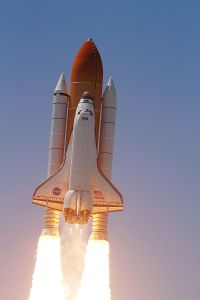
(NASA)
The Return to Flight mission for Atlantis, STS-115, was delayed due to these tragedies but ultimately took place in September 2006, resuming the shuttle program’s vital role in space exploration.
As the final Space Shuttle program approached its conclusion, Atlantis was selected to perform the program’s last mission. On July 8, 2011, Atlantis embarked on STS-135, transporting essential supplies to the ISS and leaving a lasting legacy as the last shuttle to launch.
After its final mission, returning to Earth on July 20, 2011, Atlantis was retired from active service and was put on display at the Kennedy Space Center Visitor Complex in Florida. It serves as a poignant reminder of the shuttle program’s achievements and the dedication of the astronauts and scientists who contributed to its success.
The Space Shuttle Atlantis played a central role in advancing space exploration, paving the way for scientific discoveries, satellite deployment, and the assembly of the International Space Station. From its early missions to the iconic Hubble Space Telescope servicing and its final flight, Atlantis’ legacy remains etched in the history of space exploration.
Though the Space Shuttle program has come to an end, Atlantis and its sister ships have left an indelible mark on humanity’s quest to understand the universe. The lessons learned from these missions continue to guide future space exploration efforts, as we aim to explore further into the cosmos and push the boundaries of human exploration. The Space Shuttle Atlantis stands as a testament to the extraordinary human spirit of exploration, innovation, and perseverance in the quest to reach for the stars.




 DAVE DOES HISTORY
Leave a comment