
NASA
The Gemini X mission was a crucial milestone in the Gemini program, NASA’s second human spaceflight program during the 1960s. Launched on July 18, 1966, Gemini X marked a significant step forward in space exploration, as it achieved numerous breakthroughs in rendezvous techniques and paved the way for future Apollo missions to the Moon. This essay delves into the objectives, achievements, and impact of the Gemini X mission, highlighting its importance in advancing human spaceflight capabilities.
The primary goal of the Gemini X mission was to demonstrate critical rendezvous and docking techniques that would be crucial for future lunar missions. NASA sought to validate the concept of performing orbital rendezvous between two spacecraft in space, which would be vital for the Apollo missions’ lunar module to dock with the command module in lunar orbit.
The Gemini X mission was crewed by two astronauts:
1. John W. Young (Command Pilot): As one of NASA’s most experienced astronauts, Young was selected to command Gemini X. Later, he would go on to fly in the Apollo program and become the ninth person to walk on the Moon during the Apollo 16 mission.
2. Michael Collins (Pilot): Collins served as the pilot for Gemini X. His role in the mission was to execute the complex rendezvous and docking maneuvers with the Agena target vehicle.
Mission Highlights:
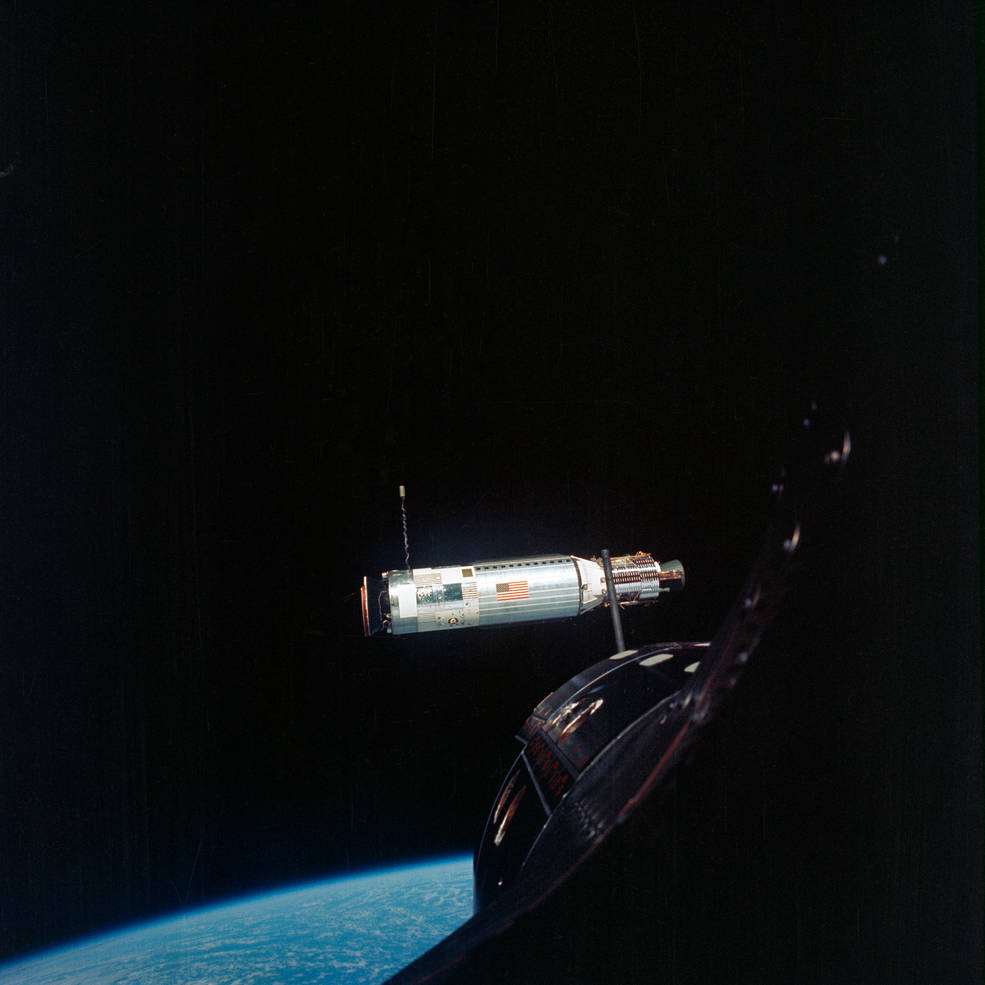
1. Agena Target Vehicle Rendezvous: Shortly after reaching orbit, the Gemini X spacecraft successfully rendezvoused with an unmanned Agena target vehicle launched separately. This crucial maneuver demonstrated the ability to rendezvous and dock in space, a prerequisite for the Apollo missions’ lunar rendezvous.
2. Docking: On the second day of the mission, the crew successfully docked with the Agena target vehicle, establishing a vital connection between the two spacecraft. This achievement showcased the feasibility of docking in space, which was essential for the future lunar module’s docking with the command module in lunar orbit.
3. EVA (Extravehicular Activity): During the mission, astronaut Michael Collins performed a spacewalk, or extravehicular activity (EVA). Collins spent over one hour outside the spacecraft, testing the capabilities of the Gemini spacesuit and conducting various tasks.
4. High-Altitude Orbit: Gemini X achieved a record-setting high-altitude Earth orbit of approximately 412 nautical miles (762 kilometers), surpassing previous Gemini missions’ maximum altitudes.
5. Ultraviolet Observations: The mission also conducted scientific experiments, including observations of ultraviolet emissions in the Earth’s atmosphere.
The success of the Gemini X mission had a profound impact on NASA’s space program, particularly the Apollo missions that followed. The mission demonstrated the practicality and viability of rendezvous and docking in space, crucial for the Apollo spacecraft to rendezvous with and retrieve the lunar module after its mission on the Moon’s surface.
The expertise gained from the Gemini X mission’s rendezvous and docking maneuvers directly contributed to the Apollo 11 mission, which achieved the first successful Moon landing in 1969. The ability to dock in space also allowed the Apollo program to bring astronauts back to Earth safely after lunar missions, a feat that would not have been possible without the Gemini X’s successful docking demonstration.
Furthermore, the mission’s spacewalk, performed by Michael Collins, provided valuable insights into the challenges and possibilities of extravehicular activity. These lessons were instrumental in planning and executing successful spacewalks during the Apollo missions and subsequent space exploration endeavors.
The Gemini X mission was a pivotal moment in human spaceflight history, proving the feasibility of rendezvous and docking in space, critical for future lunar missions. The achievements of this mission directly contributed to the success of the Apollo program, enabling astronauts to safely reach the Moon, perform lunar landings, and return to Earth. The innovative spirit and daring accomplishments of the Gemini X astronauts exemplify the unparalleled progress and determination of humanity’s quest to explore the cosmos.




 DAVE DOES HISTORY
Leave a comment