
Elbridge Gerry was one of the Founding Fathers of the United States. Born on July 17, 1744, in Marblehead, Massachusetts, Gerry’s life was marked by a deep commitment to public service, political leadership, and the pursuit of liberty and justice. From his early days as a merchant to his pivotal role in shaping the nation’s founding documents, Gerry’s contributions left an indelible mark on the course of American history.
Elbridge Gerry was the third of 12 children born to Thomas Gerry and Elizabeth Greenleaf Gerry. Raised in a wealthy and politically engaged family, Gerry received a comprehensive education, first at a private academy in Marblehead and later at Harvard College. He graduated from Harvard in 1762, displaying an early affinity for academic pursuits and intellectual pursuits that would serve him well throughout his life.
After completing his education, Elbridge Gerry entered the world of commerce, becoming a prosperous merchant and engaging in international trade. However, his interests soon shifted towards politics and public service. In the early 1770s, he became actively involved in the Patriot movement against British colonial rule.
Gerry’s political awakening coincided with the outbreak of the American Revolution. He embraced the revolutionary cause wholeheartedly and joined the Massachusetts Provincial Congress in 1774. As a delegate to the Continental Congress from 1776 to 1780, Gerry played a pivotal role in shaping the nation’s destiny during its formative years.
In the Continental Congress, Elbridge Gerry was one of the delegates who signed the Declaration of Independence on July 4, 1776. His signature symbolized his commitment to the principles of liberty, freedom, and self-governance. The Declaration’s signing marked a significant turning point in the fight for independence and the birth of the United States.
Gerry’s diplomatic skills were recognized early on, and he was appointed to various crucial diplomatic missions. He served as a delegate to the Second Continental Congress in 1776, where he played an essential role in drafting the Articles of Confederation, the country’s first constitution.
Later, Gerry became a member of the Massachusetts Constitutional Convention in 1780, where he played an instrumental role in shaping the state’s constitution. He was a strong advocate for the separation of powers and individual liberties, influencing the broader understanding of democratic governance.
Despite his significant contributions to the formation of the United States, Elbridge Gerry found himself at odds with some of his fellow Founding Fathers when it came to the ratification of the U.S. Constitution. At the Constitutional Convention of 1787, Gerry was one of the three delegates who refused to sign the final document.
His objections centered around concerns that the Constitution lacked a Bill of Rights to protect individual freedoms and that it granted too much power to the central government at the expense of the states. Gerry feared that without explicit safeguards for personal liberties, the federal government could become tyrannical.
Despite his reservations about the Constitution, Gerry remained committed to public service. He served as a delegate to the Massachusetts Ratifying Convention, where he continued to advocate for amendments that would protect individual rights. Though Massachusetts ultimately ratified the Constitution, Gerry’s insistence on the need for a Bill of Rights influenced the eventual adoption of the first ten amendments to the Constitution.
In 1789, Gerry was elected as the ninth governor of Massachusetts, a position he held from 1810 to 1812. During his governorship, he focused on fiscal responsibility and administrative efficiency, earning a reputation as a skilled and pragmatic leader.
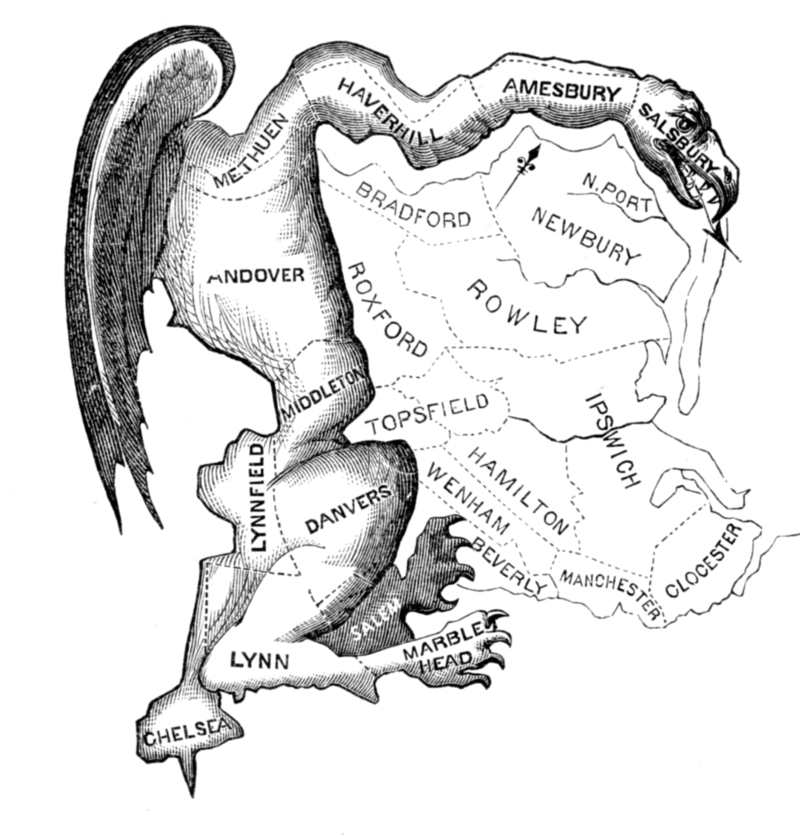
Elbridge Gerry’s legacy also includes a term that endures in American politics to this day: gerrymandering. In 1812, while serving as governor, Gerry signed a redistricting bill that sought to benefit his party, the Democratic-Republicans, by redrawing the electoral districts in the state. The new district map was criticized for its contorted shape, designed to favor Gerry’s party. A Boston Gazette political cartoonist depicted one of the new districts as a salamander, coining the term “gerrymander.”
In 1812, Elbridge Gerry was chosen as James Madison’s vice-presidential running mate. The Madison-Gerry ticket won the election, and Gerry became the fifth Vice President of the United States, serving from 1813 to 1814.
During his vice presidency, Gerry focused on the ongoing War of 1812 with Britain. He staunchly defended the war effort and championed measures to strengthen the country’s defense capabilities.
Elbridge Gerry’s political career came to a tragic end when he passed away suddenly on November 23, 1814, while still serving as Vice President. He died in Washington, D.C., leaving behind a rich legacy of public service and political leadership.
Gerry’s dedication to the principles of liberty and justice and his contributions to the founding of the United States are remembered to this day. Despite his earlier objections, the Constitution’s eventual inclusion of the Bill of Rights reflects Gerry’s commitment to protecting individual freedoms.
Although he was vice president for only a short time, Gerry’s name lives on in the political lexicon through the term “gerrymander,” a reminder of the ongoing challenges and controversies surrounding electoral redistricting in American politics.
In conclusion, Elbridge Gerry was a statesman, diplomat, and Founding Father who played a pivotal role in shaping the United States during its early years. From signing the Declaration of Independence to serving as Vice President, his dedication to the principles of liberty, democracy, and the protection of individual rights cemented his place in American history. Elbridge Gerry’s contributions to the nation’s founding continue to inspire and inform the ongoing quest for a more perfect union.



 DAVE DOES HISTORY
Leave a comment