Alexander’s inner circle was too beset by ambition and jealousy to let the matter end with Philotas’s death. Hephaestion took the floor and proposed that they torture the condemned before executing him, in order to find out who else was involved. Hephaestion, Craterus, and others tortured Philotas all night, until his will was broken. They forced him, again under torture, to give details of the alleged plot and all those involved. The following day the former commander of the Companion cavalry was stoned to death.
Paranoia, intrigue, and ambition had won the day. From that moment, there were no more trials. The ranks of the army were simply purged, leaving no one with any doubt that perceived disloyalty would be punished. Alexander knew that promotions could shore up his power. If Hephaestion had sought Philotas’s downfall to secure his own advancement, he was successful: The king made him joint commander with Cleitus the Black of the Companion cavalry, the position previously held by Philotas. Cleitus had saved Alexander’s life during the battle at Granicus and was well connected with the men who served under Alexander’s father. But, like Philotas, Cleitus had criticized Alexander’s autocratic aspirations, and Alexander wanted him where he could be easily controlled.
Following Philotas’s execution, Alexander embarked on what some scholars believe is his darkest deed. Alexander, perhaps paranoid, believed that there was no way Philotas could have plotted against him without the knowledge of his father, Parmenio. He also knew that Parmenio could act against him to avenge the death of his son. Alexander had to move fast to rid himself of the old man, whose loyalty had been questioned in Philotas’s trial. Despite a long life of trusted service to Alexander and his father before him, the old general Parmenio was now seen as a threat.
Although Parmenio had always been an influential figure, tensions had been growing. His age had made him cautious, in contrast with Alexander’s impetuousness. Their differences had led to frequent disagreements over the years on tactics and strategy. Parmenio had been put in charge of much of the empire’s wealth and strategic supply lines, a powerful position. Some historians have even suggested that the plot against Philotas was cooked up as an excuse to remove his father from power.
Parmenio was based in Ecbatana, a former summer residence of the Persian kings. Sources report that before his murder he knew nothing of the terrible fate that had befallen his son. While there was at least some semblance of a trial before Philotas’s execution, there would be no trial for his father. Parmenio was murdered by a courier sent by Alexander. Sources report that the courier handed a series of letters to Parmenio and then quickly killed him, an act carried out for political expediency alone. Alexander, determined to reassert his personal authority once and for all, also dispatched a small contingent to Ecbatana with orders to put down any rebellion that might ensue among Parmenio’s troops after his death.
Before setting out from Phrada to launch a new campaign, Alexander renamed the city Alexandria Prophthasia (Anticipation). He memorialized the city because it was there that he had anticipated Philotas’s alleged plot.
Remorse and Retreat
The deaths of two of his most trusted advisers did not soothe Alexander, whose character continued to degrade in the coming years. He continued to adopt what the Macedons saw as Persian manners, forgoing a warrior’s restraint in favor of decadence. For example, a Greek banquet represented the apogee of civilized society—a time for celebration, and discussion of philosophy and reason. Alexander’s banquets, however, had become characterized by debauchery, colored by passion and carnality.
The most notorious banquet took place in Maracanda (Samarqand) in 328 B.C. Alexander, then about age 28 and determined to reach India, was leading his reluctant army into harsh terrain in the east. That night, the great commander was drunk. A furious dispute arose between him and Cleitus the Black over Alexander’s increasingly Persian style and policies. Incensed by Cleitus’s accusations, Alexander murdered him in a rage with a javelin. Afterward, he was said to have felt great remorse: First-century A.D. Roman biographer Plutarch described in his Parallel Lives how “he spent the night and the following day in bitter lamentations, and at last lay speechless, worn out with his cries.
Alexander’s actions did little to quell opposition among his followers, and other plots arose. In 327 B.C. several of Alexander’s pages were suspected of planning to murder him. One of Alexander’s associates, the biographer and historian Callisthenes, became entangled in the plot.
Plutarch said that Callisthenes “showed great ability as a speaker, but lacked common sense.” Callisthenes had loudly glorified Alexander’s exploits, disseminating the account of his incarnation as the son of Zeus in Egypt. His writing earned him favor, but it was no match for Alexander’s ego. Alexander had adopted the Persian custom of proskynesis—prostration before the king—but Callisthenes, as a Greek, would not practice it. Alexander allowed this, but historians believe that the defiance was noted.
News of the plot surfaced, and one account seemed to seal the fate of Callisthenes. Plutarch described how one of the pages asked Callisthenes how to become “a most illustrious man.” His damning answer: “By killing the most illustrious.” None of the pages named Callisthenes as a conspirator, but the damage was done. The pages were executed. For his “crimes,” Callisthenes was imprisoned and is believed to have died in prison.
In 326 B.C., having reached the edge of India at the Hyphasis (Beas) River, Alexander’s men had had enough. They mutinied, he was forced to retreat west, and his reign would never recover. Three years later, Alexander died of fever in Babylon at age 32. On that day a Babylonian astronomer dispassionately noted in his journal: “The king died; clouds made it impossible to observe the skies.” His empire would be carved up between his generals, never to rise again.

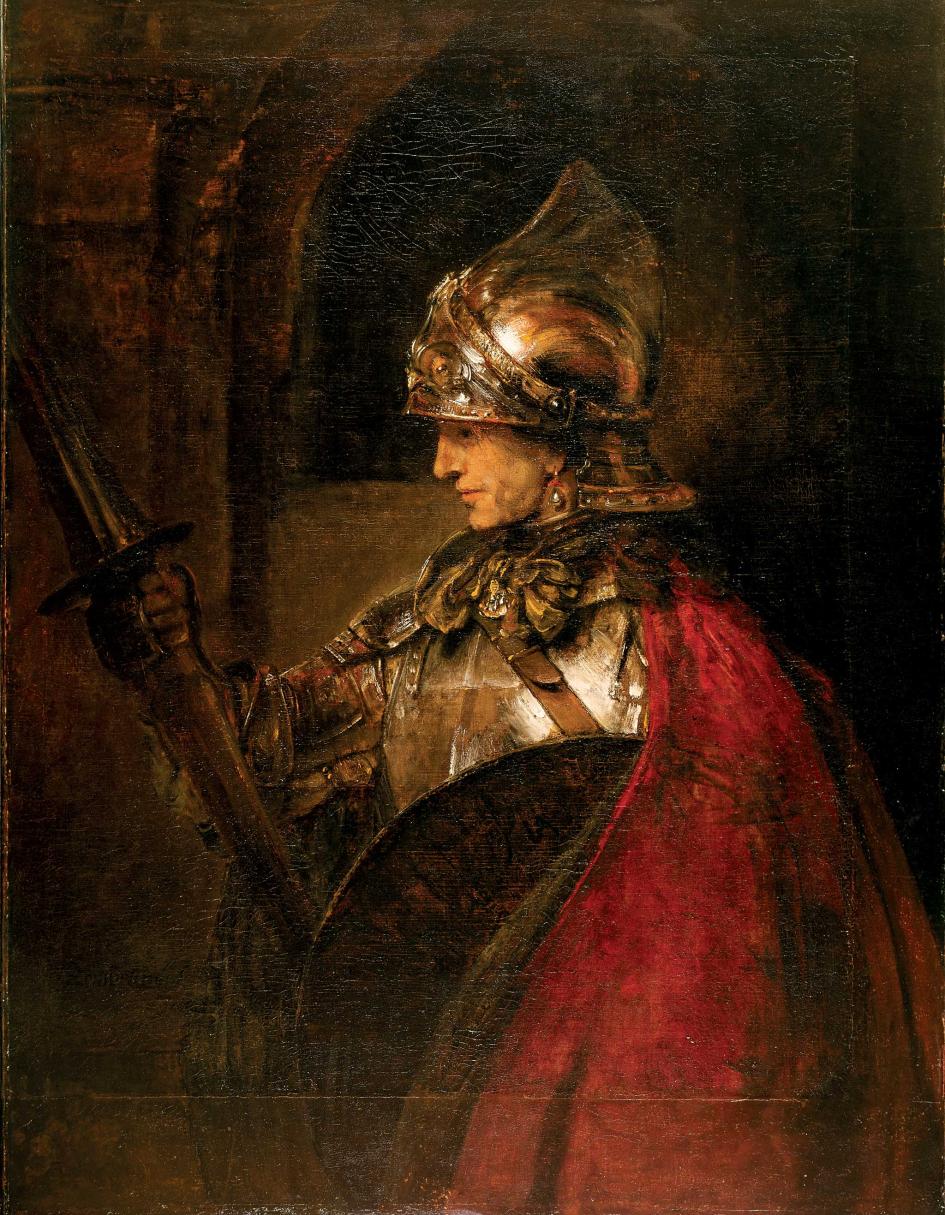 Plots of murder, both real and imagined, consumed Alexander the Great’s thoughts, turning him against former comrades in arms.



 DAVE DOES HISTORY
Leave a comment