
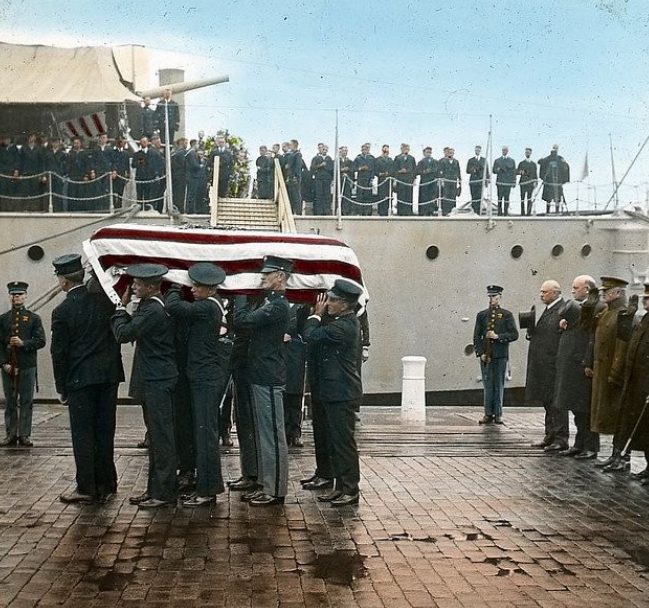
 Body bearers carry the Unknown Soldier from USS Olympia (C 6) and begin their procession to his eventual interment in Arlington National Cemetery, Nov. 9, 1921.
Source: The Ship that Carried Him: The Naval Odyssey of the Unknown Soldier | The Sextant
On the afternoon of Oct. 24, 1921, U.S. Army Sgt. Edward F. Younger paced nervously inside the city hall of Châlons-sur-Marne, France. Before him lay four caskets draped with American flags—one casket pulled from each of the American war cemeteries in France: Aisne-Maine, Meuse-Argonne, Somme, and St. Mihiel. Each casket contained the anonymous remains of an American service member killed in battle during World War I.
Younger was a twice-wounded veteran who had fought in all of the major battles of the American Expeditionary Force (AEF) during the war. For his impressive record, he was handed a bouquet of white roses and told by an American officer in charge of the detail to select an individual to become America’s Unknown Soldier.
Alone in the room, Younger wrestled with the enormous gravity of his task. After circling the caskets, he finally laid the bouquet on the third casket from the left. Younger later recalled that something drew him to that individual in particular, as if perhaps he had personally known the man.
And with that, America’s Unknown Soldier was selected, and immediately began a journey back to the United States.
From the moment he departed France, to the moment he reached his final resting place, the Unknown Soldier was escorted in some fashion by the United States Navy.
His return home was bestowed with honors like no other. The reverence and care displayed during his journey was meant to provide a sense of closure to a grieving nation. Therefore, the Navy ensured the ship that brought him back to his native soil was as grand and befitting of his status.
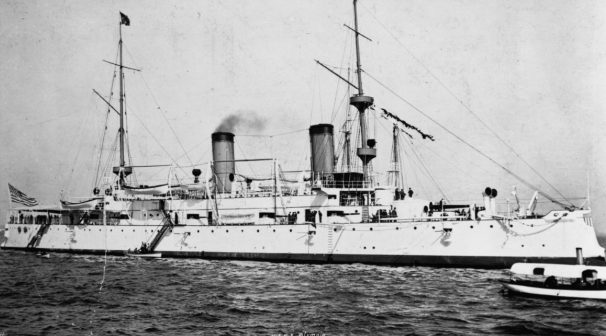 USS Olympia (C 6) was built for war. When her keel was laid in June of 1891, she was a one-of-a-kind design. She incorporated many innovative features, including electric priming for her main battery of guns, a refrigeration system, and electrical generators and electrical service for lighting and ventilation. In addition, she was a pioneer of wireless communication equipment in the Navy.
She quickly became the pride of the Fleet, famous for her role as the flagship of Commodore George Dewey at the Battle of Manila Bay, during the Spanish-American War in 1898. From her decks, Dewey uttered the infamous phrase: “You may fire when ready, Gridley.”
As World War I approached, the U.S. Navy prepared for a massive engagement with the enemy, in which the American fleet would slug it out with the German navy in a fight to the death. But the climactic battle never arrived. Aside from combatting a growing submarine threat, the Navy’s primary job was to ensure the safe transportation of the AEF to the European continent.
Olympia, like many other ships at the time, mostly found itself performing these convoy escort missions. But being one of the most distinguished ships in the Fleet, Olympia received the call to take on a mission unlike anything it had ever been asked to do before.
Journey to France
The Olympia departed Philadelphia on Oct. 3, 1921 and after a brief stop in Plymouth, England, she crossed the English Channel and arrived at Pier d’Escale at Le Havre, France, on Oct. 24 at about 1 p.m. in order receive her hallowed passenger.
The crew had meticulously cleaned the ship from top to bottom in preparation for his arrival. On Oct. 25, 1921, the Unknown Soldier arrived at Pier d’Escale to massive crowds: people had come from across France to pay their respects. In a show of gratitude, France awarded the Unknown Soldier the National Order of the Legion of Honor, the highest French order for military and civil merit.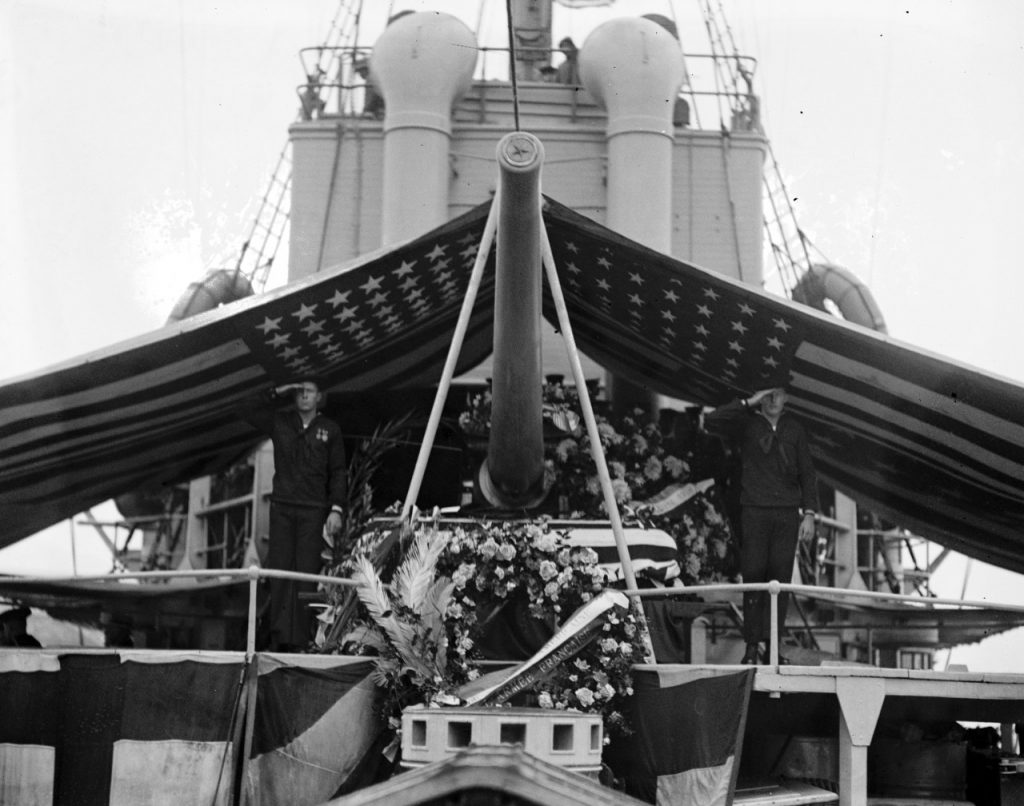
An Eventful Crossing
For the Unknown Soldier, the journey back to the United States would not be a smooth one. The casket actually made the journey outside the skin of the ship, strapped to the decks, because there was no room inside the ship’s cabins. The conditions of the Atlantic in late fall were turbulent and the ship encountered several storms.
One storm produced waves so large that, as they battered the ship, the casket was nearly washed overboard. Olympia’s crew scrambled frantically to save the Unknown and after several hours of struggle, they managed to secure the casket back to deck safely. Not only did they save the casket, but they somehow also managed to save the original bouquet of now-withered white roses.
Olympia reached the Virginia Capes on Nov. 7 and sailed up the Chesapeake Bay, where she anchored at the mouth of the Potomac. At 8 p.m. on the following day, she continued up the river, anchoring at Indian Head, Md., at 2 a.m. on Nov. 9. Planning carefully so that her arrival at the Washington Navy Yard would coincide precisely with the ceremony, she resumed her voyage at 12:38 p.m, joined by North Dakota (BB 29) and Bernadou (DD 153).
A heavy fog combined with rain covered the Potomac River that day. The only way one could be aware of the ship’s arrival was the thunderous exchange of gunfire as Olympia exchanged salutes from Fort Washington.
Coming Home
Upon his arrival, the Unknown Soldier was formally received by Secretary of War John W. Weeks, Secretary of Navy Edwin Denby, U.S. Army Gen. John Pershing, commander of the American Expeditionary Force, and Commandant of the Marine Corps Gen. John A. Lejeune.
The ship rang out “eight bells,” to signal four o’clock and buglers aboard sounded a call to attention. Out of respect, her crew manned the rails and tended the side as the boatswain piped the Unknown Soldier ashore—a ceremony usually reserved for the highest of dignitaries.
From there the casket was placed onto an awaiting caisson, in which it would begin the final leg of the journey. Although the U.S. Army took possession of the Unknown Soldier, the Navy never left his side until the final moments.
From the time he arrived back on American soil, the Unknown was accompanied by eight body bearers who were personally selected for their bravery by Pershing.
Pershing chose a variety of men from all branches to highlight the shared sacrifice of the war. Among them were two Sailors: Chief Gunner’s Mate James Delaney and Chief Water Tender Charles Leo O’Connor.
After his body lay in state at the Capitol Rotunda, the Unknown was buried in Arlington Cemetery on Nov. 11, 1921. As the body bearers lay him into the crypt, he once more came into contact with American soil.
And there he lies to this day.




 DAVE DOES HISTORY
Leave a comment