
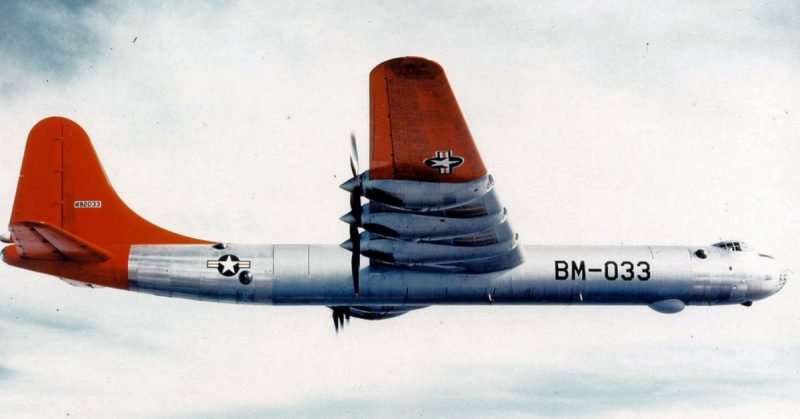
 The B-36 Peacemaker, a long-range bomber, never saw action in a war. However, it certainly caused a major political war to break out between the various arms of the American Military.
At the end of WWII, the US Air Force (USAF) was turned into an independent service and placed under the control of the National Military Establishment. This newly formed Air Force faced some significant challenges, both at home and overseas.
 These challenges included a new foe in the form of the Soviet Union. In addition, the Navy was unimpressed with the idea of a new military service that took funds from a diminishing defense moneybag, especially as the Air Force was trying to implement new technology in the form of jet propulsion.
In 1949, Louis Johnson was appointed as the Secretary of Defense, and he was ordered by President Harry Truman to economize. Johnson caused the Navy to have apoplexy when he canceled the order for their latest aircraft carrier, a week after the keel had been laid down. This carrier had been the center-point of the Navy’s strategic nuclear plan.
The Navy planned to use the vessel to carry aircraft that would be able to drop nuclear bombs thousands of miles away from home soil. Johnson’s decision set off a minor war between the various military wings as both the Navy and Air Force wanted to be the provider of a means to carry nuclear weapons to all corners of the globe.
The relationship between the Navy and the Air Force had been tenuous for some time. They had clashed in the 1920s about the defense of the American coast. During WWII, they had squabbled continuously over technology and finance.
Now, the Air Force had become a separate service alongside the creation of the Ministry of Defense, and the Navy saw two political adversaries that threatened its power base as the defender of the nation.
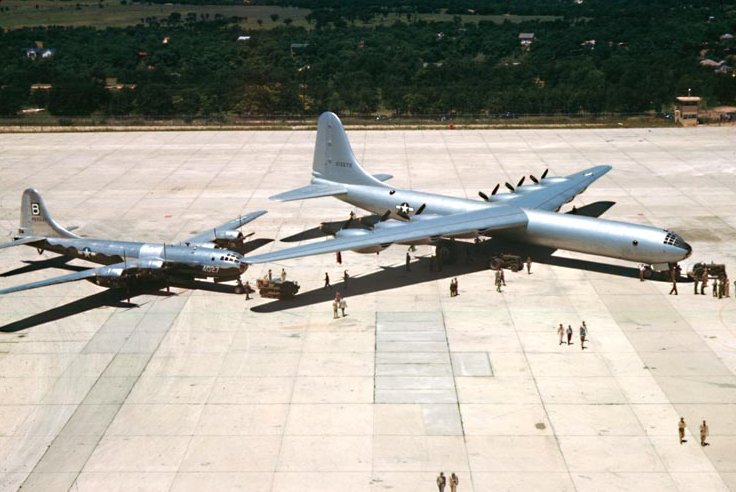
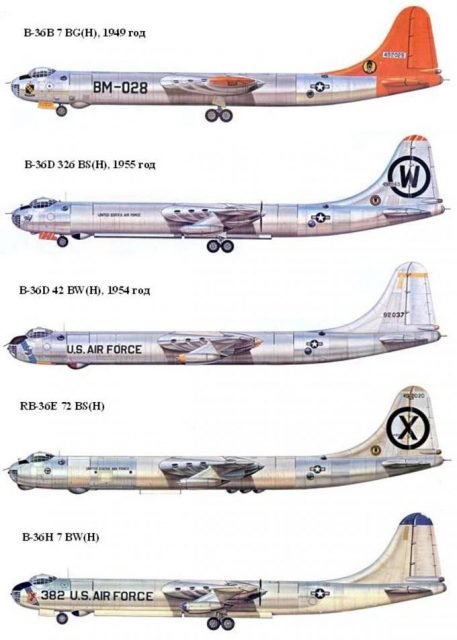
With the cancellation of the aircraft carrier order, this spat broke out into a political war that pitted the aircraft carrier against the Air Force long-range bombers in the shape of the B-36, a six-engine monster plane built by Convair (Johnson’s previous employer) that came into service in mid-1948.
The following year, a salvo was fired by Cedric Worth, who was employed in a civilian capacity by Navy Undersecretary, Dan Kimball. Worth wrote a nine-page memo in which he declared the B-36 as obsolete and unsuited for its purpose.
He also alleged that the Air Force purchased the plane after Convair donated millions to various Democratic Party politicians. This was followed up by claiming that the Navy League had spent thousands to produce reports showing the B-36 as an ungainly, lumbering beast and declared that it was a billion-dollar blunder.
The memo also claimed that the Navy had three fighter jets that could destroy the B-36 in the air and wanted a contest, but this was not to happen.
Johnson was told that the contest would not be a good idea and the Air Force contested that fighter planes were not as agile at the altitude at which the B-36 flew. They had conducted a test in the Southern United States where a B-36 flew at 40,000 feet (12,192 meters), and three fighters (an F-86A Sabre, a Republic F-84 Thunderjet, and a Lockheed F-80C Shooting Star) were given the task of intercepting it.
The B-36 was picked up on the radar, 30 minutes out from the airfield and the three fighters took off. It took them 26 minutes to climb to an altitude of 40,000 feet and then a further two minutes to find the bomber.
The fighters could outrun the bomber, but because of their wing configuration, they were incapable of turning sharply in the thin air. As a result, the Air Force concluded that, even if Soviet fighters could catch a B-36 after it had been detected, the bomber would be able to evade them by flying a zig-zag course.
The battle between the Navy and the Air Force then moved into the political arena. Politicians began insisting that the B-36 project would have been canceled long before, if not for the shenanigans of Johnson and Convair, along with the head of the Air Force, Stuart Symington.
Symington had made a ludicrous claim that the B-36 could take off from US soil, fly to enemy positions, penetrate their defense systems, destroy any industrial installations, and then return to US soil, all without having to refuel. This incredible claim was widely believed, so the US Congress decided to hold hearings on the matter.
The inevitable political meddling ensued. After many long delays, the hearings took place, but they had been expanded to include the strategic positions of the Navy and Air Force.
Cedric Worth, the author of the original report, was browbeaten during the hearings. He eventually said that his estimations were wrong and he recanted his original memo.
The DNA of the B-36 came from a series of bombers that were steadily getting larger and larger. The B-36 was developed out of the DNA of the B-24 Liberator and was developed in response to America’s fear that England would be invaded during WWII.
The Americans wanted a plane that could fly from America, bomb in Europe, and then return to home base in America. The B-36 was the proposed mega-bomber.
Its plans showed that it stretched 230 feet (70 meters) from wingtip to wingtip, could fly at a speed of 300mph (482kmph) across the Atlantic to penetrate German airspace, and drop 10,000 pounds of bombs from an altitude of 40,000 feet.
The Army was vastly impressed with the design and ordered two prototypes on November 15, 1941.
Shortly after placing the order, Pearl Harbour was bombed and America found itself mired in a war over two oceans. The plans for the B-36 were shelved and the B-24 Liberator was built in its thousands.
Source: B-36 Peacemaker – Billion-dollar Blunder or Nuclear Deterrent?



 DAVE DOES HISTORY
Leave a comment