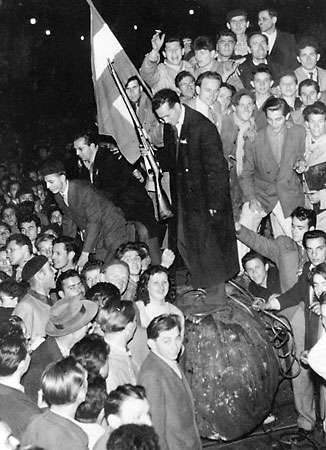
In kaleidoscopic political changes, Nagy resumed power on October 25 but then was driven from one
concession to the next. On November 3 he found himself at the head of a new and genuine coalition government representing the reconstituted Hungarian
Socialist Workers’ Party and the revived Smallholders’ Party,
Social Democratic Party, and Petőfi [former National Peasant] Party.
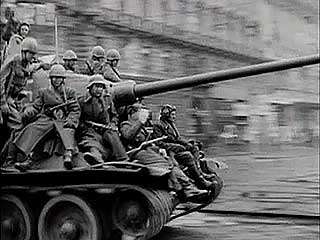
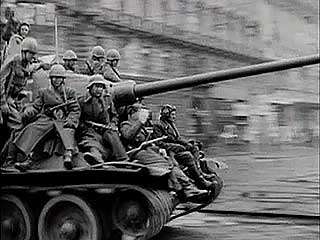
The Soviet troops had withdrawn, and Nagy was negotiating for their complete evacuation from Hungary. On November 1 he announced Hungary’s withdrawal from the Warsaw Pact (to which it had adhered since 1955) and asked the United Nations to recognize his country as a neutral state, under the joint protection of the great powers. Soviet officials were uncertain whether to act or to let matters take their course, for fear of Western intervention. But the growing pressures for intervention from China and neighbouring Romania, Czechoslovakia, and eventually even Yugoslavia; the danger posed by Nagy’s gravitation out of the Soviet bloc; Israeli, British, and French involvement in the Suez Crisis; and an increasing realization that the United States would not risk a global confrontation over Hungary emboldened the Soviet leadership to act. Their tanks, which had halted just across the frontier, began to return, reinforced by other units. On November 4 the Soviet forces entered Budapest and began liquidating the revolution. Nagy took refuge in the Yugoslav embassy and Cardinal Mindszenty in the U.S. legation. Gen. Pál Maléter, the Nagy government’s minister of defense, who had been invited by the Soviet commanders to negotiate, was taken captive and eventually executed.
In the early morning of the same day, János Kádár—who had defected from the Nagy government and left Budapest on November 1—broadcast a radio speech wherein he declared the illegitimacy of the Nagy government and proclaimed the formation of the new Soviet-supported “Hungarian revolutionary workers’ and peasants’ government.” It consisted entirely of communists, who now congregated under the flag of the Hungarian Socialist Workers’ Party that had replaced the discredited Hungarian Workers’ Party. The new government was headed by Kádár as prime minister and Ferenc Münnich as his second in command. Kádár promised that once the “counterrevolution” was suppressed and order was restored, he would negotiate for the withdrawal of the Soviet garrison (although the denunciation of the Warsaw Pact was retracted). Having been imprisoned himself by Rákosi’s Stalinist regime, he now dissociated himself from the “Rákosi-Gerő clique” and promised substantial internal reforms.
Most Hungarians, however, were skeptical of these promises, and fighting continued. But the odds were too heavy in favour of the Soviets, and the major hostilities were over within a fortnight, although sporadic encounters continued into January 1957. The workers continued their struggle by proclaiming a general strike and other forms of peaceful resistance. It took many weeks before they were brought to heel and many more months before some semblance of normality returned to the country. The price in human lives was great. According to the calculations of historians, the Hungarians suffered about 20,000 casualties, among them some 2,500 deaths, while the Soviet losses consisted of about 1,250 wounded and more than 650 dead.
Meanwhile, Nagy, who had left his place of refuge under safe conduct, had been abducted and taken to Romania. After a secret trial, he and Maléter and a few close associates were executed in 1958. Many lesser figures were seized and transported to the Soviet Union, some never to return, and 200,000 refugees escaped to the West (about 38,000 of whom emigrated to North America in 1956–57). Thus, a substantial proportion of Hungary’s young and educated classes was lost to the country, including several top noncommunist political leaders and intellectuals, as well as Gen. Béla K. Király, the commander of the Hungarian National Guard organized during the revolution. Material damage was also very heavy, especially in Budapest.
The Kádár regime
In the first uncertain weeks of his regime, Kádár made many promises. Workers’ councils were to be given a large amount of control in the factories and mines. Compulsory deliveries of farm produce were to be abolished, and no compulsion, direct or indirect, was to be put on the peasants to enter the collectives. The five-year plan was to be revised to permit more production of consumer goods. The exchange rate of the ruble and forint was to be adjusted and the uranium contract revised. For a time there was even talk of a coalition government.
The larger hopes were dashed after representatives of the Soviet Union, East Germany, Czechoslovakia, Romania, and Bulgaria conferred with those of Hungary in Budapest in January 1957. A new program was soon issued stating that Hungary was a dictatorship of the proletariat, which in foreign policy relied on the Soviet Union and the Soviet bloc. Further, it was asserted that the Soviet garrison was in Hungary to protect the country from imperialist aggression. Internal reforms were again promised, however, and foreign trade agreements were to be based on complete equality and mutual advantage.
Subsequently, Kádár was at great pains to give the Soviet Union no cause for uneasiness over Hungary’s loyalty. When any international issue arose, he invariably supported Moscow’s policy with meticulous orthodoxy, even sending a contingent into Czechoslovakia in 1968 to help crush the “Prague Spring.” At home he ignored some of his promises and honoured others only superficially. The peasants were so greatly pressured to enter cooperatives that within a few years practically no private farms survived. The workers’ councils were dissolved, but trade unions were later granted rights to query decisions by management. Parliament remained a rubber stamp, and a Patriotic People’s Front (PPF), on which noncommunists were represented, was a mere facade.
The bloody retributions in 1957–59 resulted in the execution of “counterrevolutionaries” (among them Prime Minister Imre Nagy and several of his associates) and the imprisonment of thousands of others. Yet by the 1960s, conditions had changed for the better. Between 1960 and 1963, by way of two separate amnesty decrees, most of those imprisoned for “counterrevolutionary activities” or for the misuse of their party positions during the “years of the personality cult” (i.e., the Rákosi regime) were pardoned and released. At this time the United Nations (UN) ended its debate on the “case of Hungary” and by June 1963 helped to remove the moral stigma from the Kádár regime by the formal acceptance of its credentials at the UN.
Almost simultaneously, Kádár enunciated the principle that “he who is not against us is with us,” which meant ordinary people could go about their business without fear of molestation or even much surveillance and could speak, read, and even write with reasonable freedom. Technical competence replaced party orthodoxy as a criterion for attaining posts of responsibility. More scope was allowed to private small-scale enterprise in trade and industry, and the New Economic Mechanism (NEM), initiated in 1968, introduced the profit motive into state-directed enterprises. Agricultural cooperatives were allowed to produce industrial goods for their own use or to sell on demand, while the private plots of their members supplied a large proportion of fruits and vegetables for the rest of the population.
Contacts with the West were encouraged. A modus vivendi was found with the Vatican and with Protestant churches. The standard of living began to rise substantially. Tourismdeveloped as a significant industry. In addition to a huge influx of foreign visitors—many of them from western Europe, the United States, and Canada—an increasing number of Hungarians traveled abroad. This was especially true after the introduction (January 1, 1988) of “global passports,” which removed restrictions on travel. Income from tourism increased dramatically, yet the net balance was less in Hungary’s favour than would be expected, because Hungarians going to the West spent most of their official hard currency quotas on purchases of consumer goods, owing to shortages and skyrocketing prices at home.




 DAVE DOES HISTORY
Leave a comment