
In 1933, during the depths of the Great Depression, the “March of the Swiss Soldiers” finale from the William Tell overture came blaring over the airwaves from radio station WXYZ in Detroit to announce the arrival of a new American hero. Station owner George Trendle wanted a show about a mysterious cowboy, so writer Fran Striker developed a character who was the sole survivor of a group of Texas Rangers ambushed by a gang. After being found near death and nursed back to health by the Indian Tonto, the Lone Ranger dons a mask and sets out on his horse Silver to seek justice for his murdered colleagues. The Lone Ranger was an immediate smash hit and soon garnered a national audience of 17 million listeners, 1.5 million of whom joined the official fan club.
Hollywood was eager to tap into the established audience. Republic Pictures obtained the rights to produce a movie serial and began to survey fans about how they envisioned the Lone Ranger. From this feedback, the studio determined that the Lone Ranger had to be 5’11”, weigh 170 pounds, and have no facial hair. Fans also stipulated that the Lone Ranger must always wear a white hat and carry two guns. To ensure that the Lone Ranger was not distracted from his quest for justice, he could never have a romantic interest.
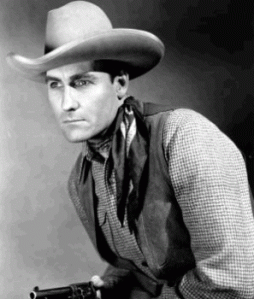
Republic believed they had the right actor to portray the masked man in Lee Powell. In addition to meeting the physical description, it helped that Powell was an accomplished horseman, having worked on a ranch in Montana while studying to be a mining engineer. Powell had been acting in small stock companies as a hobby when he returned to his home state of California and was discovered by the studio while performing in a play. He was signed to a contract and given a few minor parts before being chosen to be the man to ride Silver.
Released in 1938, the 15-chapter The Lone Ranger was the most expensive serial produced at that time. The studio had incorporated many of the details provided by the fans but gave the Lone Ranger an unusual mask with a veil that made him look like a cowboy beekeeper. The mask was the result of how the serial was structured. The true identity of the Lone Ranger could be one of five different characters who were opposing a formidable outlaw scheming to conquer Texas. The audience was left to guess who the real Lone Ranger was. As not to expose the secret to the audience before the big reveal in the final chapter, another actor dubbed the Lone Ranger’s voice. The odd mask covered Powell’s mouth, which meant the studio did not have to be troubled with lip-synching.
Like the radio show, the serial proved to be popular with both the public and critics because of its emphasis on action over talk. Even today, many Lone Ranger aficionados rate the serial version very high and consider it better than the more recognizable 1950s television series starring Clayton Moore. The serial later was condensed into the 1940 feature film Hi-Yo Silver, which also performed well at the box office.
Powell wrote in an article for Good Housekeeping magazine that three elements contributed to the success of the serial: “Fast riding. Fast Shooting. Fast Punching.” While Powell enjoyed the notoriety the role brought him, he admitted that he thought it would be fleeting because the Lone Ranger’s popularity would probably fade and another hero would be embraced by the public. He even thought that the catch phrase “Hi-Yo Silver” would become as outdated as “23 skidoo.”
Shortly after The Lone Ranger, Powell co-starred with Herman Brix in The Fighting Devil Dogsas a Marine battling a sinister mastermind with a powerful electric weapon trying to enslave the world. The serial played to packed houses and has since developed a cult following, because many fans believe the costumed villain known as the Lightning served as the model for Darth Vader. George Lucas has never confirmed the connection but has stated in the past that he was heavily influenced by serials. In a 1981 Rolling Stone interview he credited the chapter play Don Winslow of the Navy as the inspiration for Raiders of the Lost Ark.
Perhaps accepting that he had been knocked off the pedestal of matinee idolatry, he decided to become a real hero and enlisted in the Marines in August 1942. As a sergeant in the 2nd Marine Division, he fought in the brutal battles on Tarawa and Saipan. On Saipan he was charged with organizing security watches to guard against Japanese snipers who had infiltrated the lines. It was during the Battle of Tinian on 29 July 1944 that the unthinkable happened. Within a week, headlines in newspapers across the United States would report that the Lone Ranger had been killed in action.
Source: Naval History Blog » Blog Archive » The Death of the Lone Ranger, USMC


 DAVE DOES HISTORY
Leave a comment