
To fly through the apex of a storm, NASA needed to raid the boneyard.
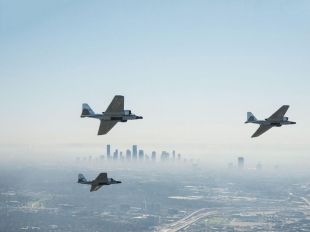 Though it spent 40 years rusting away in the Arizona desert, in October 2016 it was flying miles high over Guam. The Martin WB-57F, with a NASA logo on its tail, climbed into the troposphere on a mission called POSIDON, an investigation of cirrus clouds and other atmospheric phenomena. Porpoising between altitudes of eight and 11 miles, it flew around a typhoon, dipped into volcanic plumes to study sulfur dioxide gas, measured the density and thickness of the clouds, and sniffed for molecules of ozone.
“Cirrus clouds are not so well understood,” says Eric Jensen, an atmospheric scientist with NASA’s Ames Research Center and one of the lead researchers on the POSIDON mission. These structures, which form the anvils on thunderstorms and, at higher altitudes, regulate the amount of water vapor and other particles that float up into the stratosphere, are “one of the big uncertainties in our ability to predict climate change…. So these measurements of the clouds, understanding how they form and how they evolve, is very important to improving these global models,” Jensen says.
The western Pacific is the perfect laboratory for studying cirrus clouds, especially during fall, when thunderstorms are a daily feature and typhoons can spin to life at any time. “Guam is right in the middle of the action,” Jensen says. Warm, moist air rising from the ocean around the island pushes the clouds to especially high altitudes. Strong winds shear off the tops of the clouds, forming the lacy cirrus, which are thin streamers of ice crystals. Tiny particles—from bits of sea foam to factory pollutants blown over from Asia—climb into these streamers, where they can be carried around the entire planet.
The high altitude of these formations makes them difficult to study—too high for most aircraft to reach with heavy instrument payloads and too low and wispy for satellites to view with a high enough resolution for accurate measurements. But in 2011, Jensen’s team got their hands on a WB-57, and the high cirrus came within reach.
The airplane is the last version of the B-57 bomber, with the ability to carry a heavier payload to higher altitudes than any other available research aircraft. “And it’s really hardy, so you can fly near convection—these big thunderstorms—which is a turbulent environment,” Jensen says. With the WB-57s, scientists can send instruments to directly sample the clouds.
The aircraft that flew the Guam mission and two other WB-57s—all three are more than 60 years old—are the only aircraft of their type operating today. The B-57 actually came into the world as the English Electric Canberra, a British-designed jet-powered medium bomber conceived during World War II, though it didn’t make its first flight until 1949. A year later, when hostilities erupted in Korea, the U.S. military began looking for a replacement for the Douglas B-26 Invader (which flew in World War II as the A-26). As part of a demonstration of the Canberra’s suitability, the British bomber made the first unrefueled jet flight across the Atlantic. That cinched the job with the U.S. Air Force. The Glenn L. Martin Company got the license to build the American version, the B-57, which made its first flight in 1953. (Too late for combat in Korea, it was sent there to defend the 1953 armistice.) Though the American version officially dropped the “Canberra” moniker, most still refer to the aircraft by that name.
NASA’s WB-57s fly out of Ellington Airport in Houston, not far from the Johnson Space Center, as part of the agency’s high altitude research fleet. According to Charlie Mallini, who manages the WB-57 program, the airplane occupies a research niche. “It’s one of NASA’s core aircraft for atmospheric work,” he says. “There are only so many aircraft that go to the altitudes we go to. And we can carry a lot of different things—antennas, sample probes, and other payloads.”
NASA’s other high-altitude research aircraft, the ER-2 (a version of the U-2 spyplane) and the Global Hawk drone, fly at least as high as the Canberra and offer greater range and duration. But the Canberra can carry three times the payload of the ER-2 and more than four times that of the Global Hawk. That capacity allows the WB-57 to tote more than two dozen instruments, distributed across the nose, a large payload bay, cubbyholes in the wings, and wing-mounted pods. The Canberra is also the only one of the three research craft that can carry a crewmember in the backseat to operate the instruments and relay data to a team on the ground. “The scientists can make real-time decisions to re-target where they want to go,” says Mallini. “That gives them a lot of flexibility to get the best data.”
Mallini joined the program in 2011 as a lead engineer after working on NASA’s Constellation program, the scrapped initiative to send astronauts back to the moon and on to Mars. In 2014, he became the WB-57 program’s project manager. He shows off the aircraft at their home base, Hangar 990 at Ellington, a former Air Force base. NASA 927, the aircraft that flew the POSIDON mission, sits near the hangar door as Tom Parent, one of the Canberras’ pilots, instructs visiting pilots from the Naval Test Pilot School on its operation. (Small groups of the center’s aviators train on the WB-57F for a few days each year, giving them experience in high-altitude flight.) A second aircraft, NASA 928, is undergoing major maintenance; its engines have been removed and its cargo bay sits open and empty. The final member of the fleet, NASA 926, perches at the other end of the hangar, surrounded by instrument-carrying pallets and shipping containers stuffed full of tools, spare parts, and other gear for deployments outside Houston.
Mallini’s charges look like the aviation equivalent of muscle cars. Their wings span 122.5 feet—almost 20 feet longer than the wings on a U-2S—providing the lift needed to reach altitudes that require pressure suits and giving the WB-57F its nickname: the Long Wing. A hefty Pratt & Whitney TF33 engine, similar to those used in B-52 bombers, is mounted in the middle of each wing and provides the aircraft with 31,000 pounds of thrust. That power makes takeoff both loud (cockpit noise levels can reach 105 decibels) and unnerving. “Quite an eye-opener, and, for a first-time flyer a bit disconcerting,” says Parent. “When the engines are advanced to takeoff power, the entire aircraft shakes so badly it’s difficult to read the engine and flight instruments.”
Parent is one of four pilots for the vintage aircraft. He joined the project in 2011 after retiring from the Air Force. During his 25-year military career, he served as a crew chief for F-111s, then flew B-52s and, finally, the U-2. Nicknamed “Duster” for the thick mustache (a “cookie duster”) that he wore during a deployment to Afghanistan, Parent has logged more than 900 of his almost 8,000 flight hours in the Canberra. In the cockpit, Parent and his fellow pilots face 1960s instrumentation. (The backseat sensors have been updated to modern glass displays.) “Nothing is automated in the cockpit except the new digital autopilot,” says Parent. “The cockpit displays have changed very little since the plane first flew.”
B-57s served for two decades, including in combat in Vietnam. In the early 1960s, General Dynamics was commissioned to design the F model for high-altitude reconnaissance and atmospheric observation. WB-57Fs, operated by the 58th Weather Reconnaissance Squadron in New Mexico, were dispatched around the world to sniff out traces of atmospheric nuclear tests. The last military B-57s were mothballed in 1974, replaced by, among others, the supersonic SR-71.
NASA began borrowing Canberras from the Air Force in the 1960s. After the model had proven its usefulness as a research platform, the agency acquired two permanently. One of them initially served as a reconnaissance aircraft, including a deployment to Rhein-Main Air Base in Germany, while the other began life as a bomber and served Stateside. Both were converted to RB-57F models about 10 years into their careers. “The history is one of the neat things about these aircraft,” says Parent. “Everybody looks at [them] and is amazed that they still exist. Most of them are in museums. In fact, we were looking at museums for our latest aircraft until we found one in the boneyard.”
Air Force 63-13295, also an RB-57F, had retired to Davis-Monthan Air Force Base in Tucson in July 1972. It sat there for almost 39 years, baking under the desert sun. Then in May 2011, NASA engineers descended on the boneyard to resurrect it. “We looked at the work coming up and saw a need for a third plane,” says Mallini. “This was sort of our last opportunity. The planes [at Davis-Monthan] were slowly decaying. And our planes were getting old. It’s like having an insurance policy. And we often have a plane down for maintenance, so the new one allows us to still have two airplanes available.”
It took two years to rejuvenate the aircraft, using parts scavenged from other scrapped airplanes. (A second airframe, which had suffered more damage during its time in storage, served as a testbed, helping engineers determine how to pull things apart and put them back together before applying wrench or screwdriver to 63-13295.) “We stripped it down to bare metal,” Mallini says. “The wings were put up in jigs and rebuilt from scratch. Then we slowly but surely put it back together again.” In August 2013, the redesignated NASA 927 took to the skies for the first time in more than four decades—one of the longest hiatuses for any aircraft consigned to a boneyard.
Read more at https://www.airspacemag.com/flight-today/mission-resurrected-180970371/#Ybd35J0ipiWCpqa9.99
Source: A Mission for the Resurrected | Flight Today | Air & Space Magazine



 DAVE DOES HISTORY
Leave a comment