
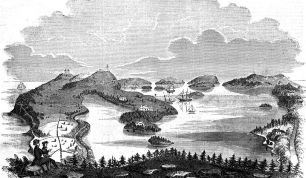
 For most of 1775, Revolutionary troops under the command of George Washington had the British Army trapped in Boston, but it was hard to say who was at the mercy of whom. By July, after three months of skirmishes against the Redcoats, Washington’s soldiers had only enough gunpowder for nine bullets per man. The year prior, as tensions in the colonies worsened, George III banned the import of firearms and gunpowder from Europe, and had been confiscating them in a bid to disarm the rebellion. The only American gunpowder mill, the Frankford Powder-Mill in Pennsylvania, wasn’t producing enough to fight a war. Knowing their guns were close to becoming useless, the Americans began equipping themselves with wooden pikes and spears for hand-to-hand combat.
They needed gunpowder, however they could get it.
It was a lucky problem for Henry Tucker, a Bermudan merchant eager to find new business. The Continental Congress had announced an embargo against loyal British colonies, set to come into effect in September, and in July 1775, Tucker traveled to Philadelphia, where Congress met, to find some way out of it. Bermuda relied significantly on American food imports, and he argued as much for his business as for his belly. He’d noted a clause in the embargo that said ships carrying munitions to American ports would be allowed an exemption to trade with American colonies, regardless of their affiliation with the British.
As the Second Continental Congress met, Tucker schemed with Benjamin Franklin to help both of their causes. Two of Tucker’s sons, living in South Carolina and Virginia, had freely talked about an unguarded magazine where the gunpowder cache was held, just north of Bermuda’s main town, St. George’s, and its existence was by now an open secret in the American colonies. Franklin, having heard about the gunpowder, told Tucker that Bermuda could bargain its way out of the embargo if he brought gunpowder for trade. Tucker didn’t have gunpowder to offer, but he knew how to get it.
Since 1691, the colonial authorities in Bermuda had instituted a policy that required visiting ships to donate either money or gunpowder to the island every time they arrived, according to Dorcas Roberts, the director of preservation of the Bermuda National Trust, a historical preservation charity. Over the years that amounted to a great deal of gunpowder.
Tucker had written in a 1774 letter that the Americans were right to rebel against the Crown, and that British rule was equal to slavery. Elsewhere and at other opportunities, he was open about his contempt of the British government. On the whole, his fellow Bermudans sympathized with the Americans, but living on a 20-square-mile speck 700 miles off North Carolina, they couldn’t afford conflict with the British—the whole island could have been shut down by one British warship and an angry stare.
Tucker would need a lot of good, loyal men to liberate the gunpowder from its storehouse.
Read More: The Raid on Bermuda That Saved the American Revolution | History | Smithsonian



 DAVE DOES HISTORY
Leave a comment