
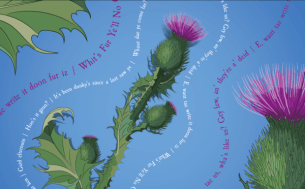
 Against all odds, 28 percent of Scottish people still use it.
OVER THE PAST FEW DECADES, as efforts to save endangered languages have become governmental policy in the Netherlands (Frisian), Slovakia (Rusyn) and New Zealand (Maori), among many others, Scotland is in an unusual situation. A language known as Scottish Gaelic has become the figurehead for minority languages in Scotland. This is sensible; it is a very old and very distinctive language (it has three distinct rsounds!), and in 2011 the national census determined that fewer than 60,000 people speak it, making it a worthy target for preservation.
But there is another minority language in Scotland, one that is commonly dismissed. It’s called Scots, and it’s sometimes referred to as a joke, a weirdly spelled and -accented local variety of English. Is it a language or a dialect? “The BBC has a lot of lazy people who don’t read the books or keep up with Scottish culture and keep asking me that stupid question,” says Billy Kay, a language activist and author of Scots: The Mither Tongue. Kay says these days he simply refuses to even answer whether Scots is a language or a dialect.
What Scots really is is a fascinating centuries-old Germanic language that happens to be one of the most widely spoken minority native languages, by national percentage of speakers, in the world. You may not have heard of it, but the story of Scots is a story of linguistic imperialism done most effectively, a method of stamping out a country’s independence, and also, unexpectedly, an optimistic story of survival. Scots has faced every pressure a language can face, and yet it’s not only still here—it’s growing.
Source: How the English Failed to Stamp Out the Scots Language – Atlas Obscura



 DAVE DOES HISTORY
Leave a comment