
History, whether human or prehistoric, rarely moves with the neat inevitability we like to imagine. The rise of the dinosaurs is a good example. Popular imagination paints the story as a swift and decisive takeover. Dinosaurs appear, prove biologically superior, and sweep the old reptiles aside like a cavalry charge scattering infantry.
Reality, as usual, is messier and more interesting.
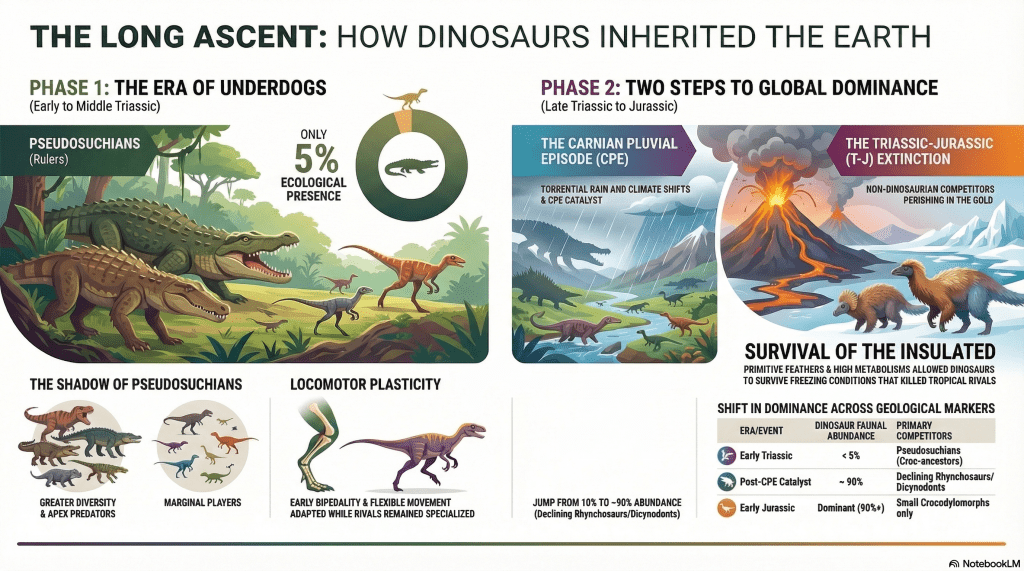
The truth is that dinosaurs did not conquer the Earth overnight. Their rise took roughly fifty million years and unfolded through a combination of environmental catastrophe, evolutionary opportunity, and a fair amount of blind luck. They were not the unstoppable champions of the Triassic world. For a very long time, they were marginal players waiting for history to break their way.
Humble Beginnings in a Broken World
The dinosaur lineage emerged during one of the bleakest chapters in the history of life.
Roughly 252 million years ago, the Permian–Triassic mass extinction wiped out an estimated 90 percent of marine species and about 70 percent of terrestrial vertebrates. Ecosystems collapsed across the globe. Forests vanished. Oceans stagnated. The world that followed was not lush or stable. It was a biological frontier.
In that unstable aftermath, the archosaurs began their slow radiation. These reptiles would eventually divide into two great branches: the crocodile line, called pseudosuchians, and the bird line, which includes dinosaurs and ultimately birds.
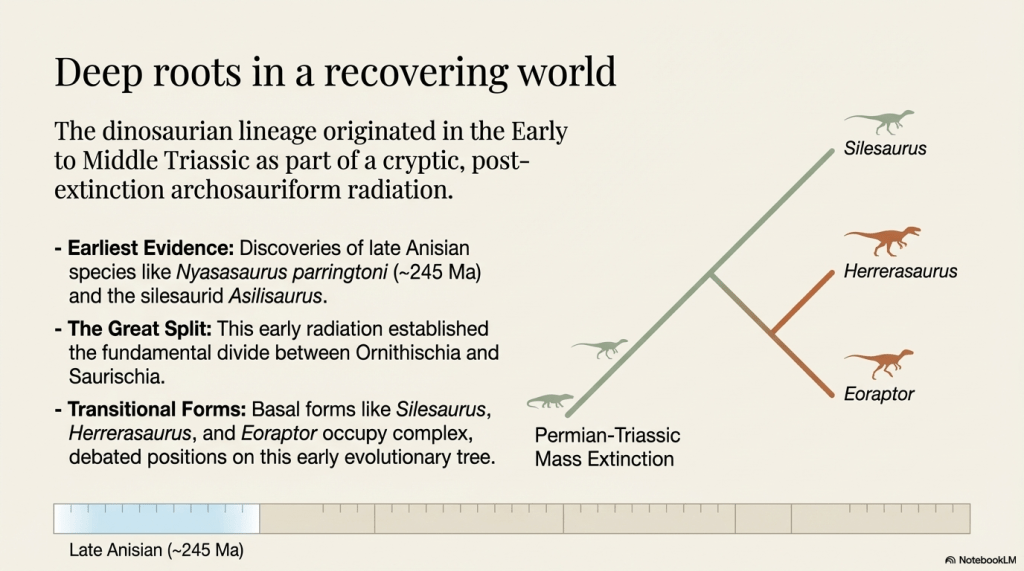
Evidence suggests that the dinosaur lineage originated earlier than scientists once believed, probably in the Early or Middle Triassic. Fossils such as Nyasasaurus parringtoni, dating to roughly 245 million years ago, hint that dinosauriform animals were already present during this early recovery period. Another key fossil, the silesaurid Asilisaurus, shows that the dinosaur lineage was part of a broader and somewhat cryptic radiation of archosauriform reptiles.
Yet these early dinosaur relatives were hardly rulers of the Earth.
For their first twenty million years, dinosaurs were small, rare, and ecologically insignificant. In many fossil assemblages they represent less than five percent of the animals found. They were bit players in ecosystems dominated by other reptiles.
Evolutionary groundwork was nevertheless being laid. During this period the major divisions of dinosaur evolution were beginning to form. The great split between the two primary branches, Ornithischia and Saurischia, had its roots in these early radiations. Fossils such as Eoraptor and Herrerasaurus illustrate the experimental nature of this phase. These animals occupy uncertain positions in the evolutionary tree, sharing features with multiple later groups.
At the time, however, none of this hinted that dinosaurs would one day dominate the planet.
The True Rulers of the Triassic
During the Middle and Late Triassic, the world belonged not to dinosaurs but to their archosaurian cousins.
These reptiles, known as pseudosuchians, were the ancestors of modern crocodilians. They were extraordinarily diverse in body form and ecological role. Some resembled crocodiles, others walked on long legs like predatory dinosaurs, and still others were heavily armored herbivores.
In terms of evolutionary experimentation, the pseudosuchians were the clear winners of the Triassic.
Their diversity in body plan far exceeded that of early dinosaurs. They filled numerous ecological niches and dominated the predator guilds of the time. Among them were the rauisuchians, formidable carnivores that stood at the top of the food chain.
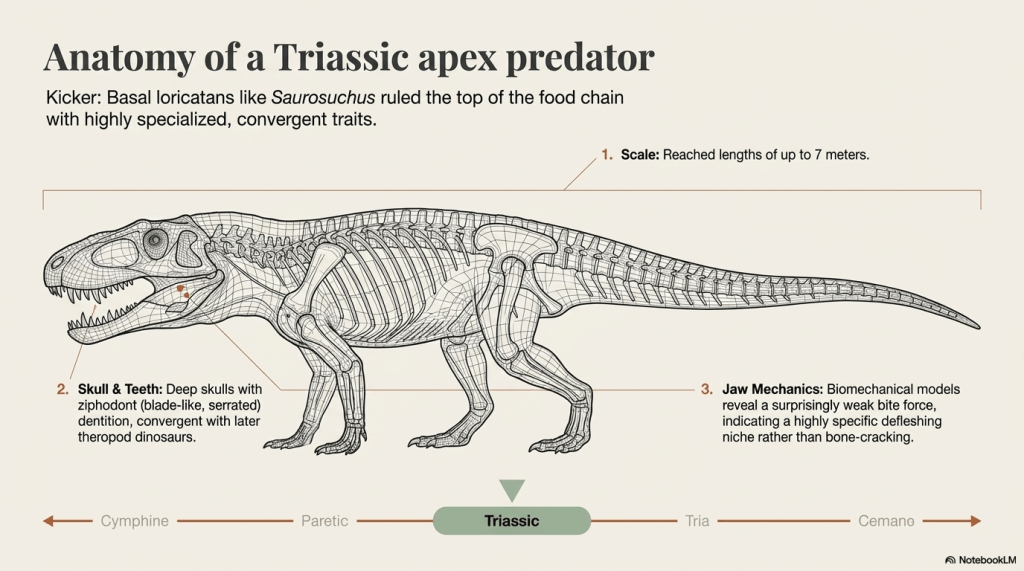
One of the most impressive was Saurosuchus, a massive predator reaching lengths of around seven meters. With its deep skull and blade-like teeth, it bore a striking resemblance to later theropod dinosaurs such as Allosaurus. At first glance it seems like a prototype for the later dinosaur predators.
But appearances can deceive.
Biomechanical modeling of Saurosuchus skull mechanics indicates that its bite force was surprisingly weak. Rather than crushing bone, it likely specialized in slicing flesh from carcasses or subdued prey. Its ecological role may have been closer to that of a defleshing predator rather than a bone-crushing apex hunter.
This difference highlights an important point. Similar body shapes often arise through convergent evolution, yet the underlying biology can remain distinct.
Locomotion also differed between the groups. Dinosaurs early developed an erect stance supported by a mesotarsal ankle joint, which allowed efficient bipedal running in many species. Pseudosuchians experimented with a wider variety of locomotor styles, from sprawling quadrupeds to semi-upright walkers.
In short, the Triassic world was not awaiting dinosaurs. It was already full of successful reptiles.
A Stormy Turning Point
The first major turning point in the dinosaur story came not from evolutionary competition but from climate.
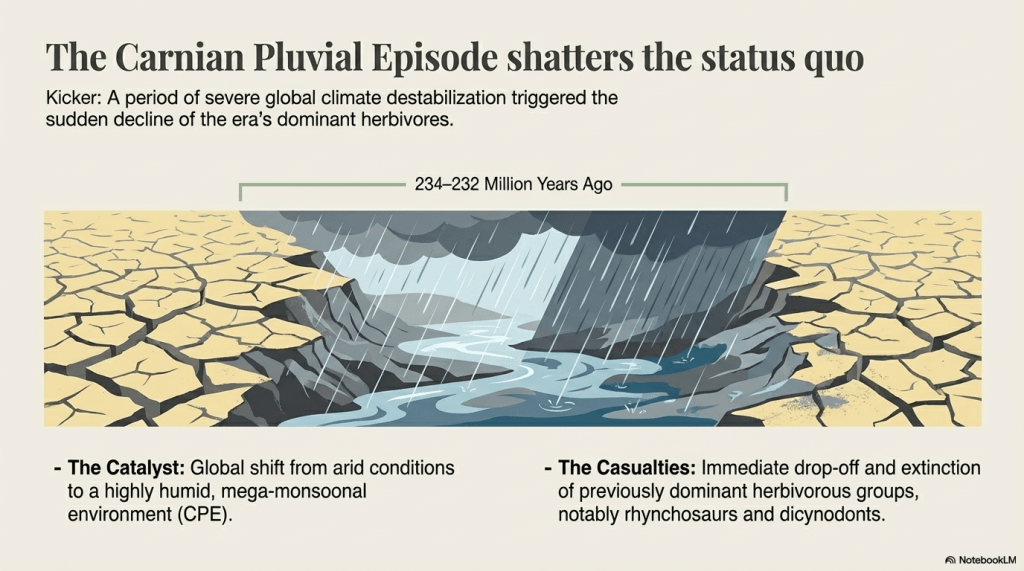
Around 234 to 232 million years ago the Earth experienced a dramatic climatic upheaval known as the Carnian Pluvial Episode. For millions of years before this event, much of the supercontinent Pangaea had been dominated by arid desert conditions.
Then the climate shifted.
Intense volcanic activity injected massive amounts of greenhouse gases into the atmosphere. Rainfall increased dramatically across large portions of the planet, creating what scientists describe as a mega-monsoonal climate. River systems expanded. Lakes spread across continental interiors. The environmental transformation was profound.
Such upheaval proved disastrous for several established groups of herbivores.
Rhynchosaurs, which had previously been among the most common plant eaters, declined sharply. Dicynodonts, a group of beaked synapsids that had survived since the Permian, also suffered major losses.
Whenever ecological vacancies appear in nature, something eventually fills them.
Following the Carnian Pluvial Episode, dinosaurs began to diversify rapidly. Paleontologists refer to this burst of evolutionary expansion as the Dinosaur Diversification Event. Across multiple regions of Pangaea, dinosaurs increased dramatically in both species richness and ecological presence.
Their share of terrestrial faunas rose from under ten percent to sometimes approaching ninety percent in certain assemblages.
It is important to note that dinosaurs did not instantly become the dominant animals everywhere. But the trajectory had shifted. They were no longer rare curiosities. They were becoming major players in the ecosystem.
Most of the major dinosaur body plans began to appear during this period, particularly across the boundary between the Carnian and Norian stages of the Late Triassic.
Still, the old powers had not yet vanished.
The true dinosaurian takeover required another catastrophe.
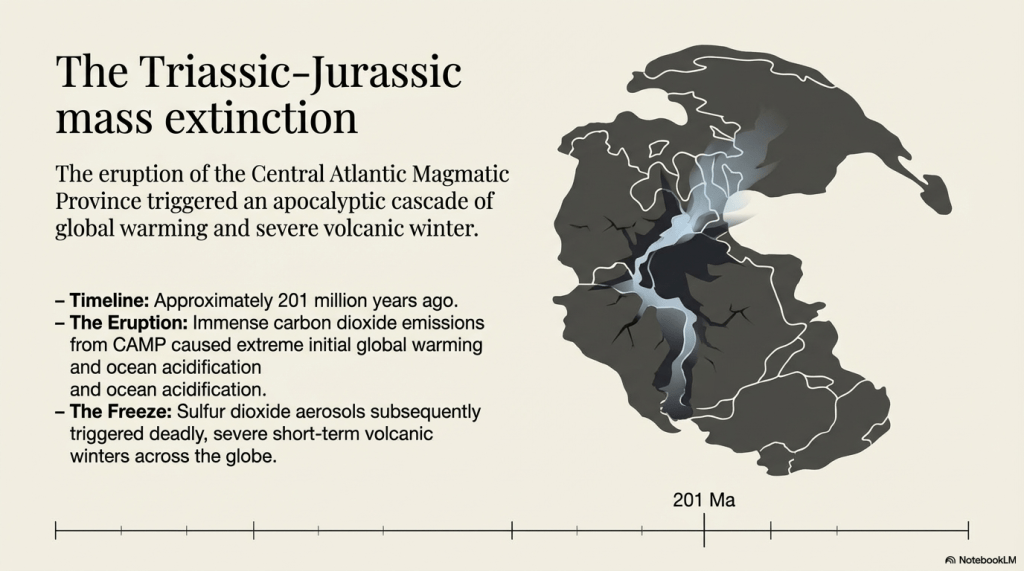
Around 201 million years ago the Earth experienced the Triassic–Jurassic mass extinction. The trigger was one of the largest volcanic events in planetary history, the eruption of the Central Atlantic Magmatic Province.
These eruptions occurred as the supercontinent Pangaea began to break apart. Vast flood basalts poured across enormous regions of what is now North America, South America, Africa, and Europe. The environmental consequences were severe.
Carbon dioxide levels spiked, driving intense global warming. Oceans acidified. Ecosystems destabilized.
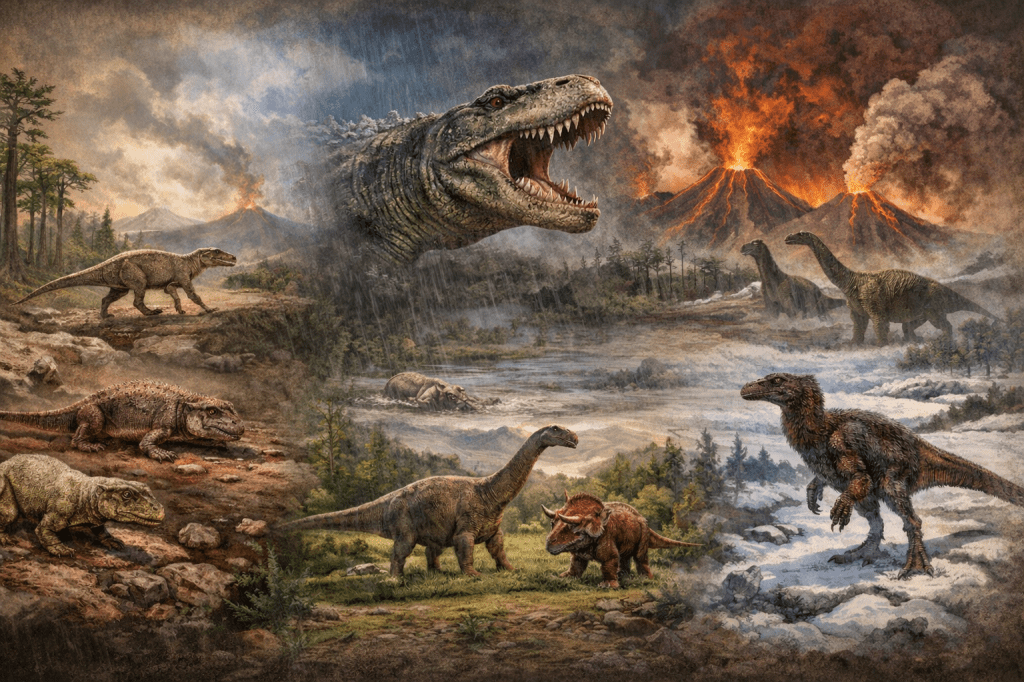
Yet volcanic eruptions also released large amounts of sulfur dioxide, which can temporarily block sunlight and cause dramatic cooling. The result may have been a series of brutal climatic whiplashes, alternating between greenhouse conditions and volcanic winters.
Not all animals were equally prepared for such chaos.
Geological evidence from regions such as the Junggar Basin in northwestern China suggests that high-latitude environments during the Late Triassic experienced freezing conditions and seasonal cold. Fossil evidence indicates that some dinosaurs had already adapted to these cooler climates.
Many theropods and other early dinosaurs possessed primitive feather-like structures that likely functioned as insulation. Combined with relatively high metabolic rates, these adaptations may have allowed them to tolerate colder conditions better than their reptilian rivals.
If severe volcanic winters swept across the planet during the extinction interval, insulated dinosaurs may have had a crucial survival advantage.
By contrast, many pseudosuchians appear to have been more tightly tied to warm tropical climates. When the environmental crisis struck, these reptiles were disproportionately affected.
A New Jurassic World
The end-Triassic extinction removed a large portion of the dinosaurs’ competitors.
Many pseudosuchian lineages disappeared entirely. Only a handful of small crocodylomorphs survived to continue the crocodilian line. Overall, roughly forty percent of terrestrial tetrapod groups vanished.
In the aftermath, dinosaurs found themselves in a radically altered world.
Curiously, the shapes and body plans of dinosaurs did not immediately change dramatically after the extinction event. Most of the key dinosaur morphologies had already evolved during the earlier Carnian diversification.
What changed instead was abundance.
During the Early Jurassic, dinosaur populations expanded enormously. Their taxonomic diversity increased, and they spread across nearly every terrestrial habitat.
Freed from competition with large pseudosuchians, dinosaurs began to occupy ecological roles that had previously been unavailable.
One factor that aided their success was locomotor flexibility. Early dinosaurs had begun as primarily bipedal animals, but their anatomy allowed for multiple evolutionary directions. Some lineages retained their running adaptations. Others shifted toward quadrupedal locomotion and evolved into massive herbivores.
This flexibility eventually produced the gigantic sauropods, the armored stegosaurs, the horned ceratopsians, and the swift theropods that would dominate Jurassic and Cretaceous ecosystems.
In evolutionary terms, dinosaurs had not simply outrun their rivals. They had inherited a world reshaped by catastrophe.
Fortune and Survival
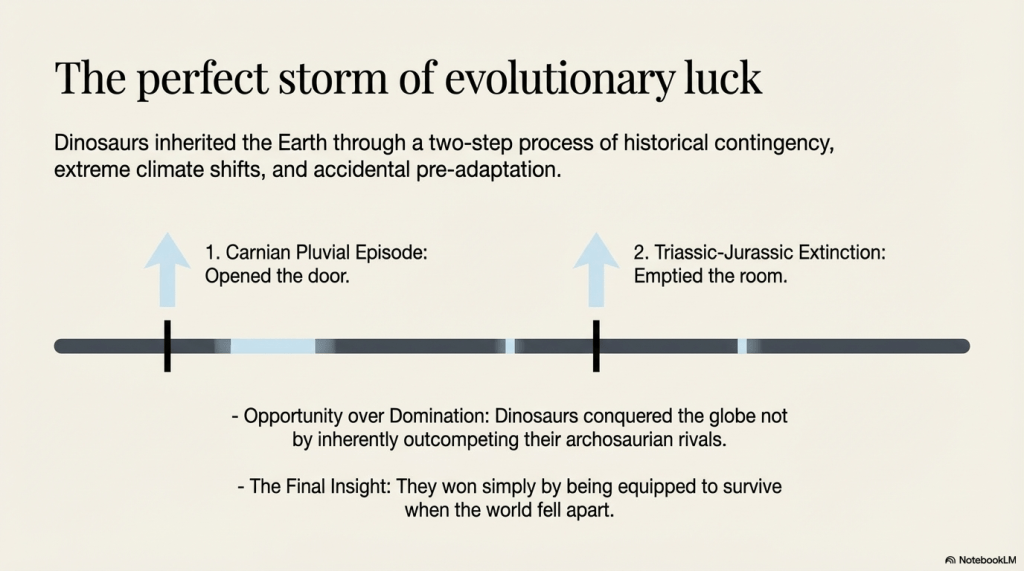
The rise of the dinosaurs was therefore not a simple story of superiority. It was a complex, two-stage process shaped heavily by environmental crises.
The Carnian Pluvial Episode opened ecological space by disrupting earlier herbivore communities. Dinosaurs diversified and began expanding into these new niches.
Then the Triassic–Jurassic mass extinction removed many of their remaining archosaurian competitors. Dinosaurs, already equipped with traits that allowed them to survive harsh climates, endured the crisis and emerged as the dominant terrestrial vertebrates of the Jurassic.
Their success owed as much to circumstance as to biology.
In the long sweep of evolutionary history, dominance is rarely permanent and rarely inevitable. Dinosaurs rose because they were adaptable, because they were fortunate, and because the world around them changed in ways that favored their survival.
For millions of years they had lingered in the shadows of the Triassic world. When catastrophe cleared the stage, they stepped forward and inherited the Earth.
Bernardi, Massimo, Piero Gianolla, Fabio Massimo Petti, Paolo Mietto, and Michael J. Benton. “Dinosaur Diversification Linked with the Carnian Pluvial Episode.” Nature Communications 9, no. 1499 (2018). https://doi.org/10.1038/s41467-018-03996-1.
Brusatte, Stephen L., Michael J. Benton, Marcello Ruta, and Graeme T. Lloyd. “The First 50 Myr of Dinosaur Evolution: Macroevolutionary Pattern and Morphological Disparity.” Biology Letters 4, no. 6 (2008): 733–736. https://doi.org/10.1098/rsbl.2008.0441.
Fawcett, Molly J., Stephan Lautenschlager, Jordan Bestwick, and Richard J. Butler. “Functional Morphology of the Triassic Apex Predator Saurosuchus galilei (Pseudosuchia: Loricata) and Convergence with a Post-Triassic Theropod Dinosaur.” The Anatomical Record (2023). https://doi.org/10.1002/ar.25299.
Fraser, Nicholas C., and Hans-Dieter Sues. “The Beginning of the ‘Age of Dinosaurs’: A Brief Overview of Terrestrial Biotic Changes during the Triassic.” Earth and Environmental Science Transactions of the Royal Society of Edinburgh(2010). https://doi.org/10.1017/S1755691011020019.
Krajick, Kevin. “Dinosaurs Took Over Amid Ice, Not Warmth, Says a New Study of Ancient Mass Extinction.” Lamont-Doherty Earth Observatory, Columbia University. July 1, 2022.
Langer, Max C., and Michael J. Benton. “Early Dinosaurs: A Phylogenetic Study.” Journal of Systematic Palaeontology4, no. 4 (2006): 309–358.
Nesbitt, Sterling J., Paul M. Barrett, Sarah Werning, Christian A. Sidor, and Alan J. Charig. “The Oldest Dinosaur? A Middle Triassic Dinosauriform from Tanzania.” Biology Letters 9, no. 1 (2013): 20120949. https://doi.org/10.1098/rsbl.2012.0949.
Shipley, Amy E., Armin Elsler, Suresh A. Singh, Thomas L. Stubbs, and Michael J. Benton. “Locomotion and the Early Mesozoic Success of Archosauromorpha.” Royal Society Open Science 11 (2024): 231495. https://doi.org/10.1098/rsos.231495.



 DAVE DOES HISTORY
Leave a comment