
The last time we stood together in this story, it was still dark at Moore’s Creek Bridge. Highland Scots charged across a greased span shouting “King George and broadswords.” Old Mother Covington answered. And in three violent minutes, Governor Josiah Martin’s grand Loyalist rising collapsed into swamp water and smoke.
But that battle was only half the story.
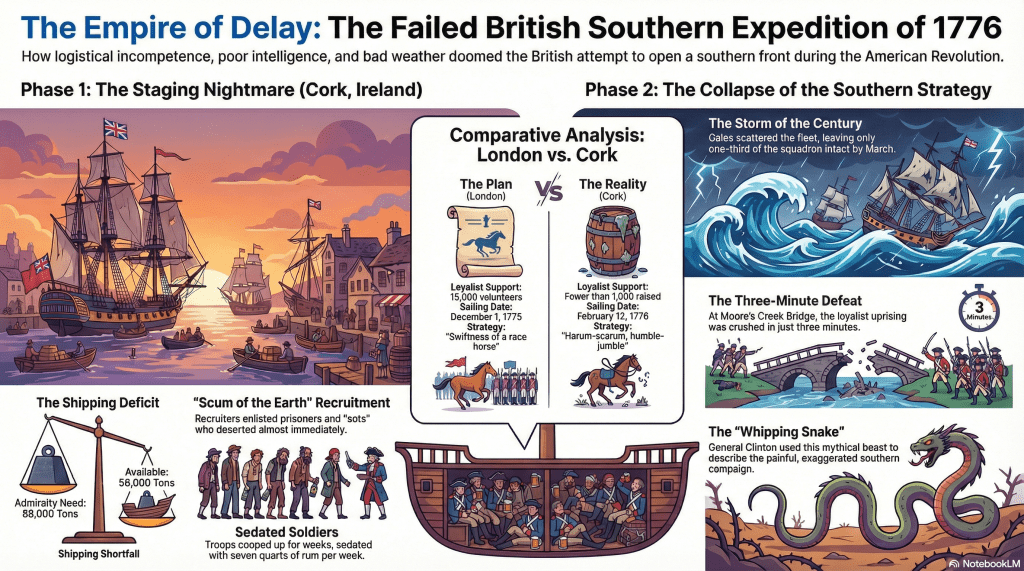
While Patriots were digging earthworks in North Carolina, an entire British expedition was assembling three thousand miles away in Cork, Ireland. On paper, this was the hammer meant to fall in coordination with that uprising. Seven regiments. Artillery. Royal confidence. The force that would secure the South, split the colonies in half, and end the rebellion cheaply.
Instead, Cork became a study in delusion, delay, and disaster.
In Greek mythology, Agamemnon faced a stalled fleet and silent winds. To move forward, he sacrificed his daughter Iphigenia. The winds returned. The army sailed. But the cost poisoned everything that followed. It was ambition demanding blood for the sake of momentum.
In the winter of 1776, Britain faced its own still winds. The empire believed it had discovered a shortcut. Crush the rebellion in the South. Do it quickly. Do it cheaply. Governor Martin promised 10,000 Loyalists would rise if London would send just a handful of regiments. King George III embraced what can only be called fatal optimism. Every means of distressing America would meet with his concurrence.
It was a beautiful theory.
It was also an illusion.
Before the fleet ever sailed, the plan was muddled. Orders from London were filled with conditionals. If the South can be secured. If resistance collapses. Secure the Carolinas, then abandon them and join Howe in the North. What began as a modest show-the-flag mission was already becoming something larger and less coherent.
Cork itself was less a city than an engine of war. Eighty thousand bullocks processed. Salted beef packed into barrels. The air thick with blood and livestock filth while merchants toasted one another with claret. Beneath the commerce was strain. Recruiting was abysmal. Desertion rampant. Ships were scarce. Deadlines slipped from December to January to February.
And when the fleet finally sailed on February 12, it sailed into a screaming gale.
Ships scattered. The Marquis of Rockingham sank. Ninety soldiers drowned. By the time the expedition straggled into North Carolina months later, Moore’s Creek had already been decided. The “domestic insurrection” Martin promised had dissolved in three minutes.
The Cork Expedition was not defeated by American brilliance. It was undone by hubris, delay, and the logistical impossibility of fighting a war across an ocean while relying on paper armies.
Empires can survive defeat.
They struggle to survive delusion.
And in 1776, it was delusion that sailed from Cork, and arrived far too late.

 DAVE DOES HISTORY
Leave a comment