
When Thomas Jefferson wrote the words, “He has excited domestic insurrections amongst us,” he was not indulging in rhetorical flourish. He was describing something painfully real. The ink of that accusation was still wet with memory. In the swamps of North Carolina, the Crown had not merely sent redcoats. It had tried to turn neighbor against neighbor.
The Revolution, as we prefer to remember it, is tidy. Patriots in homespun. British regulars in scarlet. Lines of musket fire and the clash of empire against liberty. But in the southern colonies, particularly the Carolinas, it was something harsher. It was a civil war. And the fuse was lit deliberately.
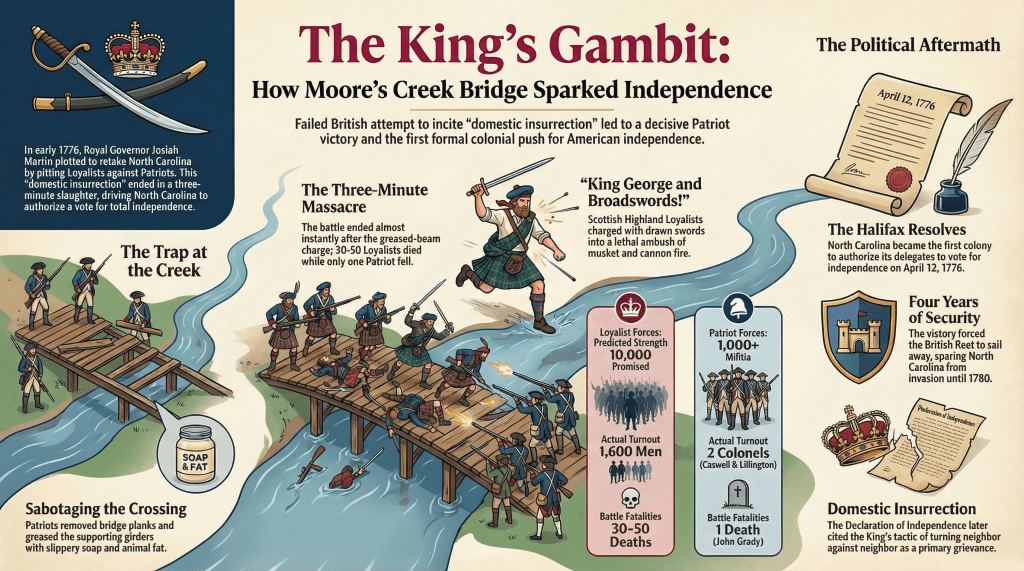
By late 1775, North Carolina was a colony teetering between rebellion and reprisal. Its royal governor, Josiah Martin, had already fled his capital at New Bern. Patriot pressure had made governance impossible. Instead of administering the king’s authority from a grand hall, Martin found himself exiled aboard the British warship Cruizer, anchored off the coast near Wilmington. From there, floating in uneasy safety, he drafted a plan bold enough to save the Crown’s southern holdings in one decisive stroke.
Martin convinced London that North Carolina could be reclaimed from within. He promised that he could raise an army of 10,000 loyal subjects who would rally to the king’s banner. These men would coordinate with a British invasion force of 7,000 troops sailing from across the Atlantic. The two forces would meet along the Cape Fear coast, crush the rebellion in North Carolina, then march northward, linking with British operations in Virginia and beyond.
On paper, it was elegant. A pincer from sea and soil. An uprising synchronized with imperial might. The Revolution strangled before it drew full breath.
But numbers on parchment and men in the mud are two different things.
To understand why Martin believed this might succeed, one must look at who he expected to answer his call.
The backbone of his projected army would be the Highland Scots of the Cape Fear region. Many were recent immigrants, drawn to North Carolina by promises of land and opportunity after the crushing of the Jacobite cause at Culloden. They had sworn oaths of loyalty to the Crown. They held royal land grants. Their cultural memory still burned with defeat at British hands, yet paradoxically, many remained loyal to King George III. Loyalty, for them, was not mere politics. It was identity, honor, survival.
Alongside them stood another unlikely constituency: the Regulators. These were backcountry settlers who had rebelled earlier against corrupt colonial officials in North Carolina. They despised eastern elites, and their resentment toward Patriot leadership in the colony often ran hotter than their feelings toward London. If offered a choice between distant royal authority and nearby gentry who taxed and judged them, some chose the king.
Martin’s genius, if one can call it that, lay in recognizing these fractures. He did not invent divisions within North Carolina. He exploited them. He offered incentives: land grants, tax exemptions, protection. Take up arms for the Crown, and you will be rewarded. Refuse, and you may find yourself on the losing side of history.
Jefferson later described it as incitement. He was not wrong.
Martin issued commissions to lead this internal army. Among them were Donald MacDonald, a veteran officer who had fought at Bunker Hill, and Donald McLeod. These men would gather the loyalist force at Cross Creek, what we now know as Fayetteville. From there, they would march to the coast, rendezvous with the British fleet, and begin the systematic reconquest of the southern colonies.
The gathering at Cross Creek was meant to be triumphant. Ten thousand loyal subjects, tartan banners snapping in the wind, claymores at their sides, marching to restore order. That was the fantasy.
The reality was humbler. Only about 1,600 men materialized.
Of those, many lacked firearms. They carried broadswords instead of muskets. They brought resolve, but not uniform equipment. They had spirit, but not discipline. Still, the timeline pressed forward. The British fleet was en route. The window for coordinated action was narrow. Delay meant failure.
So, the march began.
As the loyalist column moved south and east toward the coast, Patriot militia leaders mobilized in response. Colonel James Moore positioned forces to block the most direct routes. Rivers, creeks, and swamps defined the terrain of eastern North Carolina. Every crossing mattered. Every bridge became a potential battlefield.
What followed was not a grand set-piece engagement but a campaign of maneuver. The loyalists slipped around Patriot blockades, crossing waterways, burning bridges behind them, trying to evade interception. Patriot commanders Richard Caswell and Alexander Lillington moved swiftly to cut them off. Each side raced through cold winter countryside, navigating bog and forest in a desperate contest of timing.
The geography itself favored whoever could seize the choke points first. And in this landscape, one crossing loomed larger than the rest: Moore’s Creek Bridge.
By the time the loyalists approached it in late February 1776, the conflict had already transformed. What had begun as a governor’s gamble now teetered on the edge of catastrophe. The promised legion had shrunk to a determined but vulnerable column. The British fleet was still weeks away. And the Patriots, far from scattering, were organizing.
The bridge over Moore’s Creek would decide more than a march. It would test whether the Crown’s strategy of internal insurrection could succeed. It would reveal whether loyalty could be summoned by decree. And it would show, in the starkest way possible, what happens when a king wagers on civil war.
In the darkness before dawn on February 27, 1776, that wager was about to be called.
By the time the Loyalist column turned toward Moore’s Creek, the campaign had become a race measured in hours, not days. The original dream of a sweeping internal uprising had narrowed to a single objective: reach the coast, link with British regulars, and salvage the plan. Everything now depended on speed.
Patriot forces understood that as clearly as their opponents did.
Colonel James Moore first attempted to block the Loyalists along Rockfish Creek, forcing them into a frustrating series of detours. The countryside of eastern North Carolina was no open parade ground. It was a tangle of blackwater streams, marsh, pine forest, and narrow roads. Bridges were rare. Wagons bogged easily. Fires burned slowly in damp winter air. The army that controlled the crossings controlled the campaign.
When the Loyalists slipped past Moore’s position, Patriot commanders Richard Caswell and Alexander Lillington maneuvered ahead of them. They identified Moore’s Creek Bridge as the decisive choke point. It was one of the few viable crossings in the region, a narrow wooden structure spanning a dark, swift current. The creek itself was no mighty river, but it was deep enough and swampy enough to halt an army that tried to ford it blindly.
Whoever held the bridge held the road to Wilmington.
The Patriots arrived first.
At first, they made a mistake. Caswell’s men initially camped on the same side of the creek as the advancing Loyalists. Realizing that this left them exposed to a direct assault, they withdrew during the night across the bridge to the eastern bank. That retreat, however, was not panic. It was preparation.
The transformation of Moore’s Creek Bridge into a trap was deliberate and methodical.
Patriot soldiers removed the planks from the bridge, leaving only the rounded support beams running its length. Then, in one of those improvisations that history tends to overlook because it lacks polish, they coated the exposed beams with soap and tallow, rendered animal fat. The wood became slick as ice. In daylight, the crossing would have been treacherous. In darkness, it would be deadly.
Behind the bridge, the Patriots dug earthworks and positioned their artillery. Two small three-pound cannons were trained directly on the narrow approach. One had been nicknamed “Old Mother Covington,” after the matriarch of a local Patriot family. The other was playfully called her daughter. The names sound almost quaint, but in the predawn stillness they would speak with thunder.
The Patriots added one more layer to the deception. They left their abandoned campfires burning on the western bank, the side from which the Loyalists would approach. To an advancing force in the dark, the flicker of flame would suggest disorder, vulnerability, perhaps even retreat. The outline material from the broadcast describes this as a calculated decoy, meant to lure the attackers into believing the Patriots had fled.
Everything depended on timing. Everything depended on surprise.
Before dawn on February 27, 1776, the Loyalist column reached the western side of Moore’s Creek.
Their commander, Donald MacDonald, was ill (dunk off his Tam O’Shanter – Editor) and remained behind. Leadership fell to Colonel Donald McLeod. The Loyalists saw the glowing campfires and an apparently empty encampment. To them, it appeared that the Patriots had abandoned the position in haste. The bridge lay ahead, quiet and unguarded. Victory seemed within reach.
The Loyalists were largely Highland Scots. Many wore heavy woolen tartans. Many carried claymores, the broad Scottish swords that had become symbols of martial pride. Firearms were in short supply among them. But confidence was not.
As they formed to cross, voices rose in a cry that would echo through American memory: “King George and broadswords!”
It was not a whispered advance. It was a charge.
In the dim gray before sunrise, the first ranks surged onto the bridge. Almost immediately, reality intruded. The planks were gone. Beneath their boots were rounded beams, slick with grease. Men slipped. Others tried to steady themselves, balancing awkwardly over dark water. Behind them, more Loyalists pressed forward, unaware of the danger ahead.
Then the trap sprang.
From behind the earthworks on the eastern bank, Patriot muskets erupted in a coordinated volley. Cannon fire followed. “Old Mother Covington” boomed, its shot ripping through the narrow column compressed upon the bridge. In that confined space, there was no room to deploy, no opportunity to maneuver.
McLeod himself fell under a storm of bullets. Accounts record that he was struck repeatedly, more than twenty times. Leadership collapsed almost instantly.
The battle lasted roughly three minutes.
Three minutes.
In that brief span, the Loyalist advance disintegrated. Some men were cut down by musket fire. Others, unable to find footing on the greased beams, toppled into the creek. The water was not deep by grand standards, but it was deep enough, and the current strong enough, to claim men weighed down by soaked wool and equipment. Many drowned where they fell.
Behind the first ranks, confusion turned to panic. The narrow approach prevented rapid retreat. Those who had not yet stepped onto the bridge suddenly found themselves caught between forward momentum and deadly resistance. The very geography that had promised speed now ensured defeat.
When the smoke cleared, 30 to 50 Loyalists lay dead, many from drowning as much as gunfire. Approximately 850 were captured. The Patriots suffered only one fatality, a man named John Grady.
The grand internal army of North Carolina had been shattered in less time than it takes to boil water.
The implications rippled outward immediately.
The British fleet that was meant to rendezvous with this force would not arrive until May. Even had the Loyalists crossed successfully, they would have found no substantial support waiting for them. The coordination upon which Governor Martin’s entire strategy depended had unraveled.
Instead of linking with 7,000 British regulars, the Loyalist survivors found themselves disarmed and marched into captivity. The promised invasion of North Carolina evaporated. The larger British objective shifted southward toward Charleston.
But beyond military consequences lay something deeper.
For Patriots across the colonies, the events at Moore’s Creek confirmed what many had begun to suspect: the Crown was willing to ignite civil war to preserve its authority. This was not merely imperial enforcement. It was neighbor set against neighbor, incentivized and armed by royal decree.
Jefferson’s later language did not emerge from theory. It emerged from scenes like this.
Moore’s Creek was not Saratoga. It was not Yorktown. It lacked the grandeur that later historians prefer. Yet it revealed a truth about the Revolution that cannot be ignored. This struggle was not only between colonies and empire. It was a reckoning within communities, within families, within parishes and counties.
On that narrow, greased bridge in the Carolina swamp, the king’s gamble collapsed. The insurrection he hoped to kindle had instead hardened resistance. The charge of “King George and broadswords” faded into smoke, and in its place rose a new certainty among many in North Carolina.
If the Crown would wage war through internal division, then reconciliation was no longer possible.
The political consequences would follow swiftly.
When the smoke drifted away from Moore’s Creek on the morning of February 27, 1776, the military outcome was already beyond dispute. What remained unclear, at least in that moment, was how deeply the shock would travel.
It traveled far.
The Loyalist column that had marched so confidently from Cross Creek was gone. Roughly 850 men were taken prisoner. Their officers were dead or captured. Their weapons were seized. Their hopes of linking with British regulars dissolved in the Carolina swamp. The survivors were marched off under guard, many facing the grim choice of swearing renewed loyalty to the Patriot cause or returning to Scotland stripped of land and standing.
And then there was the British fleet.
The entire strategy of Governor Josiah Martin had depended on timing. Seven thousand regulars from across the Atlantic were to converge with this internal army. Together they would sweep the rebellion aside. Instead, when the fleet finally reached the Carolina coast in May, it found nothing waiting. No massed Loyalist army. No secure foothold. No restored royal authority.
The invasion that had been so carefully imagined never materialized.
British commanders adjusted course. Attention shifted southward toward Charleston. North Carolina, for the moment, was spared a full-scale British invasion. Strategically, the colony had dodged a cannonball. Politically, it had absorbed something even more powerful.
The emotional toll was not confined to battlefields.
Among the Loyalists were Highland Scots who had believed their loyalty to the Crown would secure their future. Instead, many lost everything. Land grants were voided. Property was confiscated. The famous Flora MacDonald, whose name had once been associated with Jacobite romance and daring escape in Scotland, saw her husband imprisoned. Her American experiment ended in loss and return. The romantic memory of Culloden met the hard arithmetic of revolution.
If one wishes to understand how civil wars harden attitudes, Moore’s Creek provides the case study.
For months, many colonists had still harbored hope that reconciliation might be possible. Parliament had overreached, perhaps. Ministers had erred. But could not some accommodation be reached with the king?
Moore’s Creek answered that question for North Carolina.
The battle confirmed that royal authority was prepared to arm one segment of the population against another. The outline of the February broadcast makes this connection explicit: by manufacturing a conflict between Loyalists and Patriots, the Crown was inciting internal war. This was not an abstract grievance. It had a location, a date, and a body count.
News of the victory spread quickly. In a colonial world connected by riders, taverns, and pamphlets, word traveled with speed. Patriots elsewhere in the colonies took notice. The king’s plan to detonate North Carolina from within had failed. The supposed reservoir of Loyalist strength in the South had proven fragile.
In North Carolina itself, something more profound occurred. Fear gave way to resolve.
Before Moore’s Creek, independence was a subject of debate. After Moore’s Creek, it became a destination.
On April 12, 1776, less than two months after the battle, North Carolina’s Provincial Congress adopted what became known as the Halifax Resolves. The language authorized the colony’s delegates to the Continental Congress not merely to consider independence, but to vote for it and to press for it. This was not vague encouragement. It was direct instruction.
North Carolina became the first colony to officially empower its representatives to support total independence from Great Britain.
That date, April 12, 1776, remains etched on the state flag to this day. It is not decorative nostalgia. It marks the moment when political steel replaced lingering hesitation.
Thomas Jefferson, drafting the Declaration of Independence in June, would include among his grievances the charge that the king “has excited domestic insurrections amongst us.” Those words were rooted in events like Moore’s Creek. When Jefferson listed that accusation, he was drawing from fresh memory. The image of a governor scheming from exile, of Highlanders charging across a greased bridge at royal encouragement, of neighbors firing upon neighbors, was not distant theory.
Moore’s Creek also altered the broader strategic map of the Revolution. British planners had hoped to capitalize on presumed Loyalist strength in the southern colonies. The swift collapse of Martin’s internal army complicated that calculus. The South would indeed become a central theater later in the war, but the notion that it could be easily reclaimed through Loyalist mobilization suffered a severe blow.
For Patriots, the lesson was clear: organized resistance, even improvised and locally led, could defeat royal strategy.
For Loyalists, the lesson was harsher. Allegiance to the Crown carried risk. The outcome at Moore’s Creek signaled that Patriot forces were not only willing but able to suppress internal opposition. The social fabric of the colony tightened under strain.
And so, Moore’s Creek Bridge occupies a peculiar place in Revolutionary memory. It was not a sprawling battle with thousands maneuvering across open fields. It was not immortalized in oil paintings of gleaming bayonets. It lasted three minutes.
Yet in those three minutes, a governor’s gamble collapsed, a strategy of civil fracture failed, and a colony’s patience ran out.
When historians search for the turning points that nudged America toward independence, they often look to grander names: Lexington, Bunker Hill, Saratoga. Moore’s Creek rarely headlines the list. Perhaps that is because its violence was intimate. It was not empire against continent. It was community against community, engineered from above.
But its consequences were undeniable.
The defeat of the insurrection emboldened North Carolina. The attempted use of domestic division to restore royal control hardened resistance instead. The colony that had nearly been reclaimed by internal uprising became the first to authorize independence formally and unequivocally.
The king had wagered that civil discord would weaken rebellion. Instead, it strengthened it.
On a narrow bridge in a Carolina swamp, the argument for reconciliation drowned. In its place rose a resolve that would carry forward to Philadelphia, to parchment, and eventually to a declaration heard around the world.
North Carolina would remember itself as “First in Freedom.”
And it was at Moore’s Creek that the claim began to earn its weight.

 DAVE DOES HISTORY
Leave a comment