
The Virginia Statute for Religious Freedom stands as one of the rare moments in history when law does more than regulate conduct. It redraws the boundaries of thought itself. Long described as an unparalleled achievement in Western political thought, the statute earned that reputation because it accomplished something no legislature had previously managed. It fully dismantled a state sanctioned church and did so not as a temporary expedient or a concession to political pressure, but as a matter of principle. In Virginia, religious establishment was not softened, pluralized, or redistributed. It was ended.
That decision did not emerge suddenly or cleanly. It was the product of more than a century of enforced conformity, decades of growing resistance, and a revolutionary moment that forced Virginians to reconsider not only who governed them, but what government itself was allowed to govern. The statute did not arise from abstract philosophy alone. It was forged in jail cells, courtrooms, parish vestries, and legislative chambers, shaped as much by resentment and suffering as by ideas.
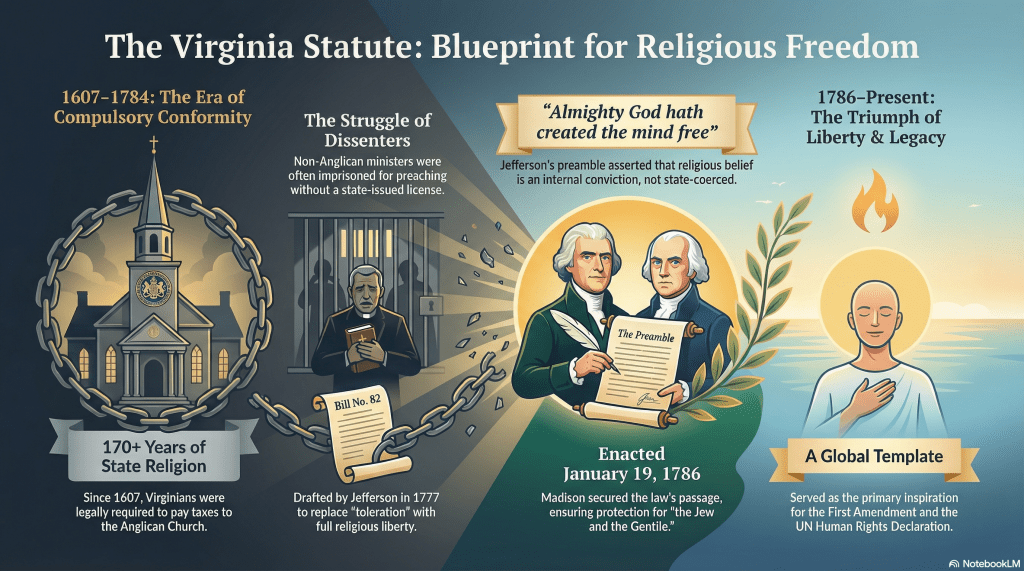
From the founding of Jamestown in 1607, the Church of England was embedded in the legal and financial structure of Virginia. Anglicanism was not simply the dominant religion. It was the official religion, supported by law and enforced by civil authority. Attendance at worship was compulsory. Taxes were levied to support ministers and maintain parish churches regardless of personal belief. Early colonial legal codes left little room for dissent. The Laws Divine, Moral and Martial of 1611 mandated daily worship and imposed severe penalties for blasphemy, religious neglect, or refusal to conform. Faith was not treated as a private matter. It was treated as a civic obligation.
The parish system reinforced this arrangement. Parish boundaries doubled as units of local governance, binding religious conformity to social order. Ministers exercised moral authority alongside civil power, recording births, marriages, and deaths, administering poor relief, and acting as guardians of communal behavior. To challenge the church was to challenge the structure of society itself. Religion and government did not merely cooperate. They overlapped.
For those who stood outside the Anglican establishment, the burden was immediate and personal. Baptist and Presbyterian ministers who preached without licenses were arrested and imprisoned. Congregations that resisted church taxes were fined or hauled into court. Ordinary Virginians were compelled to subsidize a religious system they did not believe in under threat of legal punishment. This was not theoretical intolerance. It was experienced in confiscated property, broken livelihoods, and time spent behind bars. Faith, under this regime, was entangled with power, and power rarely exercised restraint.
By the middle of the eighteenth century, that arrangement was beginning to fracture. The First Great Awakening swept through the colonies and reshaped Virginia’s religious landscape. Evangelical preaching emphasized personal conversion, emotional engagement, and direct interaction with scripture. It bypassed formal training and ecclesiastical hierarchy, appealing instead to conscience and experience. Baptist and Presbyterian congregations multiplied rapidly, particularly in rural areas where Anglican oversight was weaker and less consistent. These communities were often poor, tightly knit, and deeply committed. They did not quietly accept the burdens imposed by the state church. They resisted them.
That resistance mattered because it transformed religious liberty from a philosophical abstraction into a lived political demand. Dissenters petitioned legislatures, protested taxes, and challenged licensing laws. Their opposition was not limited to sermons or pamphlets. It appeared in courtrooms and jails, in organized petitions and collective refusals to comply. The pressure did not come from elite thinkers alone. It came from farmers, artisans, and itinerant preachers who had paid the cost of establishment firsthand. Without this rising tide of dissent, philosophical arguments might have remained safely theoretical.
At the same time, the intellectual climate of Virginia was shifting. Enlightenment ideas circulated widely among educated Virginians, particularly those engaged in revolutionary politics. Writers and statesmen increasingly questioned inherited authority and the assumption that power, once granted, was naturally benevolent. Thomas Jefferson absorbed these ideas deeply, especially the writings of John Locke. Locke argued that civil government existed to protect civil interests such as life, liberty, and property, not to dictate belief or concern itself with the salvation of souls. This distinction resonated in a society already challenging monarchy, hierarchy, and tradition.
These ideas did not replace religious conviction. They reframed the role of government in matters of faith. Belief, in this view, was not weakened by freedom. It was strengthened by it. Coercion produced conformity without conviction. Liberty allowed belief to stand or fall on its own merits.
The American Revolution accelerated this transformation. As Virginians challenged the legitimacy of British rule, they also began to question older assumptions about power and obedience more broadly. In 1776, the Virginia Declaration of Rights marked a critical turning point. Its original language offered religious toleration, but James Madison successfully amended it to guarantee free exercise instead. The change was subtle in wording and profound in meaning. Toleration implied permission granted by authority. Free exercise assumed a right that existed independent of government approval. That distinction laid the groundwork for more comprehensive reform.
It was against this backdrop that Jefferson drafted his Bill for Establishing Religious Freedom in 1777, designated Bill No. 82. The bill went further than any previous proposal. It asserted that religious belief was an internal matter, immune from coercion, and that civil rights must have no dependence on religious opinions. Jefferson did not seek to balance denominations or spread public funding more evenly. He sought to withdraw the state from the religious sphere altogether.
The bill’s preamble carried its philosophical weight. It declared that Almighty God hath created the mind free and that attempts to influence belief by coercion were both illegitimate and ineffective. Truth, Jefferson argued, did not require legal support. It would prevail on its own if left alone. The role of government was not to enforce doctrine, but to protect liberty.
Timing, however, worked against him. When the bill reached the legislature in 1779, Virginia was still consumed by war. Resources were strained, attention was divided, and lawmakers hesitated to provoke controversy while survival itself felt uncertain. Fear also played a role. Many believed that without state support, religion would weaken and public morality would collapse. The idea that social order depended on government backed faith was old, familiar, and comforting. Jefferson’s bill was tabled and left to wait.
That delay proved decisive. It allowed opposition to organize and alternative solutions to take shape. By the time the war ended, the question was no longer whether religious establishment would change, but how. Many Virginians were willing to loosen Anglican dominance, but not to abandon government involvement altogether. The stage was set for a confrontation that would determine whether religious liberty would mean genuine disestablishment or merely a rearrangement of control.
When the Revolutionary War finally loosened its grip on Virginia, the question of religion returned to the legislature with renewed urgency. The old Anglican establishment had been weakened by war, by dissent, and by the collapse of royal authority, but it had not been erased. What remained unresolved was whether the state would finally relinquish control over belief or simply redesign the mechanism by which that control was exercised. The years immediately following independence would answer that question, and the answer was not foreordained.
By the early 1780s, Virginia stood at an uneasy crossroads. The legal authority of the Church of England had eroded, but the assumption that government ought to support religion had not disappeared. Many lawmakers feared that removing public funding altogether would invite moral disorder. Religion, they believed, was a necessary support for republican virtue. Without it, liberty itself might collapse under the weight of human weakness. This fear was sincere, widespread, and deeply rooted in Western political tradition.
It was in this atmosphere that Patrick Henry reentered the debate. Few figures commanded more respect in Virginia. He was the voice of resistance to British tyranny, the orator who had warned that liberty must be defended at all costs. Yet on the question of religious establishment, Henry’s instincts remained cautious. In 1784, he introduced what became known as the General Assessment Bill, a proposal that sought to chart a middle course between full disestablishment and the old Anglican monopoly.
Henry’s plan called for a general tax to support Christian teachers. Rather than funding a single church, citizens would be allowed to direct their payments to the denomination of their choice or to religious education more broadly. On its face, the proposal appeared inclusive and moderate. It acknowledged religious diversity while preserving the belief that government ought to encourage faith. To many lawmakers, it seemed a reasonable compromise, one that avoided both sectarian favoritism and moral vacuum.
Yet beneath its surface, the General Assessment Bill preserved the core principle of establishment. The state would still compel citizens to support religion financially. Conscience would remain subordinate to law. Control would be dispersed, not abandoned. For those who had suffered under compulsory church taxes, the distinction was not subtle. It was decisive.
At this critical moment, Thomas Jefferson was absent from Virginia, serving as minister to France. The responsibility for opposing Henry’s proposal fell to James Madison. Madison approached the crisis with deliberate care. He understood that a direct confrontation would likely fail. Henry’s popularity and the lingering fear of moral collapse gave the assessment bill considerable momentum. Instead, Madison pursued a strategy that combined delay, persuasion, and public engagement.
His first move was procedural. Madison worked to postpone a vote on the assessment bill, buying time to shift public opinion. This delay was not obstruction for its own sake. It created space for argument, and argument was Madison’s chosen weapon. During this pause, he composed and anonymously circulated his Memorial and Remonstrance Against Religious Assessments.
The Memorial was not a fiery denunciation. It was a carefully reasoned appeal to principle, history, and consequence. Madison argued that religious belief was an inalienable right, one that belonged to the individual conscience and existed prior to the formation of civil society. Because this right predated government, it could not be legitimately regulated by it. To surrender control of belief to the state was not merely imprudent. It was unjust.
Madison also addressed the practical effects of state support for religion. Far from strengthening faith, he argued, government funding weakened it. Clergy supported by law grew complacent, insulated from the discipline of voluntary support. Citizens compelled to fund beliefs they did not share grew resentful. Religion, once backed by coercion, lost its moral authority. True faith, Madison insisted, depended on persuasion, not power.
These arguments struck a chord far beyond the walls of the legislature. The Memorial circulated widely among Virginia’s dissenting communities, particularly Baptists and Presbyterians who had long resisted compulsory church taxes and licensing laws. These groups recognized the assessment bill as a renewed threat to their hard won freedom. They responded with organized resistance.
Petitions flooded the General Assembly. Congregations that had once been isolated by geography or poverty found a common cause. The language of the Memorial gave structure and legitimacy to grievances that had been felt for decades. What had begun as a legislative proposal now faced a storm of public opposition that could not be dismissed as theoretical or marginal.
This popular response altered the political calculus. Lawmakers who had been inclined to support Henry’s proposal began to reconsider. The assessment bill no longer appeared as a safe compromise. It appeared as a return to coercion under a different name. The momentum shifted steadily away from establishment in any form.
Henry, sensing the change, found his position increasingly isolated. His reputation could not overcome the breadth of resistance. The General Assessment Bill collapsed under the combined weight of Madison’s reasoning and public protest. With its defeat, the final obstacle to full disestablishment was removed.
Madison moved quickly. With the alternative proposal eliminated, he reintroduced Jefferson’s original Bill for Establishing Religious Freedom, unchanged in its core principles. The delay that had once hindered the bill now worked in its favor. Years of debate had clarified the stakes. Public opinion had hardened. The choice before the legislature was no longer between order and chaos. It was between coercion and liberty.
The vote in January 1786 reflected that transformation. The General Assembly passed the Virginia Statute for Religious Freedom, bringing an end to more than a century of state sanctioned religion. Yet even in victory, one final decision remained.
During debate, an amendment was proposed to insert the name of Jesus Christ into the statute’s preamble. The proposal carried symbolic weight. Its adoption would have narrowed the law’s scope, anchoring it explicitly in Christian doctrine. Its rejection would affirm a broader principle. The Assembly chose the latter.
This decision was not an act of hostility toward Christianity. It was a declaration of intent. The law would protect belief itself, not a particular theology. Its protection would extend to all, regardless of creed or lack thereof. The state would not rank consciences. It would not define orthodoxy. It would withdraw.
With that choice, the statute completed its work. It did not promise harmony or shared belief. It promised liberty of conscience, grounded in the conviction that belief, if it was to have meaning at all, must be freely chosen.
The decade long struggle that produced the statute revealed something essential about the American experiment. Freedom of conscience was not granted in a single moment of clarity. It was won through delay, argument, resistance, and an unusual willingness to relinquish power. The final consequences of that decision would reach far beyond Virginia, shaping constitutional law, judicial interpretation, and global understandings of human rights. Those consequences would unfold slowly, but their foundation was now firmly set.
When the Virginia Statute for Religious Freedom became law in January 1786, its immediate effects were clear enough. The legal authority of the state over belief was ended. Compulsory church taxes ceased. Licensing requirements for ministers vanished. No citizen’s civil standing could be enhanced or diminished on the basis of religious opinion. Yet the deeper consequences of the statute unfolded more slowly, as its principles migrated beyond Virginia and into the broader architecture of American law and political thought.
The statute did not seek to manage religion. It sought to leave it alone. That restraint was its most radical feature. In a world accustomed to governments that claimed responsibility for the moral condition of their citizens, the Virginia legislature chose to renounce that role. The statute did not claim that religion was unimportant. It claimed that religion was beyond the competence of the state. Belief, it declared, could not be compelled, supervised, or protected by law without being corrupted in the process.
This idea was tested almost immediately. Virginia did not collapse into moral disorder. Churches did not disappear. In fact, religious life flourished in the absence of state control. Congregations supported their ministers voluntarily. New denominations emerged. Old ones adapted. Faith persisted, not because it was enforced, but because it was chosen. The fears that had delayed disestablishment proved unfounded, and that quiet success mattered as much as the law itself.
The statute’s principles soon traveled beyond Virginia’s borders. When the federal Constitution was drafted, the question of religion returned with renewed urgency. The framers faced the challenge of uniting states with different religious traditions under a single national government. The solution they adopted reflected the logic of the Virginia statute. Congress would make no law respecting an establishment of religion, nor prohibit the free exercise thereof. The federal government would neither enforce belief nor suppress it.
This was not an abstract formulation. It was a direct inheritance. The statute had demonstrated that liberty of conscience could be secured by withdrawal rather than supervision. The First Amendment carried that insight into national law. It did not define doctrine. It defined boundaries.
Over time, courts were called upon to interpret those boundaries. When judges sought to understand what religious freedom meant in practice, they repeatedly turned to the Virginia statute as a guide. In the nineteenth century, the Supreme Court described it as defining the original meaning of religious liberty as understood by the founding generation. That recognition anchored constitutional interpretation in a specific legislative act rather than in vague aspiration.
In the twentieth century, the statute again served as a point of reference when the Court addressed the relationship between church and state. Its insistence that civil authority had no jurisdiction over belief informed decisions that applied the First Amendment’s principles to the states. The metaphor of a wall separating church and state did not emerge from judicial invention. It reflected the statute’s core logic. Religion, to remain free, must remain outside the machinery of government.
This legal legacy was reinforced by the statute’s universal scope. By rejecting sectarian language, the Virginia legislature ensured that religious liberty would not belong to one tradition alone. The law protected Christians and non Christians alike, believers and skeptics together. This universality was not an afterthought. It was central to the statute’s philosophy. If liberty of conscience rested on the freedom of the mind, then it could not be limited by theology. The state could not protect one conscience without threatening all others.
That principle proved durable. As American society grew more diverse, the statute’s refusal to rank beliefs allowed religious liberty to adapt without losing coherence. The law did not require agreement. It required restraint. It did not promise harmony. It promised freedom.
The influence of the statute extended beyond the United States. Thomas Jefferson understood its broader significance and ensured that it did not remain a local curiosity. He arranged for the statute to be translated and circulated across Europe, where it entered debates about rights, governance, and conscience. In nations still struggling with religious establishment, the Virginia example offered a different model. It showed that a government could renounce control over belief without sacrificing stability or order.
In the twentieth century, the statute’s principles found expression in international human rights law. The guarantee of freedom of thought, conscience, and religion adopted after the Second World War echoed the logic Jefferson and Madison had articulated more than a century earlier. Belief was recognized as an internal matter. Coercion was rejected as illegitimate. Liberty of conscience was treated as a universal human right rather than a concession granted by the state. What began as a statute in a single American commonwealth became part of a global vocabulary of rights.
Jefferson’s own view of the statute’s importance offers a final measure of its significance. When he composed the inscription for his tombstone, he chose to list only three accomplishments. He authored the Declaration of Independence. He authored the Virginia Statute for Religious Freedom. He founded the University of Virginia. He did not mention the presidency. This omission was deliberate. Jefferson believed that offices were transient. Ideas that liberated the human mind endured.
That judgment has held. The statute endures not because it solved every problem associated with religion and politics, but because it refused to solve them by force. It did not attempt to perfect belief. It declined to manage it. The law rested on a quiet confidence that truth did not require enforcement and that conscience, left free, could govern itself.
The Virginia Statute for Religious Freedom stands as a reminder that liberty sometimes advances through subtraction rather than assertion. By removing the state from the realm of belief, the statute created space for faith, doubt, and conviction to exist without supervision. It trusted citizens to navigate questions of ultimate meaning on their own terms. That trust reshaped American law, influenced global human rights, and remains one of the most demanding and consequential ideas to emerge from the revolutionary era.
Taken together, this story reveals a hard won truth. Freedom of conscience was not inevitable. It was contested, delayed, resisted, and finally secured through argument, sacrifice, and restraint. The statute’s legacy lies not in the power it exercised, but in the power it relinquished. In doing so, it affirmed a principle that remains as challenging today as it was in 1786. Belief, if it is to mean anything at all, must be free.


 DAVE DOES HISTORY
Leave a comment