
Alexander Hamilton entered the world already marked by circumstances that polite society preferred not to discuss. He was born in the British West Indies, on the island of Nevis, the son of James Hamilton and Rachel Faucette Lavien. Even the year of his birth remains uncertain, likely 1755 or 1757, which is fitting for a man whose life never quite fit clean categories. Illegitimacy was not merely a social embarrassment in the eighteenth century. It was a legal condition, one that followed a person like a brand. From the beginning, Hamilton was defined less by what he was than by what he was not permitted to be.

The phrase often attached to him, the “bastard brat of a Scotch peddler,” was not an insult coined by enemies after success. It reflected the assumptions of the world into which he was born. In the Caribbean colonies, lineage mattered. Respectability mattered. Hamilton possessed neither. His parents were not married because Rachel Lavien was still legally bound to her first husband, a man who had imprisoned her after a failed marriage. This detail would later become ammunition for critics, but in the Caribbean it was simply fact, unsoftened by sentiment.
James Hamilton, his father, drifted out of the family’s life around 1765. He was not cruel so much as absent, a man incapable of sustaining responsibility. The departure left Rachel and her sons exposed in a society that offered little mercy. Three years later, in 1768, Rachel died of yellow fever. Hamilton was still a boy. Within months, the fragile scaffolding holding his world together collapsed completely. His mother’s estate was seized. Because he was illegitimate, Hamilton was barred from inheritance. Even the small security she might have provided was denied to him by law.
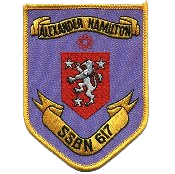
USS Alexander Hamilton
SSBN-617 on
Patrol Reports
He was taken in briefly by a cousin, Peter Lytton, who soon died by suicide. This detail rarely receives much attention, perhaps because it complicates the clean narrative of genius rescued by opportunity. The truth is messier. By his early teens, Hamilton had endured abandonment, death, legal erasure, and the kind of instability that leaves permanent marks. It is difficult to read his later obsession with order, structure, and authority without hearing the echo of this early chaos.
Necessity forced Hamilton into work early. He found employment as a clerk at the trading firm of Beekman and Cruger on the island of St. Croix. This was not genteel bookkeeping. Caribbean trade in the eighteenth century was a hard, unforgiving business, tied to shipping schedules, fluctuating currencies, insurance risks, and the brutal realities of the Atlantic economy. Sugar, rum, and enslaved labor were part of the same system. Hamilton did not create it, but he learned it intimately.
At an age when many of his future peers were still receiving classical instruction, Hamilton was managing cargo manifests, tracking exchange rates, and corresponding with merchants across the Atlantic. He learned how credit worked, how fragile it was, and how trust could be converted into profit or disaster. These were not abstractions. A delayed shipment could ruin a firm. A misjudged risk could sink a vessel. The young clerk absorbed the logic of commerce not as theory, but as survival.
It was in this environment that Hamilton’s ambition surfaced with startling clarity. In a 1769 letter to his friend Edward Stevens, he lamented his obscurity and expressed a desire for war, believing it would provide an opportunity to distinguish himself. The line is often quoted with a hint of youthful bravado, but it deserves closer reading. Hamilton was not glorifying violence. He was articulating a belief that systems reward action, not birth. War, in his mind, was a disruptive force that could reorder hierarchies. For someone excluded by law and custom, disruption was opportunity.
The Caribbean was also where Hamilton learned the limits of sentiment. Trade rewarded discipline, calculation, and foresight. It punished hesitation. This lesson stayed with him. Later critics would accuse him of coldness, of preferring numbers to people. That charge misunderstands the environment that shaped him. In the world Hamilton came from, numbers were not abstractions. They represented ships, wages, debts, and lives. Disorder had consequences.
In 1772, nature delivered its own reminder of fragility. A massive hurricane struck the Caribbean, tearing through islands with little regard for human planning. Buildings were destroyed. Ships were wrecked. Commerce halted. In the aftermath, Hamilton wrote a detailed account of the storm, describing not only the physical destruction but the moral reckoning it imposed. The letter was published in the Royal Danish American Gazette, likely without his knowledge or consent.
The essay revealed a voice far beyond his years. It combined vivid description with reflection, conveying both the terror of the storm and the vulnerability of human systems. Local leaders took notice. This was not simply a talented clerk. This was a mind capable of synthesis, observation, and persuasion. In response, a subscription fund was raised to send Hamilton to North America for education.
This moment is often portrayed as rescue, as though benevolent patrons plucked a deserving boy from obscurity. The reality is more transactional. The community recognized an asset worth investing in. Hamilton had already proven his value. His passage north was not charity. It was opportunity, earned through demonstration of ability under pressure.
When Hamilton left the Caribbean, he did not leave its lessons behind. He carried with him an understanding of empire that few of his future compatriots possessed. He had seen British colonial administration up close, not as an abstraction but as an operating system. He understood trade routes, financial dependency, and the vulnerabilities of imperial logistics. He had watched how distant decisions reverberated through local lives.
He also carried a permanent awareness of precarity. Unlike Virginia planters or Massachusetts merchants, Hamilton had no ancestral land, no family fortune, no safety net. Everything he achieved would be constructed. Everything could be lost. This awareness sharpened his thinking and hardened his resolve. It also made him impatient with what he would later view as complacency among those who assumed independence alone guaranteed stability.
By the time he arrived in North America, Hamilton was already formed in critical ways. He was not a blank slate awaiting enlightenment. He was a product of the Atlantic world, forged in commerce, sharpened by loss, and driven by an unrelenting desire to impose order on chaos. His later arguments for strong government, sound credit, and national authority did not emerge from abstract theory. They emerged from lived experience.
Part I of Hamilton’s story is not the tale of a prodigy destined for greatness by providence. It is the story of a boy who learned early that systems determine outcomes, that sentiment does not substitute for structure, and that stability must be built deliberately. He did not romanticize hardship, but he understood it. He did not trust luck. He trusted design.
When Hamilton stepped onto the mainland colonies, he carried no illusions about human nature or political virtue. He believed people acted in their interests. He believed institutions mattered. He believed disorder invited collapse. These beliefs would soon place him at the center of revolution, controversy, and enduring influence. But they were born far from Philadelphia and New York, under Caribbean skies, in a world where survival depended on understanding how power actually worked.
That world never left him.
Alexander Hamilton arrived in North America with no illusions about comfort, but even he could not have predicted how quickly the colonies would sharpen him. The world he entered was already tense, already argumentative, already pulling itself apart over questions of authority and allegiance. This suited him. Instability had never frightened Hamilton. What unsettled him was drift, the sense that events might unfold without design or purpose. In the years immediately following his arrival, he found both education and agitation in abundance.
His early schooling at Elizabethtown Academy in New Jersey introduced him to formal classical education, but it was at King’s College in New York City where Hamilton truly came alive. The college itself was a Loyalist-leaning institution, and that fact mattered. Hamilton was not radicalized in an echo chamber. He was surrounded by students and faculty who defended royal authority, tradition, and gradual reform. Arguments were not hypothetical. They were daily, personal, and sharp edged.
New York in the early 1770s was a volatile place. It was a commercial hub, tied tightly to British trade, and deeply divided in loyalty. Hamilton watched as political ideas spilled out of taverns, newspapers, and street corners. He did not drift into the Patriot cause out of sentiment. He argued his way there. He listened, evaluated, and then committed with characteristic intensity.
By 1774, Hamilton was writing publicly. His pamphlet A Full Vindication of the Measures of Congress took aim at Loyalist critics and defended colonial resistance with a clarity that surprised readers who assumed its author must be older and more established. When critics responded, Hamilton answered again with The Farmer Refuted, a longer and more aggressive work that dismantled Loyalist arguments point by point. These were not crowd pleasing slogans. They were dense, legalistic, and rooted in constitutional reasoning.
What mattered was not merely that Hamilton supported the Patriot cause, but how he did so. He framed resistance as a question of lawful authority rather than mob passion. Parliament, he argued, had overstepped its legitimate bounds. Power required consent. Force without legitimacy bred instability. Even at this early stage, Hamilton was less interested in rebellion than in replacement. If British authority was to be rejected, something sturdier would need to take its place.
Ideas alone, however, did not satisfy him. When fighting broke out, Hamilton sought action. He joined a volunteer militia unit known as the Hearts of Oak, composed largely of students and young tradesmen. They drilled in graveyards and public spaces, watched by both supporters and skeptics. It was not yet an army. It was a rehearsal.
In 1776, Hamilton received a commission as Captain of the New York Provincial Company of Artillery. This was not ceremonial. Artillery required discipline, mathematics, and calm under pressure. Guns had to be placed precisely. Ammunition managed carefully. Panic ruined outcomes. Hamilton excelled. During the New York campaign, he distinguished himself under fire, even as the Patriot cause faltered and retreated.
The battles of Trenton and Princeton later that year offered a different kind of test. These were risky operations, dependent on timing, secrecy, and resolve. Hamilton’s artillery performed effectively, helping turn momentum at moments when failure could have ended the war outright. He learned firsthand how fragile victory could be, how narrow the margin between success and disaster often was.
His competence did not go unnoticed. In 1777, George Washington invited Hamilton to join his staff as an aide-de-camp. The position carried no battlefield glory, but it placed Hamilton at the center of the war effort. He became Washington’s principal secretary, managing correspondence, drafting orders, negotiating with foreign officers, and coordinating logistics across a fragile coalition of states and militias.
This relationship shaped Hamilton profoundly. Washington was older, cautious, and acutely aware of political realities. Hamilton was younger, restless, and intellectually aggressive. What developed between them has often been described as a father son dynamic, though it was more complex than that phrase suggests. Washington trusted Hamilton’s judgment. Hamilton admired Washington’s steadiness. Each compensated for the other’s limitations.
From headquarters, Hamilton witnessed the war as a system rather than a series of battles. He saw the consequences of weak central authority, the endless disputes between states, the difficulty of supplying an army that technically did not belong to any single government. Soldiers went unpaid. Supplies arrived late or not at all. Congress argued while the army froze.
These frustrations left deep impressions. Hamilton began to articulate, in letters and private memoranda, the necessity of a stronger national structure. Victory, he concluded, would mean little if the country that emerged could not sustain itself. Independence without order would invite collapse or conquest. These were not abstract fears. They were daily realities.
Yet Hamilton grew increasingly dissatisfied with his role. Desk work chafed. He wanted a field command, a chance to prove himself in action rather than administration. In early 1781, after a minor but symbolic dispute with Washington, Hamilton resigned from the staff. The break was brief and respectful, but it mattered. Hamilton needed closure on his own terms.
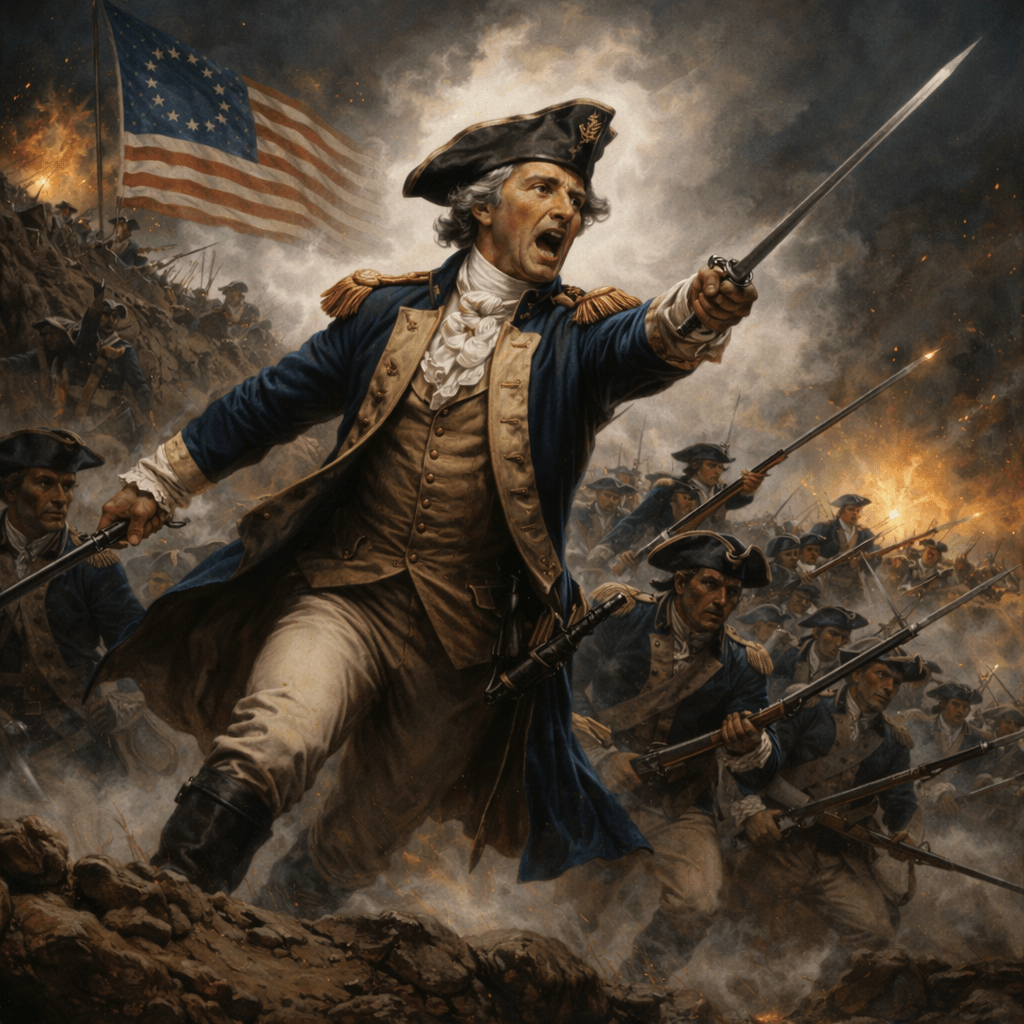
That opportunity arrived at Yorktown. As the combined American and French forces tightened their siege around Cornwallis, Hamilton requested a combat role. Washington agreed. Hamilton was given command of a light infantry battalion tasked with assaulting Redoubt No. 10, a fortified British position critical to the siege.
The attack was conducted at night, with bayonets fixed and muskets unloaded to maintain silence. Hamilton led from the front. The assault succeeded quickly, decisively, and at relatively low cost. The capture of Redoubt No. 10 helped seal the fate of the British army and, by extension, the war itself.
For Hamilton, Yorktown was more than a military success. It resolved a personal tension between intellect and action. He had proven himself not only as a thinker and organizer, but as a leader under fire. The war ended soon after, but Hamilton emerged with a reputation that extended beyond pamphlets and correspondence.
The Revolution transformed him, but not in the way later mythology sometimes suggests. It did not turn him into a romantic idealist. It confirmed his skepticism. He had seen courage, but also pettiness. He had seen sacrifice, but also incompetence. He had watched an army survive despite its government, not because of it.
As the war drew to a close, Hamilton turned his attention toward the peace that would follow. He understood that victory on the battlefield did not guarantee stability. The same weaknesses that had plagued the war effort threatened the future republic. States guarded their prerogatives. Congress lacked authority. Credit was shattered.
Hamilton’s rise during the Revolutionary War was not accidental. It was the product of preparation meeting chaos. He entered the conflict already hardened by experience, sharpened by education, and driven by ambition. The war gave him a proving ground. It also gave him a diagnosis of the American condition.
He emerged convinced that liberty required structure, that passion required restraint, and that nations, like armies, functioned only when authority was clear and responsibility enforceable. These convictions would soon place him at the center of debates that would shape the Constitution and the country that grew from it.
The boy who had learned commerce in the Caribbean had now learned command in revolution. He had seen what happened when systems failed. He had seen what it took to make them work. The next phase of his life would be devoted not to winning independence, but to making it last.
Victory did not bring relief. For Alexander Hamilton, the years immediately following the Revolutionary War were among the most unsettling of his life. The enemy had surrendered, but disorder remained. The army disbanded slowly, unpaid and embittered. Congress argued and delayed. The states guarded their sovereignty like jealous heirs, each convinced that independence meant insulation from obligation. The Confederation that had carried the colonies through war now seemed incapable of carrying them through peace.
Hamilton watched this unfold with mounting alarm. During the war, he had tolerated weakness in Congress because necessity demanded patience. In peace, patience felt like surrender. The Articles of Confederation had produced a government that could request but not compel, recommend but not enforce. It could not tax. It could not reliably pay soldiers. It could not secure credit. It could not speak with authority to foreign powers. In Hamilton’s view, it could not survive.
The episode known as the Newburgh Conspiracy sharpened these fears. In 1783, frustrated officers encamped near Newburgh, New York circulated anonymous letters hinting at mutiny unless Congress addressed unpaid wages and pensions. Washington defused the crisis with restraint and moral authority, but the underlying problem remained unresolved. Hamilton understood the lesson clearly. A republic that relied on personal virtue rather than institutional strength was gambling with its own existence.
After resigning his commission, Hamilton turned to law, not because he wished to retreat from public life, but because law was the language of power in the world he sought to build. He practiced in New York, handled commercial cases, and immersed himself in the mechanics of governance. At the same time, he pressed for reform. The Confederation, he argued, was not merely inefficient. It was dangerous.
This conviction led him to Annapolis in 1786. The convention itself was modest, poorly attended, and limited in scope. Only five states sent delegates. Its ostensible purpose was to address trade disputes among the states. Hamilton saw something larger. Along with James Madison, he used the gathering to issue a call for a broader convention, one empowered to revise the foundations of American government.
The Annapolis Convention did not solve anything directly, but it served as a catalyst. It named the problem without disguises. The existing system was failing. The solution would require more than amendment. It would require reconstruction.
When delegates gathered in Philadelphia in 1787, Hamilton arrived as one of three representatives from New York. His position was awkward from the start. The New York delegation was divided, with the other two delegates hostile to centralized authority. Hamilton was outnumbered within his own state, yet he refused to temper his views for the sake of unity.
His most dramatic moment came when he delivered a speech that lasted several hours. The text was not preserved in full, but its substance was remembered and debated. Hamilton argued for a strong national government, complete with an executive who would serve for life, subject to good behavior. Senators, too, would hold long terms. State governments would be subordinated to national authority.
The proposal startled many delegates. Some dismissed it as monarchism by another name. Others recognized it as an extreme case, designed less to be adopted than to frame the range of acceptable debate. Hamilton himself seemed to understand this. He knew his plan would not prevail. What mattered was shifting the center of gravity, making a vigorous government appear moderate by comparison.
Despite his limited influence on the final shape of the Constitution, Hamilton remained engaged. When the New York delegation withdrew in protest, he stayed. In the end, he was the only delegate from New York to sign the Constitution. It was a symbolic act, and a lonely one. He signed not because the document reflected his ideal, but because it represented a workable beginning.
Ratification, however, was far from assured. Opposition emerged quickly, articulate and suspicious. Critics argued that the Constitution concentrated too much power, endangered liberty, and threatened the autonomy of the states. In New York, resistance was especially fierce. Hamilton recognized that the fight had only begun.
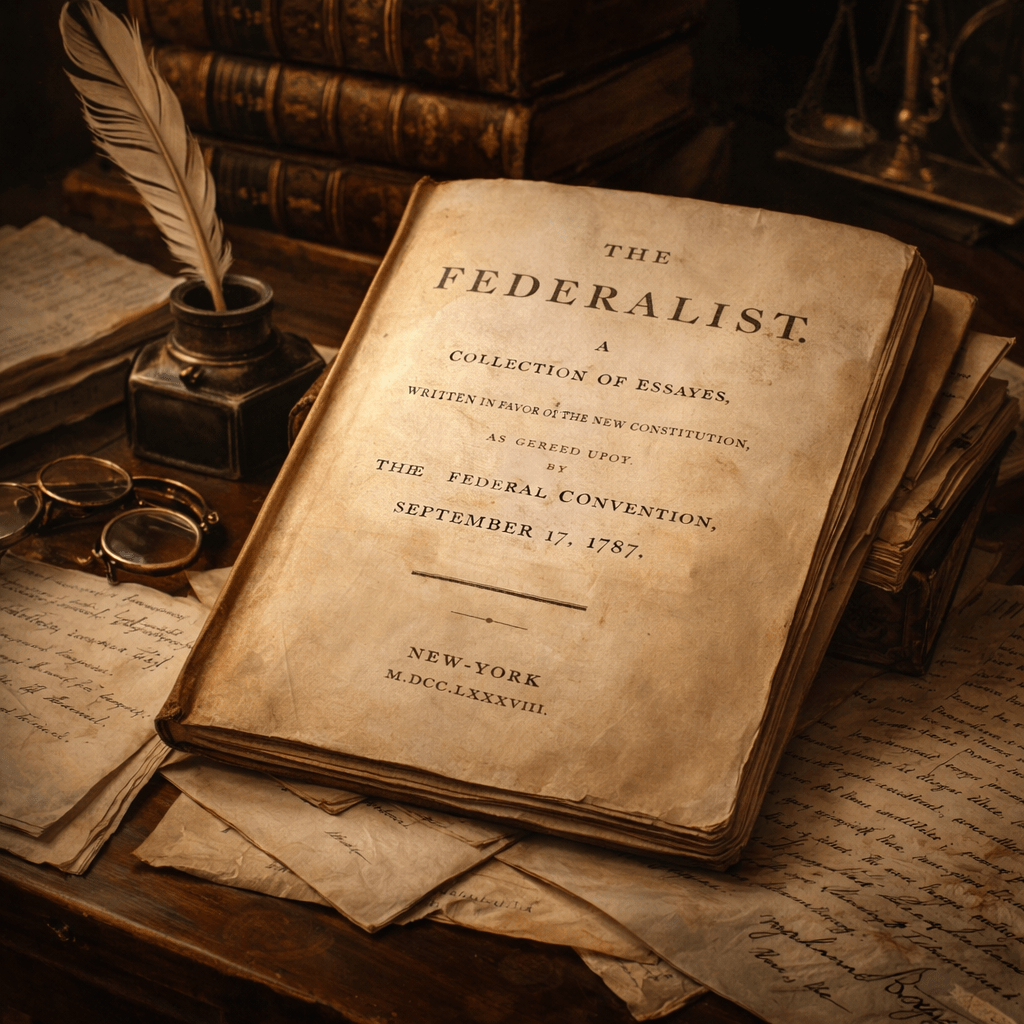
The response took the form of a series of essays published under the pseudonym Publius. Hamilton recruited James Madison and John Jay as collaborators, but he bore the bulk of the work himself. Of the eighty-five essays that would become known as The Federalist Papers, Hamilton wrote fifty-one. He wrote rapidly, often under pressure, driven by the belief that argument could still shape outcome.
These essays were not campaign slogans. They were sustained arguments, grounded in history, political theory, and practical experience. Hamilton addressed the nature of faction, the necessity of energy in the executive, and the structure of the judiciary. In Federalist 78, he articulated the principle of judicial review, arguing that courts must have the authority to declare legislative acts unconstitutional. This was not explicitly stated in the Constitution, but Hamilton insisted it was implicit in the logic of a written charter.
Perhaps most controversially, Hamilton opposed the inclusion of a Bill of Rights. In Federalist 84, he argued that the Constitution itself functioned as a bill of rights by limiting government powers to those enumerated. Listing specific rights, he warned, might imply that unlisted rights were unprotected. This position would later be overtaken by political necessity, but it revealed Hamilton’s deeper concern. He feared weakness more than overreach.
Throughout The Federalist, Hamilton returned to a single theme. Government was not an abstraction. It was an instrument. Its effectiveness depended on structure, authority, and enforcement. Liberty, he argued, could not survive anarchy. Rights without power were promises without guarantee.
The essays did their work. Ratification succeeded, narrowly in some states, decisively in others. In New York, Hamilton’s relentless advocacy helped turn the tide. When the Constitution took effect, it did so not as a perfect document, but as a living framework, capable of expansion and strain.
Hamilton emerged from the ratification struggle as the foremost interpreter of the new system. He understood its compromises because he had tested their limits. He accepted its imperfections because he had measured them against the alternative. The Constitution, in his view, was not sacred text. It was architecture.
This perspective explains both his later achievements and the controversies that followed. Hamilton did not venerate minimal government for its own sake. He valued effectiveness. He did not trust virtue to substitute for design. He trusted incentives, enforcement, and clear lines of authority.
For modern audiences, especially those wary of centralized power, Hamilton can be an unsettling figure. He believed in hierarchy. He distrusted mass enthusiasm. He assumed that ambition, if left unchecked, would corrode republics from within. These assumptions did not make him cynical. They made him cautious.
What Hamilton offered was not a guarantee of good government, but a framework capable of sustaining one. He accepted that power could be abused. His answer was not to weaken government until it could do no harm, but to structure it so that ambition would counter ambition, authority would be accountable, and failure would be visible.
By the end of the 1780s, Hamilton had moved from revolutionary to nation builder. He had fought the war, diagnosed the peace, and helped design the machinery that would govern a continent. He had done so without illusions about human nature and without patience for sentimentality.
The Constitution was ratified, but the nation it governed was still fragile. Debt loomed. Credit was broken. Institutions existed on paper, not in practice. Hamilton understood that design without implementation was fantasy. The next stage of his life would test whether theory could survive reality.
He had helped construct the blueprint. Now he would be asked to make it function.
When George Washington took the oath of office in 1789, the new Constitution had given the United States a framework, but not a functioning government. The ink was barely dry, the machinery untested, and the nation’s finances were in ruins. The war had been won on credit and promises. Peace revealed the bill. Congress could barely meet its obligations. Soldiers held unpaid certificates worth a fraction of their face value. Foreign lenders doubted American seriousness. Domestic confidence was brittle. Washington understood that if the republic failed financially, its political ideals would not matter.
He turned to Alexander Hamilton.
The appointment of Hamilton as the first Secretary of the Treasury was both obvious and controversial. No one else possessed his combination of experience, energy, and conceptual clarity. At the same time, many feared him. Hamilton did not disguise his belief that strong government was necessary. He spoke plainly about authority, discipline, and enforcement. In a nation freshly freed from imperial control, these were unsettling words. Washington valued competence over comfort. He gave Hamilton wide latitude and expected results.
Hamilton moved quickly. His first major task was to confront the national debt. The United States owed roughly seventy-five million dollars, an enormous sum for a young nation. About twenty-five million of that debt was owed by individual states. Some states, particularly in the South, had already paid down their obligations. Others had not. The situation bred resentment, confusion, and speculation. Debt certificates changed hands at deep discounts, often purchased by speculators betting on federal repayment.
Hamilton’s solution was both simple and radical. The federal government would assume the state debts and fund the entire national debt at face value. Creditors would be paid in full. The debt would be honored, not repudiated. This, Hamilton argued, would establish American credit at home and abroad. Trust, once earned, would lower borrowing costs and stabilize the economy.
The opposition was immediate and fierce. James Madison led the charge against assumption, arguing that it rewarded speculators and punished states that had acted responsibly. Southern representatives resented the idea of paying for northern debts. Others feared that consolidating debt at the national level would consolidate power as well. Hamilton listened, calculated, and pressed forward anyway.
He understood that credit was not a moral exercise. It was a practical one. If the government demonstrated that its promises meant something, future borrowing would become easier. If it faltered, the nation would be branded unreliable. Hamilton also recognized that tying wealthy creditors to the success of the federal government would create a constituency invested in its survival. Critics called this manipulation. Hamilton called it alignment.
The deadlock threatened to derail the entire program. The solution came not through argument, but negotiation. In 1790, over a private dinner with Thomas Jefferson and James Madison, a compromise was reached. Hamilton would secure passage of his financial plan. In return, the permanent national capital would be located along the Potomac River. Each side believed it had conceded less than it gained. The republic moved forward on a bargain struck over food and fatigue.
With funding and assumption in place, Hamilton turned to the next pillar of his system. He proposed the creation of a national bank. Modeled in part on the Bank of England, the institution would manage government deposits, issue loans, collect taxes, and stabilize currency. It would be jointly owned, with both public and private investment, and chartered for a fixed term.
The proposal ignited a constitutional firestorm. Thomas Jefferson and Attorney General Edmund Randolph argued that the Constitution granted no explicit authority to create a bank. Powers not enumerated, they insisted, were reserved to the states. To allow otherwise would open the door to unlimited federal authority.
Hamilton responded with one of the most consequential arguments in American constitutional history. In a written opinion requested by Washington, he asserted that the Constitution allowed for implied powers. The Necessary and Proper Clause, Hamilton argued, permitted Congress to choose reasonable means to execute its enumerated powers. If managing finances was a legitimate federal function, then creating a bank to do so was lawful.
Washington considered the arguments carefully. He was wary of precedent, but he trusted Hamilton’s reasoning. He signed the bank bill into law in 1791. With that signature, the federal government affirmed a broad interpretation of its own authority. The decision would echo through every subsequent debate over federal power.
Hamilton did not pause. He believed momentum mattered. His Report on Manufactures, submitted later that year, laid out a vision for American economic development that departed sharply from the agrarian ideal cherished by many of his contemporaries. Hamilton argued that manufacturing would diversify the economy, reduce dependence on foreign goods, and provide employment. He advocated tariffs and subsidies to nurture domestic industry and encourage immigration.
The report was not fully adopted, but its ideas endured. Hamilton understood that independence without economic strength was illusion. A nation that could not produce would always depend. Critics accused him of favoring elites and cities over farmers. Hamilton did not deny that industrialization would change society. He argued that change was unavoidable and preferable to stagnation.
To enforce the laws that made his system function, Hamilton established the Revenue Cutter Service, a small fleet tasked with combating smuggling and collecting tariffs. This was not glamorous work, but it was essential. Without enforcement, revenue laws were suggestions. The cutters represented federal authority made visible along the coastline. They were the ancestors of the modern Coast Guard, and they embodied Hamilton’s belief that law without enforcement was theater.
He also oversaw the creation of the United States Mint, replacing the chaotic mix of foreign coins and barter with a standardized national currency. The decimal system he championed simplified transactions and reinforced national identity. Money, Hamilton understood, was not just a medium of exchange. It was a symbol of sovereignty.
Throughout his tenure, Hamilton worked relentlessly. He wrote late into the night, answered critics point by point, and maintained a pace that exhausted allies and enemies alike. He viewed the Treasury not as a bookkeeping office, but as the engine of national survival. Every policy was connected. Credit enabled growth. Growth enabled stability. Stability preserved independence.
The resistance never ceased. Madison and Jefferson grew increasingly alarmed by Hamilton’s influence. They accused him of monarchist sympathies, corruption, and undue closeness to British financial models. Hamilton, in turn, accused them of romanticism and irresponsibility. The disputes hardened into the first American political parties, with Hamilton at the center of the storm.
What is often missed is how personal the stakes were. If Hamilton’s system failed, the republic might collapse into debt, division, or foreign dependence. If it succeeded, it would entrench a powerful federal government that many feared. Hamilton accepted this risk. He believed weakness posed a greater danger than authority.
By the time he resigned in 1795, exhausted and increasingly embattled, the basic architecture of American finance was in place. The nation had credit. It had a bank. It had revenue, currency, and enforcement. These were not abstractions. They were tools, tested and functioning.
Hamilton left office having transformed theory into reality. He had taken the constitutional blueprint and wired it with power. The consequences were immediate and enduring. The United States could borrow, pay, invest, and grow. It could act as a nation rather than a loose association of states.
The cost was division. Hamilton’s success intensified suspicion and opposition. He became a lightning rod for fear of centralized power and elite influence. He accepted the role reluctantly, but without apology. He had never expected gratitude.
For those who prefer simpler stories, Hamilton is a difficult figure. He was brilliant, abrasive, and often unforgiving. He trusted systems more than sentiment and design more than virtue. Yet the structures he built outlived his reputation, his rivals, and even his life.
When Hamilton stepped down from the Treasury, the republic was no longer an experiment trembling on the edge of insolvency. It was a functioning state, capable of sustaining itself in a hostile world. That transformation did not happen by accident. It happened because one man insisted that independence required infrastructure, that liberty required credit, and that ideals without institutions were fragile things.
The nation would argue over his legacy for generations. It would use his tools even while questioning his motives. Hamilton had done what he set out to do. He made the government work.
By the mid-1790s, Alexander Hamilton had won most of the battles that mattered to him, and in doing so, he had made enemies who would never forgive him. The machinery of government functioned. Credit was restored. Institutions endured. What fractured was the political consensus that had briefly held the early republic together. The arguments that once took place in pamphlets and private correspondence hardened into camps, and Hamilton stood unmistakably at the center of one of them.
The emergence of political parties was not something Hamilton initially welcomed, but it was something he understood. He believed conflict was inevitable in a free society and preferable to stagnation. What concerned him was not disagreement, but disintegration. The Federalists he helped to shape favored a strong national government, a commercial economy, and close ties to Britain as the dominant trading power of the Atlantic world. They valued order, stability, and predictability. To their opponents, this looked suspiciously like elitism.
Across the divide stood the Democratic Republicans, led by Thomas Jefferson and James Madison. They envisioned an agrarian republic, grounded in local control and wary of centralized authority. They saw the French Revolution, at least in its early stages, as an extension of the same struggle for liberty that had animated America. Hamilton saw something else entirely. He watched the French Revolution descend into violence, faction, and purges, and he concluded that unchecked popular passion was as dangerous as tyranny.
These disagreements were not theoretical. They shaped policy, alliances, and public rhetoric. The Jay Treaty of 1795, which sought to normalize relations with Britain and avert another war, became a flashpoint. Hamilton supported it as a practical necessity. The United States was not ready for renewed conflict. Trade mattered more than wounded pride. Jeffersonians denounced the treaty as a betrayal of republican principles and a capitulation to monarchy.
The debate was vicious. Hamilton was burned in effigy. Crowds shouted him down. He responded in the only way he knew how, by arguing relentlessly and publicly. He wrote essays, gave speeches, and defended the treaty point by point. He was often correct on the merits. He was also tone deaf to the growing resentment his certainty provoked.
By this point, Hamilton no longer held office. He had returned to private law practice, but he remained deeply involved in public affairs. He advised Washington. He shaped Federalist strategy. He could not let go of the belief that the republic still required guidance. That belief, admirable in its seriousness, began to curdle into rigidity.
Then came the episode that shattered what remained of his political standing.
In 1797, rumors surfaced that Hamilton had engaged in financial misconduct while serving as Secretary of the Treasury. The accusation struck at the core of his identity. Hamilton could tolerate being called arrogant or authoritarian. He could not tolerate being called corrupt. When confronted, he made a decision that remains difficult to defend and impossible to ignore.
Years earlier, Hamilton had engaged in an extramarital affair with Maria Reynolds. Her husband, James Reynolds, discovered the relationship and used it to blackmail Hamilton. Payments were made, not from public funds, but from Hamilton’s own pocket. When political enemies began to suggest that these payments represented embezzlement, Hamilton faced a choice. He could allow suspicion to linger, or he could expose himself fully.
He chose exposure.
The document that followed, known ever since as the Reynolds Pamphlet, was a detailed public confession of adultery. Hamilton laid out the affair, the blackmail, and the payments in painstaking detail to demonstrate that no public money had been misused. He succeeded on that narrow point. No evidence of financial corruption was found. His integrity as a public official was preserved.
Everything else was destroyed.
The pamphlet humiliated his wife, Eliza, and devastated his family. It provided endless ammunition to his enemies and alienated even his allies. In an era that prized public virtue, Hamilton had chosen honesty over discretion and paid the price. It was a decision rooted in the same uncompromising logic that had guided his public career. He would rather be ruined than suspected.
From that moment forward, Hamilton’s influence declined. He remained intellectually formidable, but his moral authority was compromised. Younger Federalists distanced themselves. Jeffersonians delighted in his fall. The man who had once dominated debate now found himself on the defensive, increasingly isolated and embittered.
The election of 1800 marked the final act of Hamilton’s political life. The Federalist Party, fractured and exhausted, nominated John Adams for a second term. Hamilton despised Adams, whom he viewed as vain, erratic, and unsuited to command. Rather than support the ticket fully, Hamilton worked quietly to undermine it. He circulated criticisms among party leaders and attempted to influence the outcome behind the scenes.
The result was catastrophe. The election produced a tie between Thomas Jefferson and Aaron Burr, throwing the decision to the House of Representatives. Federalists suddenly held the balance of power. Hamilton, though no longer trusted, still commanded attention. He intervened decisively.
Hamilton disliked Jefferson deeply. He opposed his politics, distrusted his optimism, and feared his weakness. Yet he believed Jefferson possessed principles. Burr, in Hamilton’s judgment, possessed none. Burr was ambitious, charming, and unmoored. He would use any ideology that advanced his interests. That, to Hamilton, made him dangerous.
Hamilton lobbied Federalists to support Jefferson. He argued that Jefferson, however misguided, loved liberty. Burr loved only himself. The effort succeeded. Jefferson was elected president. Burr became vice president, a consolation prize that satisfied no one.
Hamilton had shaped the outcome of a presidential election without holding office. It was his last significant political act. It also ensured that Aaron Burr would never forgive him.
The rivalry between Hamilton and Burr had deep roots. Burr had defeated Hamilton’s father-in-law, Philip Schuyler, for a Senate seat in 1791. The two men had crossed paths repeatedly in New York politics, each viewing the other with suspicion and contempt. Hamilton spoke of Burr with a frankness that bordered on recklessness. Burr remembered every slight.
In 1804, Burr ran for governor of New York. Hamilton opposed him openly. During the campaign, a letter was published in the Albany Register reporting that Hamilton had expressed a “despicable opinion” of Burr. The exact wording was vague, but the implication was clear. Burr demanded a retraction. Hamilton refused to offer one that satisfied Burr’s sense of honor.
What followed was a familiar and tragic ritual. Letters were exchanged. Positions hardened. Honor was invoked as though it were a measurable substance. Neither man truly wanted reconciliation. Each believed retreat would confirm the worst accusations against him.
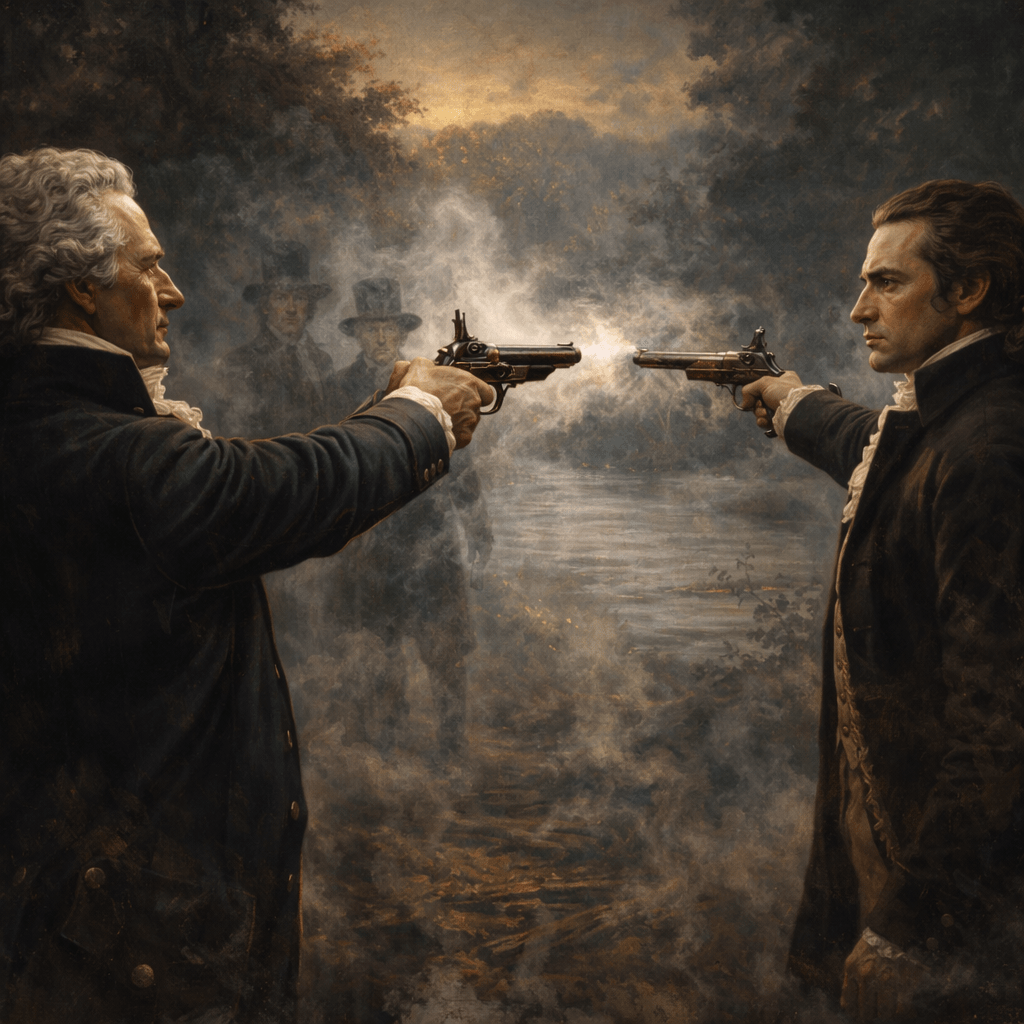
The meeting was set for July 11, 1804, at Weehawken, New Jersey, the same location where Hamilton’s son Philip had been killed in a duel three years earlier. Hamilton understood the symbolism. He also understood the risk. In a written statement prepared before the encounter, Hamilton declared his intention to throw away his shot, to fire into the air rather than at Burr.
What happened in those seconds has been argued ever since. Accounts differ. What is certain is that Burr fired and struck Hamilton. Hamilton fell, mortally wounded. He was carried back across the river to New York.
Alexander Hamilton died the following day, July 12, 1804. He received communion from Bishop Benjamin Moore. He was forty-nine years old. His death was widely mourned and widely politicized. To some, he was a martyr to principle. To others, a cautionary tale of ambition unchecked.
What remains striking is how little of his life fits neatly into modern categories. Hamilton was not a democrat in the contemporary sense. He distrusted mass movements and sentimental appeals. He was not a tyrant. He believed in law, representation, and accountability. He was not corrupt. He was painfully, often disastrously honest.
His political decline was not the result of a single mistake, but of accumulated rigidity. Hamilton could adapt systems. He struggled to adapt himself. He demanded of others the same clarity and discipline he demanded of institutions. When they failed to meet that standard, he judged them harshly.
Yet even in decline, his influence endured. The financial system he built remained intact. The constitutional interpretations he advanced continued to guide courts and lawmakers. The parties that rose in opposition to him used his structures to advance their own agendas.
Hamilton did not live to see reconciliation. He did not live to see his reputation restored. That work fell to others, most notably his wife, Eliza, who devoted decades to preserving his papers and defending his name. She understood what many of his contemporaries could not, that Hamilton’s flaws were inseparable from his achievements.
The republic he helped construct survived him. It argued, expanded, fractured, and endured. It did so using tools he designed and assumptions he articulated. Hamilton did not ask to be loved. He asked to be effective.
In the end, his life closed as it had begun, abruptly and without sentimentality. There was no grand reconciliation, no final triumph. There was only consequence. Alexander Hamilton lived at the intersection of ambition and structure, brilliance and abrasion. He built systems meant to outlast him. They did.
History remembers him not because he was agreeable, but because he was necessary.
Alexander Hamilton did not live long enough to manage his own reputation. In death, as in life, he left unfinished work behind him. What followed was not an immediate reckoning, but a slow, contested sorting of memory, influence, and consequence. His ideas endured more securely than his name. His systems functioned even as his character was debated. For decades after his death, Hamilton existed more as a problem than a hero, admired quietly by those who relied on his architecture and criticized loudly by those unsettled by his temperament.
The task of preserving him fell almost entirely to his widow, Eliza Hamilton. She survived him by half a century, long enough to witness the republic mature, fracture, and expand. She also lived long enough to see how easily a reputation could harden into caricature. Eliza understood something essential about her husband that many contemporaries missed. Hamilton’s life could not be reduced to a duel, a pamphlet, or a set of political enemies. It had to be documented, contextualized, and defended patiently.
In the years after his death, Eliza faced immediate hardship. Hamilton left behind debts and a large family. Yet she refused to retreat into obscurity. Instead, she devoted herself to public service and preservation. She co-founded the first private orphanage in New York City, an institution that reflected both personal loss and civic responsibility. This was not symbolic charity. It was sustained, practical work, carried out over decades.
More consequential still was her effort to collect, organize, and publish Hamilton’s papers. She wrote letters, conducted interviews, and pursued documents scattered across states and archives. She corrected errors and challenged misrepresentations. Where Hamilton had been combative, Eliza was methodical. Where he had burned bridges, she rebuilt them quietly. Without her, much of what is known about Hamilton’s inner life, reasoning, and intentions would have been lost or distorted.
Her work shaped the historical record. It did not sanitize him, but it preserved him in full, contradictions included. She understood that complexity was not weakness. It was truth. By the time she died in 1854, Hamilton’s place in the nation’s founding story was more secure, even if still contested.
The durability of Hamilton’s ideas is easier to measure than the durability of his reputation. The doctrines he advanced did not fade with fashion. The principle of implied powers became a cornerstone of constitutional interpretation. Courts repeatedly returned to the logic Hamilton articulated in Federalist 78, affirming the authority of judicial review and the necessity of an independent judiciary. Legislators and executives relied on his arguments whenever the federal government acted beyond the most literal reading of enumerated powers.
These debates did not resolve themselves neatly. They never do. What Hamilton provided was not finality, but framework. His vision assumed conflict and accommodated it. He did not promise harmony. He promised function. In this sense, his legacy is visible not in moments of consensus, but in moments of strain, when the system bends without breaking.
The financial structures Hamilton designed proved equally resilient. The concepts of national credit, funded debt, and centralized fiscal authority allowed the United States to expand, industrialize, and weather crises. Later generations would revise, regulate, and sometimes dismantle specific institutions, including the original national bank. Yet the underlying assumptions remained. A nation that wished to act in the world required credit. Credit required trust. Trust required enforcement and consistency.
Hamilton’s emphasis on manufacturing and diversification anticipated developments that would define the nineteenth and twentieth centuries. While his Report on Manufactures was not fully implemented in his lifetime, its logic guided future policy. Tariffs, infrastructure investment, and industrial growth followed the path he outlined. The agrarian republic imagined by some of his contemporaries proved insufficient for a continental power. Hamilton had predicted as much, not out of disdain for farming, but out of realism about scale.
The military and maritime institutions he helped create also endured. The Revenue Cutter Service evolved into the Coast Guard, a visible reminder that Hamilton understood sovereignty as something enforced, not merely declared. Law without presence meant little. Authority without reach was illusion.
For much of American history, Hamilton remained a figure admired by specialists and neglected by the broader public. He lacked the pastoral appeal of Jefferson, the stoic grandeur of Washington, or the mythic tragedy of Lincoln. His life was cluttered with arguments, paperwork, and disputes that resisted simplification. He did not lend himself easily to monuments.
That changed abruptly in the twenty-first century.
Lin Manuel Miranda’s musical Hamilton reintroduced the founder to a new generation, reframing him as an immigrant striver and lyrical protagonist. The production used hip hop and modern musical language to bridge centuries, presenting Hamilton’s life as a story of urgency, ambition, and voice. It was not a documentary. It was interpretation. Yet it achieved something historians rarely manage. It made people care.
The musical sparked renewed interest and renewed controversy. Critics questioned its portrayal of Hamilton’s relationship with slavery, its treatment of elitism, and its selective emphasis. Supporters argued that it captured essential truths about energy, insecurity, and the immigrant experience. Both were correct, within limits. Art simplifies in order to reveal. History complicates in order to explain.
Hamilton himself would likely have understood the trade. He knew that narratives shaped power. He also knew that accuracy mattered. The challenge for modern audiences is not to accept any single portrayal uncritically, whether hagiographic or condemnatory, but to sit with the tension.
Hamilton did not oppose slavery as forcefully as later generations might wish. He did oppose its expansion and associated himself with abolitionist efforts in New York, but he operated within the moral constraints of his time and class. He was elitist in temperament and assumption. He believed some people were better suited to govern than others. These facts should not be ignored or excused. They should be understood.
What complicates the picture is that Hamilton’s systems proved capable of being used by people who disagreed with him. Jeffersonians inherited his financial architecture. Jacksonians railed against his bank while relying on national credit. Progressives expanded federal power using doctrines he articulated. Conservatives defended constitutional structure using arguments he refined. Hamilton’s ideas outgrew his intentions.
This is perhaps the most telling measure of his legacy. He built frameworks that did not require his continued presence or ideological purity to function. They absorbed opposition and adaptation. They survived reinterpretation. That durability was not accidental. It reflected a deep understanding of human nature and political reality.
Hamilton never trusted virtue alone to preserve liberty. He trusted incentives, checks, and institutions. He believed ambition would always exist. His solution was not to eliminate it, but to harness it. This outlook unsettles those who prefer simpler moral landscapes. It also explains why his work remains relevant.
For military veterans and those accustomed to organizational life, Hamilton’s worldview often resonates more clearly. He understood chains of command, logistics, morale, and accountability. He knew that ideals without supply lines fail. He knew that loyalty without structure frays. His experience in war shaped his approach to peace.
For conservative audiences wary of unchecked power, Hamilton presents a paradox. He argued for strong government, but he also argued for constraint through structure. He feared chaos more than authority, but he feared arbitrary authority as well. His commitment was not to power for its own sake, but to power that could be justified, reviewed, and corrected.
Hamilton did not believe the American experiment would succeed automatically. He believed it required maintenance. That belief remains relevant in any era tempted by complacency. His life offers no neat moral lesson, no comforting assurance that good intentions suffice. It offers instead a harder truth. Republics survive when design meets discipline and when ideals are supported by institutions capable of enforcing them.
In the end, Hamilton’s legacy is neither spotless nor sinister. It is functional. He left behind a nation capable of acting, adapting, and enduring. He did so at great personal cost and with limited grace. He was often wrong in manner and sometimes wrong in judgment. He was rarely wrong about what was at stake.
Eliza Hamilton understood this when she labored to preserve his papers. She did not ask the future to forgive him. She asked it to know him. That knowledge has expanded and shifted over time, shaped by scholarship, debate, and culture. It will continue to do so.
Alexander Hamilton remains where he always was, at the intersection of ambition and structure, principle and pragmatism. He built systems that outlived him and arguments that refuse to settle. He did not leave a finished nation. He left a working one.
History has not finished with him, and it should not.


 DAVE DOES HISTORY
Leave a comment