
The first thing to understand about Woodrow Wilson is that he never stopped believing he was the smartest man in the room, and he never doubted that this was a public service. Wilson did not enter politics the way most politicians do, by compromise, instinct, or appetite for power. He entered it as a man convinced that history itself had been waiting for a proper explanation, and that explanation had finally arrived wearing pince-nez and carrying a footnote. If this sounds unkind, it is not meant to be. It is meant to be accurate. Wilson was earnest, brilliant, disciplined, and convinced that moral clarity, once articulated clearly enough, would bend the world into better shape. That conviction carried him astonishingly far, and it carried him just as surely into moral blind alleys he never fully recognized.
Wilson was born in Staunton, Virginia, in 1856, into a South that still believed defeat in the Civil War had been a misunderstanding rather than a verdict. His father, a Presbyterian minister, preached providence and order with the certainty of a man who believed God had a filing system. Young Thomas Woodrow Wilson absorbed this worldview early. History, in his mind, was not chaotic or tragic in the classical sense. It was instructional. Nations rose and fell according to principles, and those principles could be studied, cataloged, and applied. This was not cynicism. It was faith, and it never left him.

What The Frock – The Musical
The Civil War and Reconstruction were not distant chapters to Wilson. They were lived experience. He watched the South lose, watched Northern troops occupy Southern towns, and watched Reconstruction governments struggle and collapse. To Wilson, Reconstruction did not look like justice delayed. It looked like disorder imposed. He did not come to this view through cruelty. He came to it through inherited assumptions, regional memory, and an unshakable belief that social order required hierarchy. That belief would later sit uneasily beside his rhetoric of democracy and self determination.
Wilson struggled as a child to read, not mastering it until around the age of ten. Modern readers like to treat this as a charming prelude to later brilliance, but it likely mattered more than that. Wilson learned early that mastery required effort, repetition, and control. Ideas were not gifts. They were conquered territory. By the time he reached the College of New Jersey, later Princeton, he was devouring history and political theory with missionary zeal. He admired the British constitutional system, not because it was democratic, but because it was coherent. He graduated in 1879 and went on to earn a doctorate at Johns Hopkins in 1886, the only future president to do so.

His dissertation, Congressional Government, was a warning shot fired across the bow of American political complacency. Wilson argued that Congress had become fragmented, irresponsible, and incapable of decisive leadership. Power, he believed, needed a center. The presidency, properly understood, should not merely administer laws. It should lead opinion. The president should be a teacher in chief, explaining national purpose and rallying the public behind it. This idea would become the animating force of Wilson’s political life, and the source of both his greatest achievements and his most dangerous blind spots.
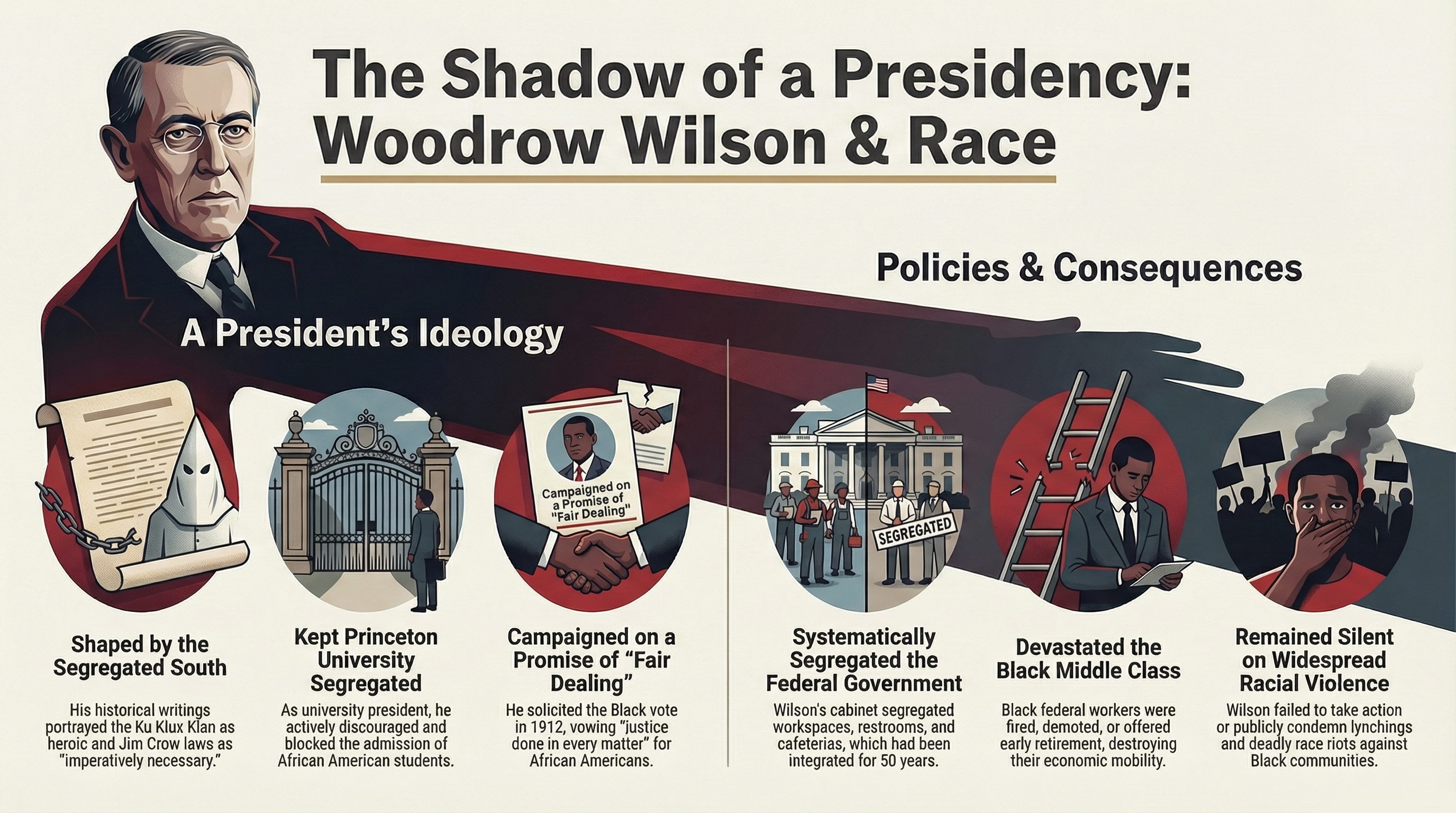
Wilson’s academic career was distinguished rather than flamboyant. He taught at Bryn Mawr and Wesleyan, wrote steadily, and built a reputation as a serious thinker. In 1902, he became president of Princeton. There he attempted to democratize campus life by dismantling the exclusive eating clubs that divided students by wealth and lineage. He lost that battle decisively, but the fight made him a national figure, a reformer willing to take on entrenched privilege. Less publicly, he discouraged Black students from applying, writing that it was inadvisable for a colored man to enter Princeton. He framed this not as hostility but as prudence. He believed integration would create friction and disorder. It is a revealing word. Friction mattered more to him than injustice.
Politics arrived in 1910, carried in by New Jersey Democratic bosses who believed Wilson would make a respectable figurehead. They mistook his manner for pliability. Once elected governor, Wilson turned on machine politics with righteous enthusiasm. He supported direct primaries, pushed through labor reforms, and spoke about corruption as a moral failing rather than a technical problem. His language was elevated, sometimes exhausting, and always confident. Within two years, he was a presidential contender.
The election of 1912 fractured American politics like a dropped plate. William Howard Taft represented Republican continuity. Theodore Roosevelt thundered about the New Nationalism and the need for strong regulatory government. Eugene Debs spoke plainly for socialism. Wilson offered the New Freedom, a promise to restore competition by breaking up monopolies and reducing tariffs. He spoke of liberty not as a feeling but as a condition that could be structured by law.
African American leaders listened closely. W.E.B. Du Bois, editor of The Crisis, and William Monroe Trotter, a militant activist, took Wilson at his word when he promised justice executed with liberality. Black voters turned out for a Democrat in unprecedented numbers. Wilson won the presidency decisively in the Electoral College while securing only about forty two percent of the popular vote. It was a victory built on division, idealism, and trust. The bill would come due quickly.
Wilson entered office determined to dismantle what he called the triple wall of privilege. The Underwood Simmons Tariff Act lowered rates and introduced a federal income tax. The Federal Reserve Act created a central banking system that remains one of the most consequential pieces of legislation in American history. The Clayton Antitrust Act strengthened enforcement, and the Federal Trade Commission was established to police unfair business practices. Wilson signed the Adamson Act, establishing an eight hour day for railroad workers, and supported farm credit legislation that eased rural debt. These achievements were not theoretical. They reshaped daily life and laid foundations later expanded by the New Deal.
He also appointed Louis Brandeis to the Supreme Court, the first Jewish justice. The confirmation was bitterly contested, and Wilson stood firm. This was Wilson at his best, willing to absorb political cost for a principled stand. It is important to say this plainly. Woodrow Wilson was not a cartoon villain. He was capable of moral courage, and he exercised it selectively.
That selectivity defined his presidency. Almost immediately, his administration began segregating federal offices. Restrooms, cafeterias, and workspaces were divided by race. Photographs were required for job applicants, allowing officials to screen out Black candidates. Black supervisors were demoted or dismissed. These actions reversed decades of slow progress made since Reconstruction. When challenged, Wilson defended segregation as a means of reducing friction. He claimed it benefited African Americans by sparing them humiliation. It was an argument that revealed how little he listened.
In 1914, William Monroe Trotter confronted Wilson in the Oval Office. Trotter spoke plainly, challenging the morality of segregation and reminding Wilson of his campaign promises. Wilson reacted with anger, accusing Trotter of insolence and ordering him out. The exchange was reported widely. It marked the end of any illusion that Wilson would be an ally in racial justice. Du Bois soon concluded that Wilson was unfitted for largesse of view on race, a devastating indictment from a man who had once believed.
In 1915, the White House screened The Birth of a Nation, a film that glorified the Ku Klux Klan and portrayed Black Americans as threats to civilization. The film borrowed language from Wilson’s own historical writings. Whether Wilson praised the film or merely tolerated it remains debated, but the symbolism was unmistakable. It was the first movie shown at the White House, and it sent a message that echoed far beyond the screening room.
Foreign policy offered Wilson a broader canvas. He rejected the blunt commercialism of dollar diplomacy and spoke instead of moral diplomacy. The United States, he argued, should support governments based on consent of the governed. In practice, American troops occupied Haiti and the Dominican Republic. Wilson refused to recognize Victoriano Huerta’s regime in Mexico, calling it a government of butchers, and ordered the occupation of Veracruz. He sent General Pershing after Pancho Villa. Wilson believed these actions were morally justified. He did not see the contradiction. He believed American power, guided by principle, was inherently different.
When war broke out in Europe in 1914, Wilson urged neutrality, asking Americans to be impartial in thought as well as in action. It was a noble sentiment and a fantasy. German submarine warfare, the sinking of the Lusitania, and the Zimmermann Telegram eroded public patience. In 1916, Wilson won reelection on the slogan that he had kept the nation out of war. Within months, he stood before Congress declaring that the world must be made safe for democracy.
The war transformed the presidency and the nation. The federal government mobilized industry through the War Industries Board, regulated food through Herbert Hoover’s administration, and managed labor on an unprecedented scale. Dissent was criminalized. The Espionage Act of 1917 and the Sedition Act of 1918 targeted antiwar speech. Eugene Debs was arrested and imprisoned for a speech opposing the draft. Newspapers were censored. Wilson saw these measures as regrettable necessities. He did not see how easily they could be turned inward.
The war also accelerated the Great Migration, as African Americans moved north in search of industrial jobs and relief from Southern terror. They found opportunity and hostility in equal measure. Black soldiers served in segregated units, often under French command. They returned home to a country uneasy with their service and resentful of their expectations.
When the war ended, Wilson traveled to Paris as a conquering moralist. He was the first sitting president to travel to Europe, and crowds greeted him like a savior. His Fourteen Points promised open diplomacy, free trade, self determination, and a League of Nations to prevent future wars. Around the world, colonized peoples listened. In Egypt, India, China, and Korea, activists interpreted Wilson’s words as a promise. What followed was disillusionment. Self determination was applied selectively, mostly to Europe. Colonial empires remained largely intact.
At the Paris Peace Conference, Japan proposed a racial equality clause for the League Covenant. The proposal received majority support. Wilson, serving as chairman, blocked it, citing procedural concerns and domestic political realities. It was a revealing moment. Faced with a chance to align principle with practice, Wilson chose expedience. He believed the League mattered more. History would question whether the trade was worth it.
Wilson compromised on reparations and borders to secure his League of Nations. It was his great cause, the institutional embodiment of his belief that war was not inevitable. At home, opposition formed quickly. Senator Henry Cabot Lodge feared that Article Ten would entangle the United States in foreign conflicts without congressional approval. Lodge proposed reservations. Wilson refused them all. Compromise, in his mind, diluted principle.
Wilson took his case directly to the people, embarking on an exhausting speaking tour. He spoke relentlessly, straining a body already weakened by years of stress. In October 1919, he suffered a massive stroke that left him paralyzed on his left side and severely impaired. What followed has been called the secret presidency. Edith Wilson controlled access, screened information, and managed affairs in ways unprecedented in American history. The Constitution had no provision for this situation. Power drifted.
The Treaty of Versailles failed in the Senate. The United States never joined the League of Nations. Wilson lived on until 1924, diminished, watching his great project unravel. He never admitted error. He believed history would vindicate him.
Assessing Wilson requires patience. He reshaped the presidency, expanded the regulatory state, and articulated an international vision that later influenced the United Nations. He also presided over a federal retreat from racial equality and sanctioned repression at home. Modern institutions have reevaluated his legacy. His name has been removed from buildings and schools, including at Princeton. These actions are not erasures. They are acknowledgments that greatness does not excuse harm.
Wilson matters because he embodies a paradox that still troubles American life. He believed deeply in moral progress and trusted his own prejudices as historical fact. He spoke of democracy abroad while narrowing it at home. He taught the nation to think globally and failed to listen locally. There are no neat lessons here, no comforting conclusions. History does not grade on a curve. It records, it remembers, and it waits.




 DAVE DOES HISTORY
Leave a comment