
By the end of 1521 the Reformation was officially victorious, publicly condemned, and privately leaderless, which is a dangerous combination under any circumstances. Rome had done its worst, issued its bulls, pronounced its anathemas, and pushed Martin Luther out beyond the reach of polite disagreement. The Holy Roman Empire had declared him an outlaw. Luther himself was alive only because Frederick the Wise was both clever and cautious, hiding him away at Wartburg Castle under an alias that fooled no one who mattered. Officially, the reformer was silenced. Unofficially, he was translating the New Testament and waiting for the ground to stop shaking.
But the ground did not stop shaking. It rarely does when an old authority collapses without a replacement everyone agrees on. Wittenberg, the town that had become the nerve center of Europe’s religious earthquake, felt the absence immediately. Without Luther’s steady hand, reform began to accelerate, not always in wise directions. What had begun as an argument about indulgences and grace now threatened to become a test of whether Christianity itself required restraint, patience, or even text.
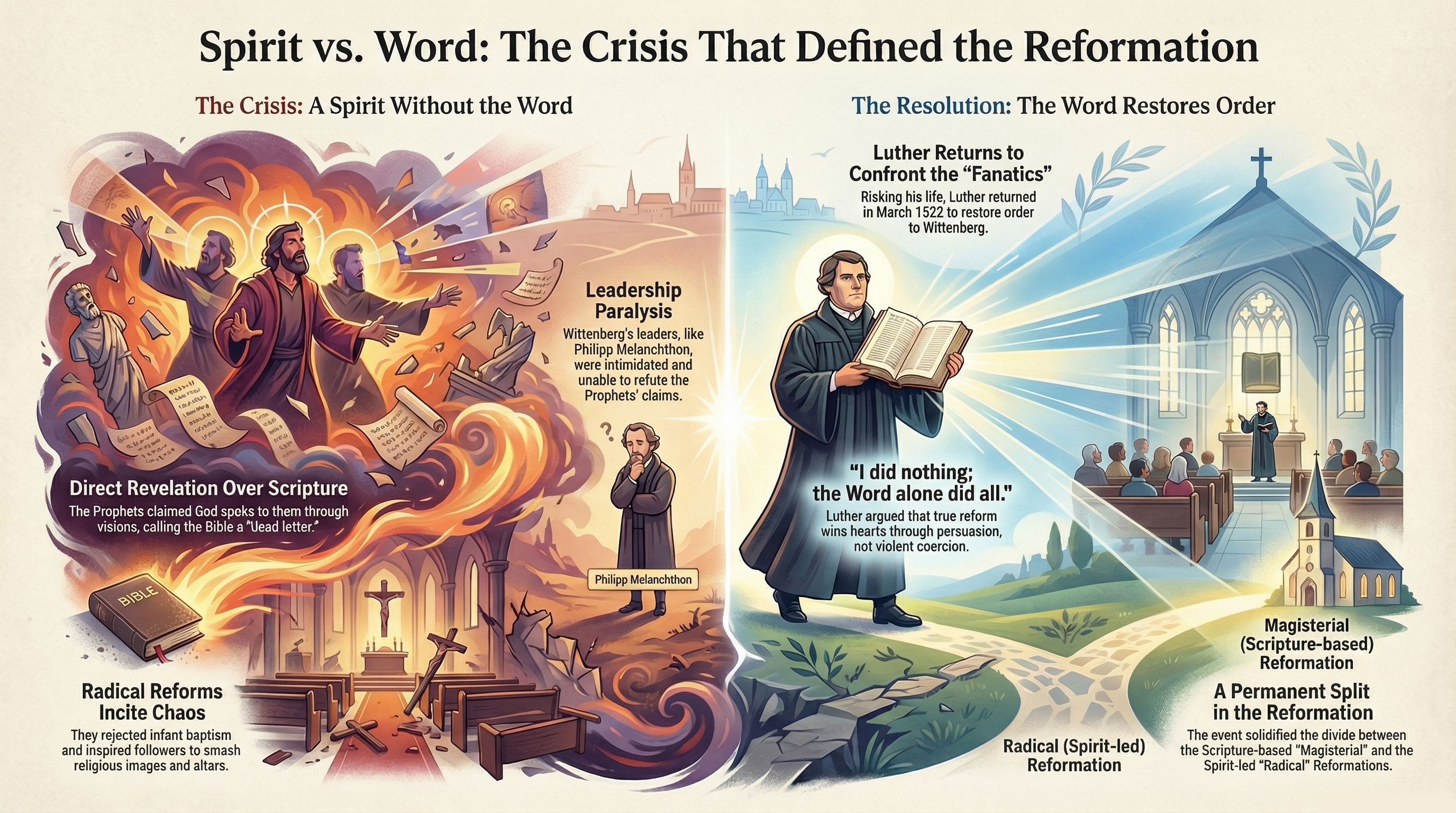
Into this uncertainty walked three men from Zwickau on December 27, 1521. They arrived without banners, without armies, and without institutional backing, which made them more dangerous than any papal envoy. Their names were Nikolaus Storch, Thomas Drechsel, and Markus Stübner. They did not claim to be reformers. They claimed to be prophets. They insisted that God had moved on from ink, parchment, and professors. Scripture, they said, was fine as far as it went, but it could not speak. The Spirit could. And the Spirit was speaking to them.

What The Frock – The Musical
Zwickau was fertile ground for such certainty. It was a manufacturing town built on the cloth trade, crowded with weavers whose lives were governed by looms, debt, and employers who spoke the language of godliness while squeezing wages to the bone. Social tension there was not theoretical. It was lived daily, felt in empty cupboards and crowded workshops. Radical ideas tend to grow where patience has been exhausted. The Reformation had promised freedom, dignity, and truth. In Zwickau, many wondered why those promises felt delayed.
A great deal of the answer lay with Thomas Müntzer, who had preached there with a ferocity that made Luther seem restrained by comparison. Müntzer was no fool and no clown. He was educated, articulate, and utterly convinced that God was done tolerating compromise. He attacked monasteries, mocked cautious theologians, and told the poor that Scripture belonged to them as much as to princes. His sermons burned with apocalyptic urgency. History, he insisted, was entering its final chapter, and neutrality was no longer an option.
Müntzer was eventually expelled in April 1521, but his ideas did not leave with him. They settled into the minds of men like Storch, a weaver who claimed direct visions from the angel Gabriel and spoke of divine election with unsettling confidence. Stübner, who had university training, provided language and arguments that dressed radical spiritualism in respectable clothing. Drechsel anchored the movement among working men who trusted lived experience over academic caution. Together they believed the Reformation had stalled. Luther, they argued, had torn down Rome’s authority but replaced it with another kind of paper tyranny. The Spirit, not the book, must now lead.
Their theology was as simple as it was explosive. Scripture was the external word, useful once, perhaps, but now insufficient. God spoke inwardly to the chosen through dreams, visions, and sudden illumination. This inner word stood above all texts, councils, and traditions. When challenged, they asked a devastatingly clever question. Can the Bible preach to us. It sounded profound, especially to those weary of sermons that never seemed to touch their lives.
Their view of history matched their view of revelation. Time was short. Judgment was coming. Within a handful of years, they said, God would purify the world through catastrophe. The Turk would invade Christendom, slaughter the ungodly, and clear the earth for the reign of the elect. Priests, princes, and all who clung to old forms would fall. This was not idle speculation. It carried practical consequences. If judgment was inevitable, then delay became sin. If God was acting now, then resistance was rebellion.
The sacraments fared poorly under this theology. Infant baptism was rejected outright. Infants could not believe, and without conscious faith, baptism was meaningless. The church, they argued, must consist only of visible believers who had chosen faith deliberately. The parish church, filled with the faithful and the indifferent alike, was a corruption. What emerged was an early vision of a believers church, separate from the state, separate from compulsion, and in practice, separate from patience.
While these ideas traveled from Zwickau to Wittenberg, the city itself was already moving faster than Luther would have preferred. Andreas Karlstadt, once a cautious academic ally of Luther, began pushing reforms through with little concern for pace or fallout. On Christmas Day 1521 he celebrated Mass in plain clothes, in German, with communion in both kinds and without sacrificial language. The theology was not the problem. Luther would later agree with much of it. The manner was.
Iconoclasm followed quickly. Images were smashed, altars dismantled, and churches stripped bare. Crowds, encouraged by preachers like Gabriel Zwilling, moved with the confidence of men convinced that delay itself was disobedience. Students were told to abandon their studies and return to manual labor. Academic theology was dismissed as unnecessary for those who possessed the Spirit. Wittenberg, once a town arguing carefully over Greek verbs, became a place where certainty shouted down caution.
Caught in the middle was Philipp Melanchthon, a man of extraordinary intellect and equally extraordinary restraint. He found himself facing claims he could not easily refute with chapter and verse. Scripture did not offer the tidy answers he wanted, especially on baptism. Worse still, he feared opposing the prophets might mean opposing God. In a moment of rare desperation, he appealed to Frederick the Wise, admitting that only Luther could decide. It was a stunning confession. The movement that claimed Scripture alone now waited for one man to return and settle the matter.
Luther watched all of this from the Wartburg with mounting alarm. He had expected opposition from Rome. He had not expected the Gospel to be torn apart by men who claimed to be improving it. He called them Schwärmer, fanatics, swarming bees who buzzed loudly and stung without warning. Their spirituality, he argued, lacked the mark that mattered most. True encounter with God did not arrive as calm reassurance or triumphant certainty. It arrived as struggle, suffering, and the painful awareness of sin. A Spirit that only affirmed was suspect. A Spirit that never wounded was counterfeit.
In March of 1522, despite the imperial ban still hanging over him, Luther returned to Wittenberg. Frederick could not guarantee his safety. Luther came anyway. Disorder among friends troubled him more than threats from enemies. Over eight days he preached what became known as the Invocavit Sermons. They were not thunderous denunciations. They were patient, deliberate, almost stubbornly restrained.
Reform, Luther insisted, must be guided by love. Removing images might be theologically defensible, but tearing them down without regard for the weak in faith was cruelty masquerading as zeal. The Word must do the work. Hearts had to be persuaded before hands were commanded. Violence, even in the service of truth, corrupted what it claimed to protect.
The effect was immediate. The mobs dispersed. Order returned. Luther later summarized the episode with characteristic bluntness. I did nothing. The Word did everything. It was not false humility. It was a declaration of method. Change imposed by enthusiasm burned fast and left nothing stable behind.
The matter of the prophets themselves remained. Luther granted them an interview. Accounts differ on details, but the substance is clear. He tested their spirits, demanded proof of their calling, even challenged them to perform miracles if they claimed apostolic authority. They failed. One attempted a theatrical display, claiming insight into Luther’s thoughts, insisting Luther was beginning to agree. Luther cut him off sharply. The Lord rebuke thee, Satan.
When the prophets cried out about the Spirit, Luther responded with a line that has echoed ever since. I slap your spirit on the snout. It was not polite. It was decisive. Their authority collapsed. They left Wittenberg, though their ideas did not retire quietly. They resurfaced elsewhere, feeding the radical movements that would soon erupt into the German Peasants War.
Modern historians have complicated the timeline. Some suggest the prophets may have departed before Luther arrived, or that later accounts compressed separate meetings into a single dramatic confrontation. These debates matter, but not as much as the deeper truth. Their presence forced the Reformation to define itself. Would it be guided by inward revelation unchecked by text, or by an external Word that restrained as much as it liberated.
The legacy of the Zwickau Prophets is not simple villainy. They spoke to real suffering. They challenged complacent religion. They reminded the comfortable that faith without consequence is hollow. Yet they also demonstrated how easily certainty curdles into coercion. Their insistence that God spoke directly to them left no room for correction, no patience for dissent, and no humility before history.
For Luther, the crisis clarified everything. Sola Scriptura became not merely a slogan, but a safeguard against spiritual anarchy. The Spirit, he insisted, bound itself to the Word, not because God was limited, but because humans were dangerous when left alone with their convictions. The Reformation survived its first internal civil war not by extinguishing passion, but by anchoring it.
Why does this still matter. Because every age produces its prophets, convinced urgency excuses excess and sincerity guarantees truth. The Zwickau episode reminds us that revolutions are most fragile when they despise restraint. Faith that forgets its limits rarely ends well. The hallway of the past still bears their fingerprints, pressed hard into the banister by men certain they were right. It is worth pausing there, listening carefully, before moving on.


 DAVE DOES HISTORY
Leave a comment