
The morning that carried Apollo 12 toward the Moon looked less like destiny and more like a Florida shrug. November 14, 1969 came on with rain that misted the gantry, low gray quilted over the Cape, and a wind that clipped the edges of every sentence over the loudspeakers. This was the second step to the Moon, the one that had to prove Apollo 11 was not a one time wonder or a fluke of good fortune. The hardware was massive and sure. The Saturn V stood at Pad 39A, three stages stacked into a white cathedral of chemistry, five F-1 engines in the first stage alone waiting to pour a flood of fire into the morning. When the count fell to zero and the ignition ripple moved through that engine cluster, the rocket lifted itself on 7.6 million pounds of thrust. The ground shook in the old way, as if the earth itself grumbled at the audacity of it. Families on the causeway pressed binoculars to their faces. Navy men in the VIP stands squared their caps against the drizzle. Inside the command module, three fellow sailors were strapped in shoulder to shoulder, riding a city of fuel that turned rain to steam. And about half a minute later, the sky reached down and slapped the mission across the face.
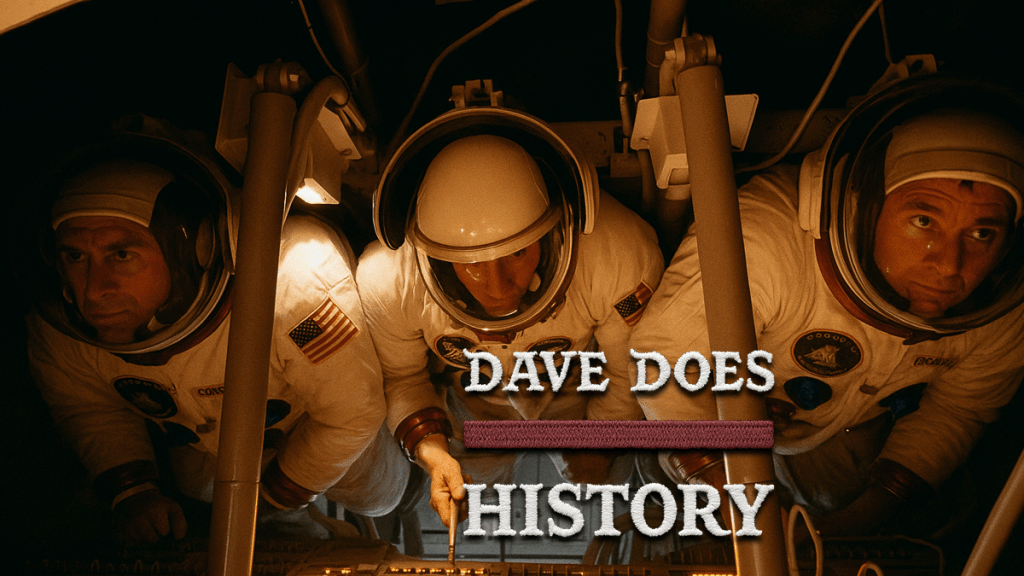
The crew was pure Navy. Commander Charles “Pete” Conrad Jr. at the left couch, short only in height and patience for nonsense, long on skill. Richard F. Gordon Jr., command module pilot, in the center seat, calm as a helmsman on a long watch. Alan L. Bean, lunar module pilot, seated on the right, the artist of the trio, quick with his hands and eyes. Their patch showed a clipper ship under full sail, a nod to the service that had trained them and to the habit of American exploration to float on salt water or vacuum and consider both a path rather than a barrier. This was not just a flight. It was an argument about what the United States could do twice, and then again, until it was routine.
The plan was ambitious. Land in Oceanus Procellarum with pinpoint accuracy, close enough to the unmanned Surveyor III that the crew could walk over and pull parts off for study. That meant mastering guidance and piloting in a new way. It meant gathering rocks, drilling, planting instruments, and proving that the Moon was not a single victory but a landscape that could be approached with precision. The backbone of the surface work was ALSEP, the Apollo Lunar Surface Experiments Package, a cluster of instruments meant to listen to the Moon and whisper its secrets back home for years. But first the rocket had to behave, the guidance had to fly, and nothing had to break. On that list, the sky failed to cooperate.
Thirty six and a half seconds after liftoff, a bolt of lightning found the column of flame and hammered the stack. Later estimates put the strike at up to a hundred thousand amps and a hundred million volts. Whatever the exact numbers, it was enough. Inside the command module the instrument panel lit with warnings like a Christmas parade that had lost its sense of order. The guidance platform tumbled. Circuit breakers vibed and muttered. Telemetry, the lifeblood flowing down the long wires to Houston, turned into nonsense at 36 seconds. Consoles at Mission Control showed a garbled mess, data that looked like it had been scrambled and thrown into the air. On the air to Houston, Dick Gordon asked the question that needed no academic polish. What the hell was that. On the ground, controllers repeated the most honest word they had on hand. Roger.

Sixteen seconds later, the sky threw a second punch. At around 52 seconds after liftoff, another strike rode the conductive path of exhaust and atmosphere back to the spacecraft. The panel went dark. Telemetry fell silent again. The Saturn V did not care in the way that a locomotive does not care about the weather. It kept burning. The vehicle was climbing fast through a low ceiling, through cloud, toward the thinner air where black gives way to blue. But the people who had to guide it could not make sense of what they were seeing. If the guidance had failed, the rocket would need to be steered on a knife edge of windows and angles and go for an abort if it drifted. If the parachutes had been fried by a surge, then a future reentry would be a death sentence. The room full of experts had a simple problem. They did not know what they did not know, and the seconds were already in motion.
This is where the whole story pivots on a human mind that had been paying attention long before the crisis. John Aaron was young enough to still be mistaken for a student and old enough to have watched a lot of noisy, complicated telemetry scroll past. He was the EECOM that day, the controller responsible for electrical systems, environmental control, and consumables. A year before the flight, down at the Cape, he had witnessed an odd pattern on the scope during a test. The values then had not matched what the consoles usually displayed. He had chased the oddity down to a supporting system that did not receive much love in the briefings, a box with a long name and an obscure habit, the Signal Conditioning Electronics. It handled the shaping and routing of many sensor signals. He knew that under low voltage conditions you could shift that system to an auxiliary setting and get usable data back. It was not magic. It was memory. But memory is everything when the clock is a hammer.
So in a room that sounded like quick prayer spoken in a hundred dialects of engineering, he offered something better than hope. Flight, EECOM, try SCE to Aux. The call drifted across the loop, and it did not land easily. People in the room were not ready to place a bet on a switch that most of them had never touched. Conrad did not recognize the term. What the hell is that, he asked. The controller repeated the command. SCE to Aux. In the right couch, Alan Bean had a picture in his head from one simulation where the position of that switch had been called out. He reached past the jungle of toggles and levers and threw the right one. Data snapped back into coherence on the screens in Houston. The crew had their instrumentation. The rocket had its brain again. The mission had a path. The whole arc of Apollo 12 drew itself back together because a junior controller remembered a weird squiggle from a test and a lunar module pilot trusted his fingers. That is the sort of thing nations build plaques about because it is the sort of thing that saves lives.
The phrase SCE to Aux became a shibboleth among flight controllers and astronauts, a way of saying that when trouble starts, you do not always need a grand solution. You might need the right small one. John Aaron earned the nickname steely eyed missile man, which is plain English for a person who keeps his head when everyone else is hearing the ocean in a seashell. It also reminded the public that control rooms are full of people who will never plant flags or hold microphones but who are the difference between a good story and a tragedy.
The Saturn V never stopped being a hammer. The first stage took them through the dark sky and delivered the stack to staging, then handed the job off to the second stage. By the time they reached Earth parking orbit, the first surge of adrenaline had turned into a systematic check. The crew and the controllers needed to know what had been scorched and what had been spared. They cycled systems, looked for shorted circuits, watched voltages on buses, checked the platform and the gimbals, and felt for any hint that the strike had damaged the parachute system. The relief, when it came, was not a cheer. It was a quiet flood as the readings lined up and stayed steady. The MIT guidance computer had kept its wits. The reason was a choice that had seemed conservative and dull when it was made. The Apollo guidance computer carried a fixed rope memory for essential programs. You could not erase it with a voltage tantrum. You could not rewrite its mind through an accident. When the lightning tried to knock the brain off the shelf, the rope memory held it steady.
After one and a half laps of Earth, the ship lit the S-IVB again and pushed for the Moon. The second burn committed them to the long coast, the long math, and the long small rituals of a translunar voyage. Apollo 12 flew a hybrid trajectory. They started on a free return path, the safe loop that would slingshot them back to Earth if the lander failed or the engine refused to light, then left that path later to get the right angle of sunlight at the landing site. That choice traded a little insurance for better science and better visibility, the sort of trade that works when you trust the ship and the crew. The S-IVB then had its own assignment. It was supposed to take a heliocentric path after separation. Instead, after a data mishap, it ended up in a stretched Earth orbit. The universe forgave the error. The main show stayed on schedule.
The lightning strikes forced NASA to treat weather with a new level of suspicion. It was not just the old rule of avoiding thunderstorms or crosswinds. The combination of a moist, charged atmosphere, a cold front sagging through, and an exhaust plume that acted like a wire had created a condition where the vehicle had triggered the bolts itself. No one had expected that behavior in quite that way. Post flight analysis led to launch commit criteria that looked harder at electrical fields and cloud layers. Future Apollos would wait for skies that could not be coaxed into hurling lightning through the vehicle. Flight rules are written in pencil before a mission, in ink after a near miss, and in stone after a loss. Apollo 12 wrote this one in ink and got back to work.
For the rest of the outward journey, the public saw a crew that treated space like a long shipboard watch with better views. There were televised broadcasts from the spacecraft. There was a midcourse maneuver that set them up for the hybrid approach and pulled them off the free return. There was the cheerful banter of three men who knew each other’s habits. For Conrad, the Moon was another target to be approached in a deliberate rhythm. For Gordon, the orbit he would command later would be a place of solitude and housekeeping, a wide silver lane. For Bean, there was a painter’s eye already at work, even if he would not start his serious canvases until the program was behind him. They talked to children and signed their names on the air. It is a good thing to see a crew laugh. It lets you know the job is hard, but not grim.
Lunar orbit insertion burns put them into a working altitude of roughly 62 by 76 miles, a path that gave the command module good passes and the lunar module a good starting line. Television showed the separation of Yankee Clipper and Intrepid, two ships with names that belonged as much to naval history as to spaceflight. The target was Oceanus Procellarum, the Ocean of Storms, a dark mare that seemed to welcome surfer metaphors and sober geology in equal measure. Precision mattered. The navigation numbers were not quite where Houston wanted them. There was a discrepancy in the orbital data. So Houston deployed a new tool, a small data processor sometimes called the Lear box, that could precompute powered flight corrections and feed the crew an adjusted profile. That sort of tweak demonstrates what the program had become by late 1969. Apollo was learning to fly with grace.
The landing is not our main story today, but it deserves its lines. Conrad took partial manual control for the final few hundred feet, jousting with boulders and craters that always seem to grow teeth as you get closer. The result was so good that the NASA geologists had to grin. The lander touched down within a few hundred yards of Surveyor III. In sailor’s language, it was right where they aimed, close enough that a man could shoulder his tools and walk over without making a day of it. Conrad popped the hatch at about 115 hours into the mission. He was small but moved like he was bulletproof in low gravity, a man who loved machines and loved them even more when they behaved. He and Bean performed the first EVA. The ALSEP went out six or seven hundred feet from the lander, and the Moon acquired a new set of ears and nerves. Then came a very human mistake. The television camera died because Bean pointed it at the sun. The surface operations ended up being a little more private than planned. It is not a crime to break a camera when you have already saved a mission. It is simply a reminder that the Moon is a place where even pros can get dazzled.
The second EVA was a master class in errands. The traverse stretched to about 5,200 feet. The crew ranged as far as 1,300 feet from the lander at points, careful and methodical. They collected about 70 pounds of samples. The prize chore was the trip into Surveyor Crater to visit the old robot. Surveyor III had been sitting there for more than two years, patiently waiting for company. Conrad and Bean removed the camera, the scoop, and pieces of cable and aluminum. Scientists on Earth had a plan to study the parts for micrometeorite strikes and thermal wear and even for biological hitchhikers that might have survived a launch from Earth and a landing on the Moon by accident. It was early days for planetary quarantine as a practice, and this forensic walkabout would help refine it. The other folk tale from that second outing is Bean’s hammer work on the plutonium generator for ALSEP, a SNAP-27 RTG. The heat source had stuck in its container. He tapped and whacked until it came loose, then later distilled the lesson into a line for the ages. Never come to the Moon without a hammer. This is the kind of wisdom that would have pleased a pioneer or a machinist.
While they worked, Gordon circled alone in Yankee Clipper, taking photographs, running experiments, keeping the ship ready. There is a certain loneliness in that task that does not get the appreciation it deserves. The command module pilot is the man who keeps everyone honest about returning. The view is magnificent, and the company is his own.
When it was time to leave, Intrepid’s ascent stage lifted from the surface after just over 31 hours on the Moon. The rendezvous was clean. After the transfer and the ceremonies that always feel like both housekeeping and ritual, the ascent stage was sent to its end. It was deorbited to strike the Moon with the punch of roughly a ton of TNT. The seismometers listened to the ringing. The data told us something about the lunar interior that a gentle knock could never have said. There are places where you only learn by making a noise.
The trip home was the kind of dull that humans pray for in spaceflight. No major surprises. No more drama from the sky. The heat shield did its job. The parachutes did theirs, which mattered a great deal after the lightning scare. They splashed down on November 24, ten days, four hours, thirty six minutes, and change after leaving. The Navy’s USS Hornet, a ship that had already recovered Apollo 11, plucked them from the Pacific and made it look routine. The landing point was only a few miles from the target. This was navigation as craft, not luck. The nation got to see the three men again without white suits or masks. The photographs looked like homecoming pictures from a long cruise.
People remember Apollo 12 for a few lines and a few moments that say more than paragraphs can. Pete Conrad had a small bet with a journalist friend that he would prove astronauts were not scripted when they touched down and made their first crack at immortality. His first words were not grand and that was the point. Whoopee. Man, that may have been a small one for Neil, but it is a long one for me. It sounded like him, which is the best thing you can say about a public line. Later, in the debrief and the pressers, he put the launch in a sentence that gets to the heart of the day. The flight was extremely normal for the first 36 seconds, then after that got very interesting. That is dry humor worthy of a pilot school chalkboard.
What lasts most, though, is the memory of a morning when weather and electricity tried to write a different ending. SCE to Aux is now a phrase that engineers love because it embodies the creed. Know your systems. Remember the strange cases. Do not freeze when the room does. John Aaron’s cool recall and Alan Bean’s quick hands made a path through a minute and a half that could have ended a mission or worse. The first lightning strike made the panel go wild. The second made it go blank. The rocket kept climbing because it is what rockets do. But climbing is not enough. Brains are required. The obscure fix opened the door and the crew walked through.
There is a lesson in the resilience of the guidance system as well. In an age that reveres the upgrade and the patch, Apollo 12 was saved in part by a hard wired memory that could not be erased by a surge. It is not an argument for living in the past. It is an argument for building foundations that do not crumble when the lights flicker. The rope memory in that computer was old school even by the standards of the late 1960s. It did the job. A nation should build some things that can take a hit.
The post flight changes to launch rules were not scolds or blame games. They were simple discipline. If the atmosphere can be made to throw lightning down the throat of a vehicle by the vehicle itself, then do not light the match under those conditions. That is how adults behave. The history of exploration is full of tragedies that taught lessons at a price that breaks your heart. Apollo 12 had the good fortune to teach a lesson with a scare instead.
If you are looking for the meaning of the second landing in the larger story, it is not a mystery. Apollo 11 planted a flag and burned an image into the national retina. Apollo 12 said, we can do this again, and better, and with skill that inches toward craft. The pinpoint landing near Surveyor III gave the geologists and engineers a chance to study an old machine that had endured the lunar environment. The ALSEP worked. The seismometers listened. The crew gathered samples that added to the growing map of lunar time. The photographs of the traverse show men who look as if they were born to clamber over odd rocks under a black sky. They were professionals, not tourists. That distinction matters.
There is a cultural echo that is worth pausing over. Apollo 12 is less famous than Apollo 11 and less tragic than Apollo 13. It sits between the banner headline and the folk ballad. That is fitting for a mission that turned a disaster in the making into a footnote before moving on with the plan. We tend to remember firsts, flames, and failures. We forget the feats that look like the way work is supposed to go. But a civilization rests on the shoulders of professionals who do not flinch. SCE to Aux belongs on a short list of phrases that describe how a mature program behaves when punched in the mouth. Checklists matter. Training matters. The odd bits of the system matter. The person who remembers the odd bits matters most.
Apollo 12 left the Moon cleaner than it found it only in the sense that the questions became more precise. The crew returned with better numbers, better processes, and better confidence that a ship could thread a needle on another world. The ascent stage’s deliberate crash taught us how the ground below our boots responds to a jolt. The navigation and communications tweaks proved that a mission could be managed in finer detail from a quarter million miles away. In a year when the country argued with itself, the image of a clipper ship on a Navy crew’s patch reminded us that the Republic still knows how to choose good men, train them well, and send them to do a job that requires both humility and nerve.
So yes, the launch of Apollo 12 was almost a cautionary tale. The weather was uncooperative. The atmosphere used the rocket like a spear for lightning. The cockpit lit up with warnings, then went dark. A second strike could have frightened the most stoic crew into reaching for abort calls. Instead, three men kept flying, a room full of engineers kept thinking, and one controller reached into his head for a solution that no manual would offer in bold print. The result was a mission that did what it set out to do and left a permanent phrase in the vocabulary. When things go sideways, you want people around who know where the SCE switch lives.
In the end, the splashdown near target and the handshake on the deck of USS Hornet put a period on a story that began in the rain. The clocks stopped at ten days and a handful of hours. The crew smiled with the relief of men who have earned a quiet dinner. The newspapers gave them the ink they deserved. Then the program turned the page and got ready for the next launch, with stricter weather rules and a deeper respect for what a cloud can do. Apollo 12’s launch is remembered as the day lightning tried to write the script and did not get the last word. The second step to the Moon was not as famous as the first, and that is fine. The second step is where you prove you were not lucky, you were good.



 DAVE DOES HISTORY
Leave a comment