
It begins with an impossible ratio and ends with a miracle. Thirteen ships against three hundred. A commander just returned from prison, stripped of his rank, beaten, disgraced, told to stand down and watch his country die. Instead, Admiral Yi Sun-sin stood in the teeth of the tide and turned it into a weapon. On October 26, 1597, in the narrow throat of the Myeongnyang Strait near Jindo Island, the Joseon navy did what no one believed could be done. They stopped the Japanese fleet dead in the water. The Battle of Myeongnyang was more than a military victory. It was the salvation of a nation at the edge of annihilation.
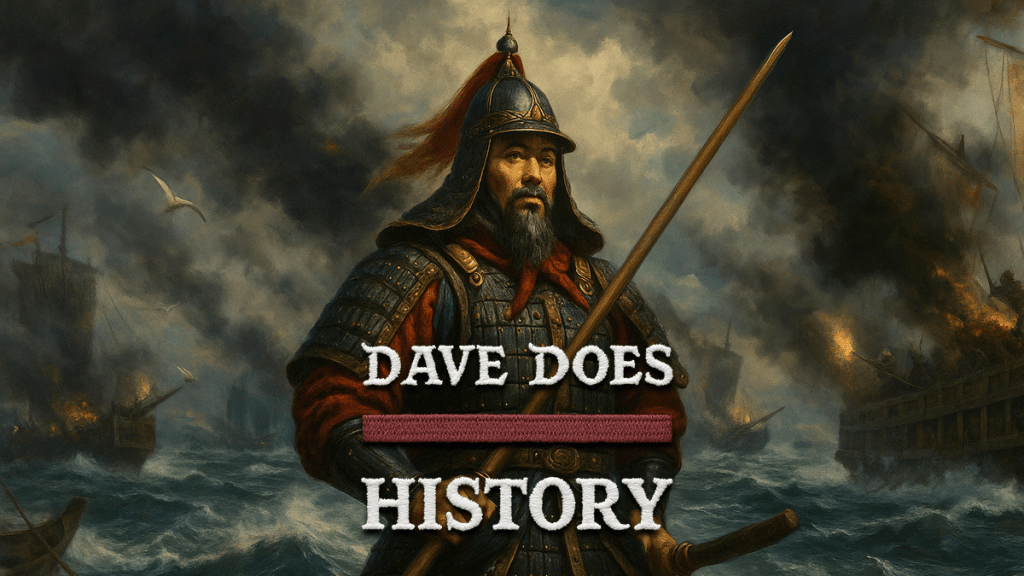
Yi Sun-sin’s name is not only carved in Korean memory. It belongs beside the great captains of the world, men who understood that the difference between defeat and deliverance is often one mind refusing to surrender. He was the anchor of a small, battered fleet facing the second Japanese invasion of the Korean Peninsula, part of the long and brutal Imjin Wars of 1592 to 1598. In this second campaign, the Jeongyu War, the Japanese objective was clear: gain control of the Yellow Sea and open the road to the capital, Hanyang. The plan depended on naval supply lines. Yi understood that if he could close those lines, the invasion would starve.
But by the autumn of 1597, Korea’s navy barely existed. Yi had been its soul and its structure, yet court intrigue had destroyed him. In a climate poisoned by jealousy and political suspicion, he was accused of insubordination, arrested, and tortured. The court demoted him to the rank of a common soldier. His replacement, Admiral Wŏn Kyun, was an arrogant man who believed command was glory, not responsibility. Within months, he led the fleet into disaster at Chilchonryang. The Japanese commander Tōdō Takatora unleashed a full assault that shattered the Joseon fleet. Out of more than a hundred sixty ships, almost all were burned or sunk. The sea was left to the invader.
When Wŏn Kyun died in that catastrophe, there was no one else to call. Yi was reinstated not because the court regained its wisdom, but because desperation left no alternative. He returned to find what used to be a navy reduced to floating wreckage and frightened survivors. Commander Bae Sŏl had saved ten ships, rough and scorched but still afloat. Kim Ŏkch’u brought two more. Another vessel was found adrift and repaired. Thirteen ships. No turtle ships, those famous armored beasts Yi had invented years before. They were all gone. The order from the king was to abandon what was left and regroup on land. Yi refused. He wrote to the throne with a defiance that would have been fatal if not for his country’s peril. “Your Majesty,” he said, “this vassal still has twelve battleships. Even though our navy is small, as long as I live the enemy will not dare to look down on us.”
He began to rebuild not with new ships but with old spirit. Survivors trickled in, men haunted by the screams and flames of Chilchonryang. They found a commander who would not accept despair. By the end of September, he had fifteen hundred sailors and marines, some still limping from their wounds. They trained and cleaned the guns. They listened to the sea and to Yi’s quiet voice telling them that honor was still possible. The Japanese, flush with victory, were already advancing inland. They captured Namwon. They clashed with Ming forces at Jiksan. Their fleet was preparing to sail through the Yellow Sea and supply the march on Hanyang. Yi knew that once they reached open water, the heart of Korea would be lost.
He looked to geography for salvation. South of Jindo Island, the sea narrows into the Myeongnyang Strait, also called Uldolmok—the screaming sea. The passage is less than three hundred meters wide. Its currents are violent, reversing direction every three hours, sometimes flowing at ten knots. Ships caught in it can be spun like leaves. To an ordinary admiral, it was suicide. To Yi, it was opportunity. He studied the tides, measured the intervals, and chose the exact place where the current could turn chaos into advantage. There, he would stand his last ground.
The Japanese came in force. Records estimate about three hundred thirty-three ships, a mix of one hundred thirty warships and two hundred logistical craft. Their plan was to crush the last resistance quickly. The leading formation consisted of Seki-bune warships, medium-sized vessels suited for boarding actions. The larger Atakebune, cumbersome in shallow waters, hung back. On October 25, the Japanese vanguard anchored south of the strait. Yi deployed his small fleet across the northern mouth near Usuyeong, preparing to block their exit into the Yellow Sea.
At dawn, October 26, the tide flowed north. Yi’s flagship moved ahead alone. He had to provoke the enemy to commit, to draw them into the channel. The Japanese commander Kurushima Michifusa took the bait and led the charge. For a long, breathless period, Yi’s flagship stood by itself, exchanging cannon fire with the Japanese vanguard. The rest of his fleet hesitated. Many of his captains saw only the horizon filled with enemy sails and felt terror crawl up their spines. But Yi’s ship did not retreat. It roared with cannon bursts, its decks steady under the shock. He was seen standing calmly at the bow, giving orders amid the smoke. The Japanese swarmed closer, expecting to swarm aboard and slaughter. They did not understand the difference between musket fire and the long-range Joseon naval cannon that Yi had perfected.
At last, one by one, the other Korean ships found courage. Magistrate An Wi was first to join, followed by Kim Ŭngham and Kim Ŏkch’u. The guns of thirteen ships now spoke together, their fire echoing off the cliffs. The Japanese pressed forward, still confident that numbers would prevail. Yi’s men kept their distance, relying on cannon rather than blades. One Japanese boarding party managed to reach An Wi’s ship, and for a few minutes chaos erupted in screams and steel. Korean sailors fought back with spears, clubs, even stones, driving the intruders into the sea.
Then, at the critical moment, the sea itself changed sides. The tide reversed, flowing south. The Japanese ships that had fought the current now found themselves driven backward. Their tight formation broke apart. The narrowness of the strait turned them into each other’s obstacles. Seki-bune smashed into their own support vessels. In that confusion, Yi ordered the counterattack. The Joseon guns poured iron into the clustered hulls. Fires broke out. Ships collided and capsized. The currents dragged wounded men into whirlpools. Thirty-one Japanese vessels went down. Among them was Kurushima’s flagship. He was killed on deck, his head later recovered and raised on a pike as proof. Tōdō Takatora himself was wounded, his arm nearly shattered by shrapnel.
When the current slowed, the Japanese commanders looked across a sea choked with wreckage. The Joseon fleet still floated, thirteen ships intact, blackened with powder but unbroken. Tōdō ordered retreat. His fleet hoisted sail and fled the screaming sea that had devoured its pride. Not a single Korean ship had been lost.
The scale of the victory was almost beyond belief. For the Japanese, the defeat was not only tactical but spiritual. Their army, advancing on land, was suddenly cut off from the sea. Supplies dwindled. Morale faltered. For Yi, the triumph came at a personal cost. In retaliation, Japanese forces burned his home in Asan and murdered his youngest son. Yi received the news with silence. There was no revenge he could take except to keep winning. He withdrew north to the Yellow Sea to regroup and patrol. His fleet, though still small, now carried the confidence of men who had seen the impossible and survived it.
The victory at Myeongnyang restored faith in Korea’s survival and convinced the Ming dynasty that Korea was still worth defending. In early 1598, a combined Ming-Joseon fleet began operating together, preparing for a final confrontation. Later that year, the Japanese attempted to cover their withdrawal from the peninsula. The resulting Battle of Noryang in December 1598 destroyed the last major Japanese fleet. It was Yi’s final battle. A stray bullet struck him near the end of the fight. His last words were simple, an order spoken without fear: “Do not announce my death until the battle is won.” His men obeyed, and victory was secured before anyone knew their admiral was gone.
The Battle of Myeongnyang changed the balance of East Asia. It denied Hideyoshi’s army the sea bridge it needed and ended the dream of a Japanese empire stretching into China. Korean independence endured because one man refused to abandon a hopeless fight. The currents of the strait may have turned, but it was Yi’s will that made them fight on his side. British Admiral George Alexander Ballard, centuries later, compared him favorably to Lord Nelson, writing that Yi never knew defeat and never made a mistake. Japanese Admiral Tōgō Heihachurō, victor of the Battle of Tsushima in 1905, studied Yi’s tactics and used his own version of them against the Russian fleet. When asked if he considered himself Yi’s equal, Tōgō replied, “That would be presumptuous. Admiral Yi was too remarkable for anyone to compare with.”
Yi Sun-sin remains a national hero in Korea, not just for his victories but for his integrity. He lived as a soldier who owed loyalty first to his country, not to court politics. The people call him Chungmu-Gong, Lord of Loyalty and Chivalry. His statue in downtown Seoul faces south toward the sea he once commanded. His journals, the Nanjung Ilgi, are read as literature as much as military record, filled with doubt, pain, and devotion. His life proves that heroism is not the absence of fear but the act of walking through it.
The Battle of Myeongnyang is remembered as a miracle because it was one, but miracles of this kind are made, not granted. Yi Sun-sin made his out of discipline, courage, and the clear understanding that the tide always turns—if you are brave enough to hold your ground until it does.




 DAVE DOES HISTORY
Leave a comment