
On the morning of September 18 in the year 96, the Emperor Domitian rose from his bed in the Flavian Palace with a heart heavy from dread. He had spent weeks poring over omens and prophecies, listening to whispers that his life would end at the noon hour. Romans were never strangers to superstition, but Domitian, though he ruled with iron, had grown increasingly fearful in the last years of his reign. His hand shook when he signed death warrants. His eyes darted at shadows. He was surrounded by people who smiled in his presence and cursed him in private. Like so many emperors before him, he sensed the blade even before he saw it.
By the time he came to power in 81, Domitian was the last man standing of the Flavian dynasty. His father Vespasian, the gruff general who had clawed his way up from equestrian rank to emperor, had restored stability after Nero’s collapse. His brother Titus had enjoyed a brief but celebrated rule, remembered for opening the Colosseum and dealing with the eruption of Vesuvius. Domitian was different. He was younger, more intense, less willing to compromise with a Senate that always regarded his family as upstarts. He demanded to be addressed as dominus et deus, lord and god. He pursued building programs, military campaigns in Germany and Dacia, and reforms to the coinage. But he also alienated senators, executed men close to him, and narrowed his circle until only the frightened and the sycophantic remained. That shrinking circle would prove fatal.
The sources we have were written after his death, which is always the historian’s headache. Pliny the Younger, writing his Panegyricus in praise of the new emperors Nerva and Trajan, painted Domitian as a monster. Tacitus remembered him as a tyrant who smothered free speech. Suetonius, who wrote under Hadrian, leaned on gossip, anecdotes, and rumor, spicing the story with ominous signs. A century later Cassius Dio gave his account, terse but grim. Not one of these men had a kind word for Domitian, and all had an interest in pleasing the ruling dynasty that succeeded him. That does not make their accounts worthless, but it does mean we should read them with suspicion. The one piece of evidence that cannot lie is the stone calendar from Ostia, the Fasti Ostienses, which records without flourish that Domitian was killed on the fourteenth day before the Kalends of October and that Marcus Cocceius Nerva was acclaimed emperor on that very same day. The stone gives us the skeleton, the writers flesh it out, and bias provides the color.
The conspiracy against Domitian was not born overnight. He had already ordered the execution of Epaphroditus, his secretary, and dismissed or killed other close officials. Those who survived understood that their turn might come next. Among them was Parthenius, the chamberlain who ran the palace with a steady hand. With him, according to Dio, stood Titus Petronius Secundus, one of the two commanders of the Praetorian Guard. Soldiers did not lightly turn against emperors, but Domitian had sown distrust even in their ranks. They chose a man named Stephanus to strike the fatal blow. Stephanus had served as steward to Domitian’s niece Domitilla. He was familiar enough to gain access, ordinary enough not to raise suspicion. What he carried with him into that chamber would end the Flavian line.
The morning itself, if we follow Suetonius, was already soaked with foreboding. Domitian had dreamed of a bald man cutting his throat. His astrologers had warned him that the thirteenth and fourteenth days before the Kalends of October would be dangerous. He paced the palace in fear of the noon hour, so much so that one of the conspirators falsely told him it was later in the day than it really was, hoping to calm his nerves just long enough for the trap to spring. The emperor, it seems, was a man already defeated in spirit, and the plotters knew it.
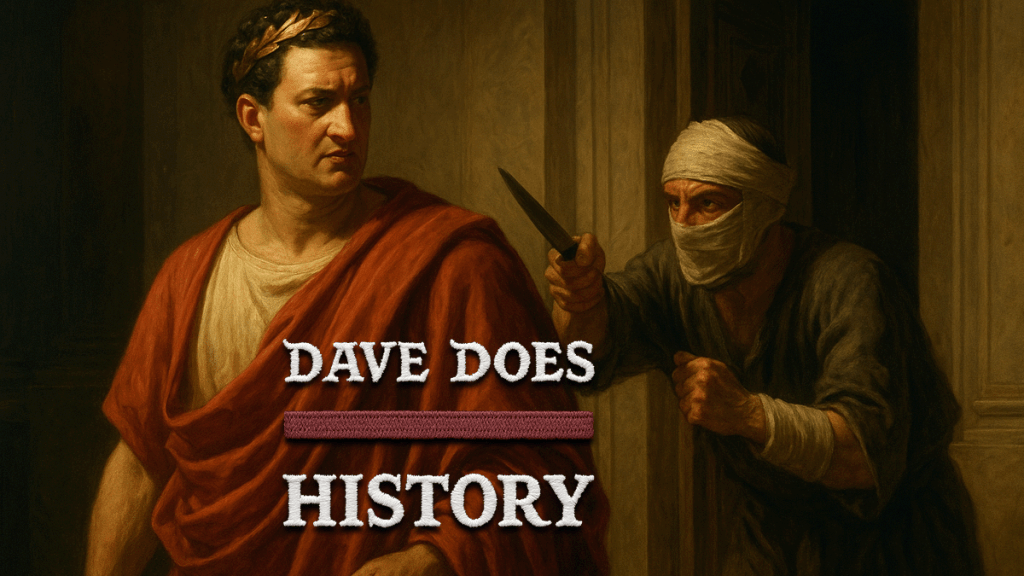
Stephanus wrapped his arm in bandages, feigning an injury. Inside the bandages he concealed a dagger. He carried with him a scroll as though it were a petition for the emperor’s attention. Domitian let him in. What the emperor did not know was that the sword he usually kept nearby had been sabotaged or removed. The doors had been locked to keep out any loyal guards. The stage was set.
As the emperor bent to read the petition, Stephanus struck. The first blow went low, into the groin, a vicious opening that stunned the emperor but did not kill him. Domitian grappled with his attacker, crying out for a blade. He fought with desperate strength, but the weapon at hand failed him. Others rushed in. Suetonius claims that seven wounds were dealt in total before the emperor collapsed. Cassius Dio adds that Stephanus himself was slain in the struggle after delivering his blow. What is certain is that Domitian, lord and god, ruler of the Roman world, died on the marble floor of his own palace chamber at the hands of men he thought beneath him.
Rome moved with ruthless speed. By evening of the same day, the Senate had declared Domitian dead and raised Nerva to the throne. Nerva was elderly, childless, and known for moderation. He had served as a lawyer and advisor to previous emperors, but never as a soldier. Whether he knew of the plot beforehand is one of history’s unanswered questions. Some say he was complicit, others that he merely took advantage of the vacuum. The Fasti does not tell us, only that his name was inscribed in the record as imperator that very day. The Senate rejoiced. Pliny would later gush that liberty had been restored. The statues of Domitian were toppled, his name was erased from inscriptions, his memory condemned in a practice called damnatio memoriae. Yet the people were indifferent. The army grumbled. Soldiers do not like emperors murdered in their beds, even when those emperors were cruel. The Praetorians would soon demand satisfaction.
In the following year, during a tense moment with the Guard, Nerva was forced to hand over the leading conspirators. Parthenius, the chamberlain, was executed. Petronius Secundus, the Praetorian prefect, was killed. Their fates show the lingering loyalty many soldiers had to Domitian, and the weakness of Nerva in controlling the army. That weakness would compel him to adopt a strong general as his heir, a man named Trajan, who would go on to lead Rome to its greatest territorial expanse. In this way, Domitian’s bloody end opened the door to one of Rome’s most celebrated reigns.
The question of Domitia Longina, Domitian’s wife, hangs in the air. Some ancient writers suggest she was part of the conspiracy, tired of her husband’s cruelty. Others paint her as a faithful widow who kept his memory alive long after his death. Inscriptions exist that seem to show her continued loyalty. As with so much about this palace intrigue, certainty eludes us. What is clear is that Domitian’s enemies had every reason to drag her name into the mud, while his supporters had reason to shield her reputation. The truth is lost between those poles.
So what are we left with? An emperor who ruled for fifteen years, who kept the frontiers secure, who built grand monuments, who saw himself as the restorer of Roman morals, and who ended up stabbed to death in his own chamber. An assassination carried out not by foreign enemies or rebellious generals, but by household staff and palace insiders. A dynasty cut off in a single stroke, and a new emperor proclaimed before the body was cold. If the story feels familiar, it should. Rome ate its own emperors with alarming frequency. But each death carried its own lessons.
For Domitian, the lesson is about fear. He ruled with it, relied on it, and ultimately was undone by it. His purges created enemies. His paranoia made his friends dangerous. His belief in fate, in omens and prophecies, left him vulnerable at the very moment he most needed clarity. A man who believed himself divine fell to a mortal dagger hidden in a bandage. A man who feared noon was struck before the hour passed. A man who proclaimed himself eternal was erased from stone by his own Senate. History remembers the irony because Romans loved to savor it.
Pliny and Suetonius and Tacitus gave us their verdicts, dripping with satisfaction. Dio gave us his nod from a later age. The stone at Ostia gave us the bare fact. For historians, the challenge is to strip away the venom and see the event for what it was: a coup born of desperation, carried out with cunning, and remembered with prejudice. Domitian may not have been the monster his enemies claimed, but he was feared enough to die like one.
On September 18, 96, the Flavian dynasty ended. The last son of Vespasian bled on the palace floor. Nerva’s reign began. The empire shifted course. The people moved on. The soldiers never forgave. The Senate wrote the story the way they wanted it read. And we, two thousand years later, are still sifting through the scraps, piecing together a death that was as much about politics as it was about steel. Rome, as always, buried the man and exalted the myth. The truth, somewhere between, lingers like the shadow of noon.
Cassius Dio. (1925). Roman history (E. Cary, Trans.; Vol. 8, Books 61–70). Harvard University Press. (Original work written ca. 200 CE).
Pliny the Younger. (1909). The panegyricus (B. Radice, Trans.). Loeb Classical Library. (Original work delivered 100 CE).
Suetonius. (1914). The lives of the Caesars: Domitian (J. C. Rolfe, Trans.). Harvard University Press. (Original work written ca. 110 CE).
Fasti Ostienses. (n.d.). Epigraphic calendar inscription recording Domitian’s death and Nerva’s accession. Corpus Inscriptionum Latinarum XIV, 4548.
Augoustakis, A. (2019). Undamning Domitian? Illinois Classical Studies, 44(2), 433–451. https://doi.org/10.5406/illclassstud.44.2.0433


 DAVE DOES HISTORY
Leave a comment